Let’s face it, there’s no market for what we write. And even if there were, we wouldn’t know how to reach that market. So, why do we write? We’re not writing for the public at large. No. Most of us are probably aware that we will spend more money buying our own products than we will ever make in sales. We’re not stupid. But we long to have our writing appreciated even if by some small subset of that public. But who are they? Or more likely who is he or she? Who is that illusive reader for whom we write?
But first, what is our inspiration? That is a muse I’m talking about? What is a muse? I went into that in an earlier post, but how does it motivate or inspire one to accomplish goals?
I remember a comment made by Bill Laimbeer – a rather obnoxious (dirty player) in the NBA who played center for the Detroit Pistons basketball team in years gone by. In an interview he said that before every game he picked out a woman sitting in the arena and played the game for her. I don’t think that’s as ridiculous as it may sound. Nor do I think that Laimbeer’s approach to motivating himself is an exception to human nature. Most of us are embarrassed to express what inspires us to do what we do; we may even be successful at hiding it from ourselves. But it’s there.
Consider the picture by Fantin-Latour of Richard Wagner doing his composing. The picture is titled ‘The Muse.’ It’s pretty amusing – right?
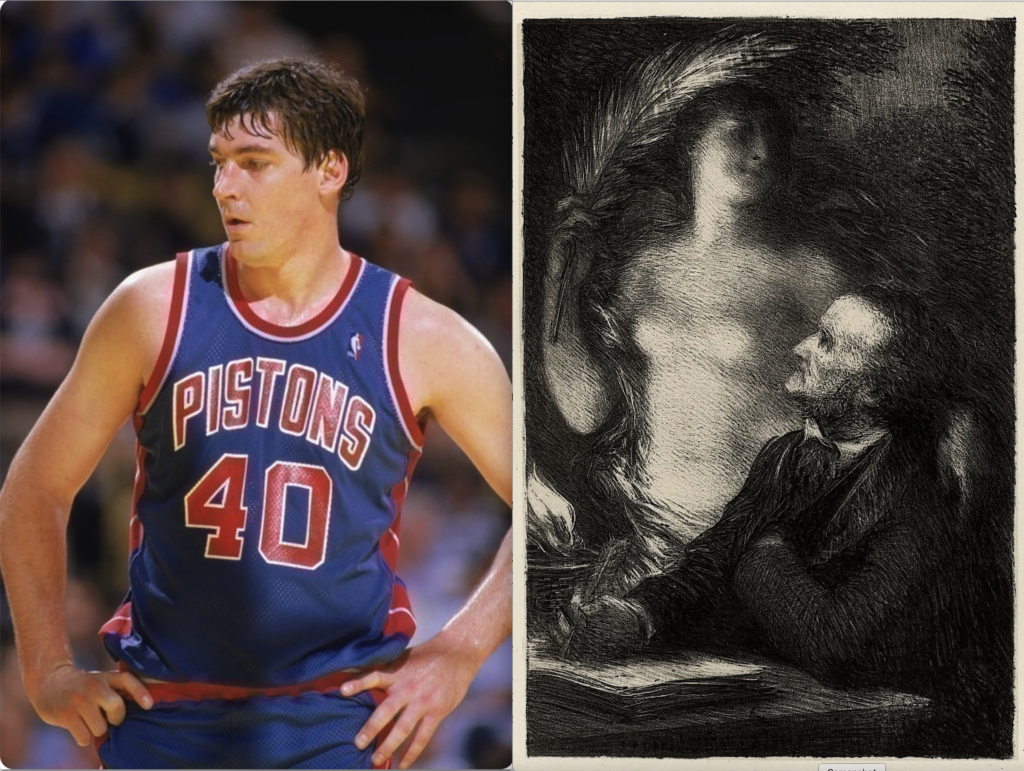
According to Wikipedia: “In ancient Greek religion and mythology, the Muses are the inspirational goddesses of literature, science, and the arts. They were considered the source of the knowledge embodied in the poetry, lyric songs, and myths that were related orally for centuries in ancient Greek culture.”
So instead of naively asking about the generality of markets and muses, let’s get on with it. Who is ‘your’ muse?
Some might wonder why my protagonists are women, why I like to draw women. I also like character-driven rather than plot-driven stories but that’s not why my heroes have always been women. ‘Really?’ you ask. Yeah, really.
But muses are just what nudges us out of writer’s block. Who is our ideal reader?
We obviously have to write what we know a little something about unless we are professionals who do the deep dive into knowing something about what a member of a larger market might care about. But we’re not professionals – at least not yet, although possibly in our dreams. So we write about what we care about. And our illusive reader must care about it too unless we are so persuasive that we can make him forsake his own goals for the duration of a read. I don’t think we’re there yet. I have plenty of data to convince me that I’m not there.
So we have narrowed our reading public down to the people who know little of what we pride ourselves in knowing, aspire to know more, and accept that we might contribute something worth knowing in that arena. What we are targeting is a mindset, not an image. The ideal reader is not pretty or handsome, strong or weak, like our muses. The ideal reader is just a mind that is interested in what we have to say about something he or she cares about. Those few who appreciated how Bill Laimbeer played the game of basketball were not among the pretty women from whom he selected his muse. Our reader is not Sophia Loren, President Obama, or Albert Einstein and he or she does not have a vote on what goes onto the New York Times best seller list. It’s a nebulous person whose mind just happens to work a little bit like ours.

Between our idealized muse who inspires us and our idealized reader who likes our turn of phrase, we strive in our mundane lives on lonely nights to reach immortality, if only in our dreams.
Leave a Reply