Why Relativity Looks Like Spacetime—and Why It Isn’t
Relativity is usually presented as a theory about spacetime: its structure, its curvature, and the transformations that relate one observer’s measurements to another’s. Yet all operational content of relativity including every clock reading, ruler length, synchronization procedure, and causal inference is mediated by electromagnetic exchange. What is actually observed is not spacetime itself, but the geometry of light-mediated transactions between relatively moving systems.
This distinction matters.
What follows is not a rejection of relativity’s predictions, nor a modification of its mathematics, but a reinterpretation of what those predictions describe. The claim is simple: relativistic effects arise from the geometry of interactions, not from intrinsic distortions of space and time.
1. What Is Observed
Every physical comparison between separated systems requires an exchange. In practice—and in principle—this exchange is electromagnetic. Whether one speaks of clocks, rulers, objects, or fields, all comparisons reduce to emission and absorption events connecting propagating energy.
Spacetime geometry, as we infer it, is therefore downstream of light transmission. It is not independently measured; it is reconstructed.
This raises an immediate question: are length contraction and time dilation properties of objects and clocks themselves, or are they properties of the communication geometry between relatively moving systems?
2. Transactions Are Two-Ended
A light signal is not a one-sided entity. It is defined only by its endpoints: an emission event and an absorption event. Energy and momentum conservation cannot be satisfied at emission alone, nor at absorption alone. They are satisfied across the transaction.
From this perspective, a “photon” is not an independently persisting object traveling through spacetime in isolation. It is a constraint-satisfying link between two material systems. Its energy, momentum, and phase are relational quantities, fixed jointly by both ends.
This immediately reframes Doppler shift. What changes is not the internal structure of some traveling object, but the parameterization of phase along a shared geometric structure defined by relative motion.
3. Aberration as the Primary Observable
Relativistic aberration—the change in observed direction of propagation due to relative motion — is an observable geometric effect. It requires no clocks, no synchronization conventions, and no spacetime ontology. It follows directly from finite propagation speed and relative motion between emitter and absorber.
Once aberration is acknowledged as fundamental, familiar relativistic effects follow naturally:
- Apparent contraction arises from tilted interaction geometry.
- Apparent time dilation arises from extended path length in the transverse direction.
- Simultaneity becomes frame-dependent because transactions, not events, define comparison.
None of this requires spacetime itself to “do” anything.
4. Helical Transaction Geometry
When transverse propagation and aberration are combined, the geometric structure of a light-mediated transaction is naturally helical. The helix is not a path traced by a particle in space, but a geometric encoding of phase advance along a direction of relative motion.
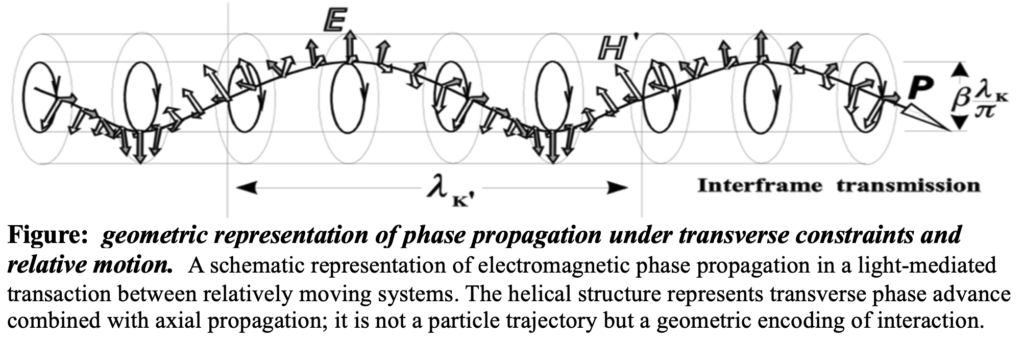
The radius of this structure is not intrinsic to the photon. It depends on the relative motion of emitter and absorber and on the conditions under which phase coherence is maintained.
Wavelength and frequency, in this view, are not intrinsic properties carried through space. They are relational parameters describing how phase accumulates along the transaction path.
5. Why Relativity Works So Well
Lorentz transformations work because they correctly encode the constraints imposed by light-mediated exchanges. They succeed because they preserve the structure of transactions, not because they describe an independently existing spacetime substance.
The mistake is not the mathematics. The misunderstanding is reifying the scaffolding.
Spacetime geometry is inferred from light transactions. It is the map, not the territory.
6. Gravity (Deferred, but Not Ignored)
In a gravitational field, the geometry of light-mediated transactions is continuously deformed. This deformation is conventionally attributed to spacetime curvature. From a transactional perspective, it is more naturally understood as a modification of interaction geometry imposed by surrounding energy distributions.
Near compact masses, transverse structure can dominate axial propagation, ultimately preventing the completion of emission–absorption transactions beyond the photon sphere of black holes.
The impact of gravity on transaction geometry deserves separate treatment and is not pursued here.
7. What This Reframes—and What It Does Not
This perspective does not deny:
- Relativistic time dilation
- Length contraction
- Doppler shift
- The empirical success of special or general relativity
It removes these effects from spacetime itself as a dynamical entity with physical agency.
Relativity describes constraints on interactions, not distortions of existential objects.
8. Closing Thought
If light is the primary mediator of all measurement, then the geometry we attribute to spacetime may be nothing more—and nothing less—than the geometry of light’s transactions between relatively moving systems.
Spacetime, in that case, is not disclaimed. It is just a derivative concept.
Leave a Reply