It’s an intriguing question, but like so many such questions, we’re not quite sure what an answer should even look like — or sound like.
Carlo Rovelli began his excellent book, ‘The Order of Time’ this way:
“I stop and do nothing. Nothing happens. I am thinking about nothing. I listen to the passing of time.“
That is poetic, but not scientific.
One cannot hear time or see it, so one might as well not listen or watch for it. When one is “doing nothing” and “nothing is happening” is an indication that time is not involved at all. But “thinking”? That is a physical process; it’s not nothing. Synapses are firing. How energetically are they firing? That’s the question.
Great minds have told us that time passes differently for each of us depending on our dynamical or gravitational situations. In the extreme we have the time traveller paradox. Two observers move away from each other at a speed that is not inconsiderable with respect to the speed each attributes to light. They somehow, at some point, reverse this situation and approach each other at the same speed. As they pass each would supposedly realize that the other has aged many years more than he has.
Is that because of their relative velocity or is it the acceleration and deceleration up to that velocity? That is the question. If they synchronize their accelerations over the short intervals required, will their relative velocity over the much more extended interval age them differently? Really? Do you actually think so or is that just what you were told? Doesn’t symmetry resolve the paradox?
Something of which we are fairly certain is the uncertainty principle where:

So if the time increment of some repeating process is reduced to a very small value of which we are certain as a unit of time, then the uncertainty of the amount of energy expended during that interval must increase accordingly. They have an inverse relationship. They are connected at the hip.
The energy embodied in a photon is:
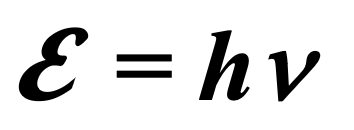
So the repeated period of that radiation is:
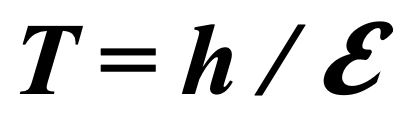
There’s no velocity there – not even c.
The Maxwell-Boltzmann distribution is not about velocities; it’s about energy — embodied this time as temperature. Chemical reactions rates increase with temperature which, in turn, is proportional to the energy of the molecules involved. So the ‘half-life’, if you will, of reactions is inversely proportional to energy as expressed by the Arrhenius equation. Thermonuclear reactions also occur at a rate dependent on the energy transition, and thus the half life — the ticks of their clocks, if you will, exhibit the same relationship to energy.
I think the question should be, ‘What Is Time Dilation?’ We’ll address that.
Leave a Reply