Suppose one could filter out the radial Doppler components responsible for the line broadening of radiation from a thermal source. What would be left would be the effect of transverse Doppler. It would be asymmetric – which makes the filtering possible by filtering out symmetric effects of radial Doppler. So… is anything left? Now consider secondary sources in the intermediate media also having thermal velocities and the associated Doppler effects. At each scattering secondary radiation would be distributed to produce line broadening, but with most of it symmetric because of first order radial velocities, but with an asymmetric component. Each iteration of forward scattering produces the same effect, but over many iterations the radial Doppler effects of equally red and blue shifting would filter out by cancelation down to the fourth order or less in velocity. I think. That’s what I see anyway, but ChatGPT insists there’s a root of n on the variance of repeated distribution sampling. I get it, but I don’t think it’s a stopper. I’m thinking about it in words and pictures for starters.
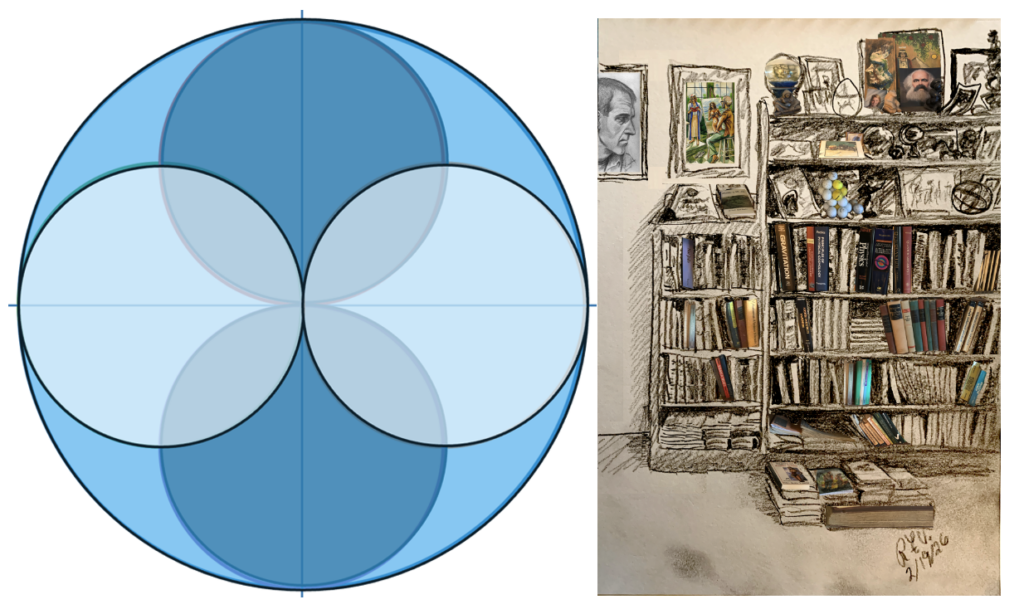
I am no kind of expert on language with my background as a monoglot engineer. But I have my own take on language nonetheless – particularly with regard to expressing ideas on what might be considered ‘technical’ areas of expertise. I defer to Sir Roger Penrose with regard to how one should read technical papers – I also understand concepts in terms like, “this is behind that, which is…” And like him, I skip the equations unless I really give a damn. So if you want my attention, you better explain your equations. If you convince me, then I will wade in, but very slowly. Richard Feynman had a way with words and opened avenues that would have been closed for most of humanity. ChatGPT isn’t there yet.
I am convinced that there is no language without which certain thoughts cannot be thought. The Turing machine I see as the ultimate proof of that. Eloquence is something else.
One time, a long time ago, I was sitting in an advanced Quantum Mechanics class at USC (yeah, they don’t just play football) with my wife right beside me. No, she is not a physicist and was only sitting with me in the back of the auditorium as a comfortable place to sit while she waited for the class to end so she could drive me back to my place of employment down Rodeo Road over to the other side of Los Angeles. As I watched the professor at the board with interest, I heard her laughing beside me. She had paused her novel reading and was watching the professor. I asked, “What’s so funny?” She responded in whispers, “Didn’t you hear what he said?” I was sure I had, but without having been amused in the slightest. She clarified what had seemed so hilarious to her: “He said, ‘Are-de-are equals rho-de-rho.” The way she swiveled and bounced as she reiterated the sounds did make the inane statement seem quite humorous. You can translate mathematical language into Greek or English, but you do need to know some of the vocabulary for it to make any sense.
I use American English – not because it’s better, but because I’m American. I applaud German for having three readily available words for knowledge which makes distinctions worth making but I get by. I think. I guess the Eskimos have many words for snow.
Leave a Reply