There are people who like to explain to other people how things work and there are people who like to invalidate other people’s explanations of how things work. In scientific parlance these two types of people are called theoreticians and experimentalists. In physics these two categories are sometimes referred to as ‘thinkers’ and ‘plumbers.’ And yes, it is theoreticians who speak that way. There is a third category; they are called ‘crank’ scientists. This is as one might speak of an architect, a builder, and … a ‘handyman,’ with implied respect descending in that order. In the religious orders, priests are the theoreticians, but there aren’t any ‘plumbers’ to experimentally validate their miraculous explanations. There are ‘protest-ants,’ of course, and evangelicals – the handymen.
But we’re talking science here, and the discoverer of the atom, Ernest Rutherford is reported to have stated, “Compared to physics, all the other sciences are just stamp collecting.” Whether apocryphal or not, his intent is clear: Other scientific endeavors involve the study of hierarchies of collections of atoms, each of whose behavior is subject to the laws of physics. And, yes, I do share this condescending perspective of a physicist.
I am what is called a logical positivist. I believe (or at least accept) that if one cannot detect it with one or more of our five senses, then it doesn’t exist. That doesn’t mean there can be no ‘love’ or ‘kindnesses’ or ‘particle collisions,’ for example, because they are not ‘things.’ They are nouns without associated objects; they are relationships that ‘happen,’ that may ‘occur.’ If you were to tell me, for example, that ‘God is love,’ I could appreciate your association of nouns. But don’t put a beard on him, for Christ’s sake! And don’t expect me to believe that you will meet him in ‘heaven’ one fine day unless you can demonstrate the existence of the objects represented by the nouns in that sentence.
Back to theoreticians in physics: The logic they employ is ‘inference’ which refers to a process of drawing a conclusion (at first only an educated guess) based on available data, observations, or evidence. It’s a reasoning process where you use what you know to make a conjecture about nature or to establish a new theory that will then be called a ‘law of nature,’ not because nature will be required to follow it, but because nature is observed to actually behave that way. For example, neutrons, which are subatomic particles, are inferred to ‘decay’ into protons and electrons – also subatomic particles. Which is all fine but for one fact: the sum of the energy and momentum of the resulting particles don’t equal the amount associated with the original particle. So the existence of a third particle (the neutrino) resulting from the decay was conjectured. But it has implied properties that make it very illusive. It can pass through fifty miles of lead before interacting with other particles. So… does it exist or not? Can it be observed rather than inferred as a loophole to satisfy conservation laws? That’s pushing the limits for a logical positivist.
My issue with neutrinos goes back to their supposed origin in neutron decay. Neutrons have no electric charge and are therefore undetectable other than by detecting protons and electrons that otherwise originate out of nowhere as a single event. The existence and dynamics of the electron and proton are all that can be observed. The existence of the neutron cannot be observed directly but its existence is not refuted because the emergence and dynamics of a proton and electron have necessarily to satisfy the conservation of energy and momentum, i.e., no real thing can come from nothing. So it has been my take that the neutron is the instantaneous collision of two neutral contons (opposite quark structure of a proton):
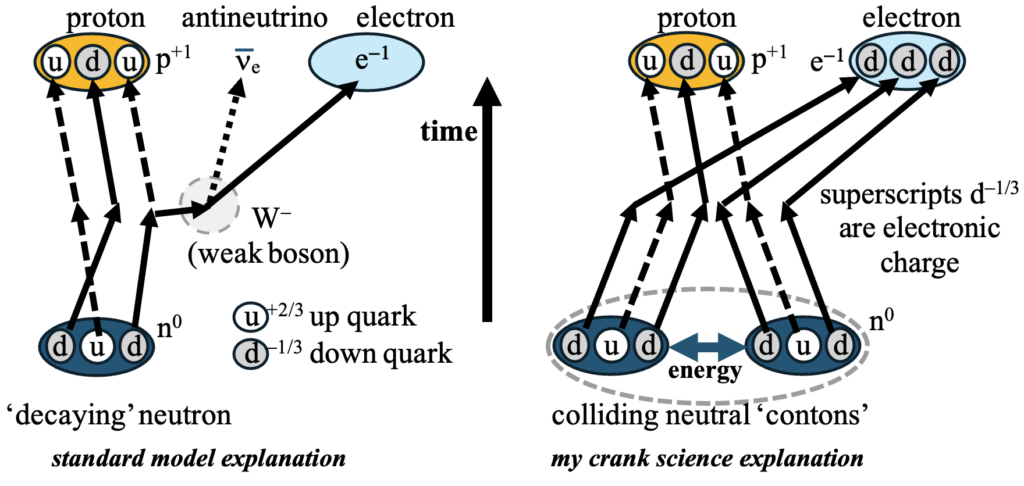
My approach does not require the creation of the neutrino and the weak boson, nor does it require the transmutation of a down quark into an up quark. The three-down-quark electron raises some eyebrows for various reasons, but masses, charges, and spin of all these particles are consistent with what has been observed. I like my solution.
In contrast with the inferences used by theoreticians, plumbers use the implications of a theory to search for logical consequences derived from the theoretical propositions; they search for experiments, not to confirm, but to refute statements that follow necessarily from the theory.
So how does one test for the existence of a neutrino? The short answer is, ‘you don’t.’ But if you insist and come up with a situation where if a chlorine atom is hit by a neutrino it turns into an argon atom, have at it. By eliminating all other causes of the reaction in which a positron (a positively charged electron which will then be annihilated by a regular old electrons to generate a high energy photon) pops out of a Chlorine atom, sure. Unbelievably elaborate detectors, buried far underground and/or underwater, are reported to have accomplished this feat. In 1967 a large tank of cleaning fluid was set up deep underground in an old gold mine in South Dakota where no (more usual) interactions could occur. If a neutrino were to strike a chlorine atom in the fluid, it would convert it into a detectable radioactive argon atom. That experiment was reported to have detected one such event every few days. These ‘observed’ neutrinos were attributed to the weak interactions taking place in the sun.
In fact, on this day (December 3, 2025) I saw the attached photo and explanation posted on the internet.
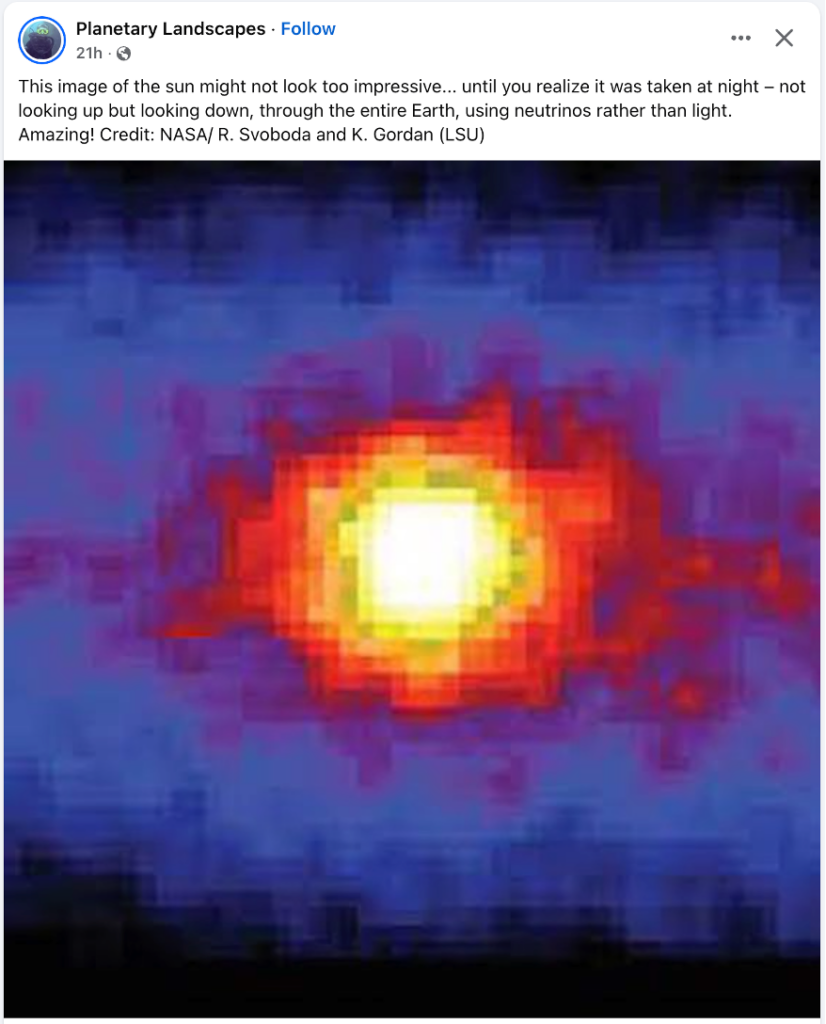
There is so much false information posted on the internet anymore (and this looks a little hoky) that I don’t know whether to believe it as fact. I tend not to. Which brings us to the crank scientists, to which disorganized group I am a proud member. I should be embarrassed to admit that, but I’m not. Even the best scientists are crank scientists with regard to everyone else’s theories. They realize that the job of plumbers is not to attempt to prove a theory correct, but to attempt to prove that it is false. And they don’t trust the plumbers. They think that their having failed to refute a theory might only be because they were looking at it from the wrong angle. Continued dedicated attempts at refutation are the closest one will ever get to confirmation.
So, I’m skeptical of claims to observe the sun through the center of the earth using neutrinos. But if that is an actual observation, and I think it probably is, I’ll have to re-think my solution.
Leave a Reply