The essence of the speed of light being the same for every observer is that the separation of the source of radiation and the observer at the time light is emitted determines when the light will be observed. Earlier it was believed that its universal speed was relative to where the light was observed. That is the significant difference that relativity makes to forward scattering of radiation in a plasma medium.
This difference plays out differently for free scattering of individual interactions between a source and secondary scatterer and for coordinated interactions of forward scattering. In the former the scattered secondary radiation will be red or blue shifted depending on the relative velocity of the secondary source. In forward scattering a filtering process involving coincident response all but excludes blue shifts. Figure 1 illustrates how that difference plays out in the two cases.
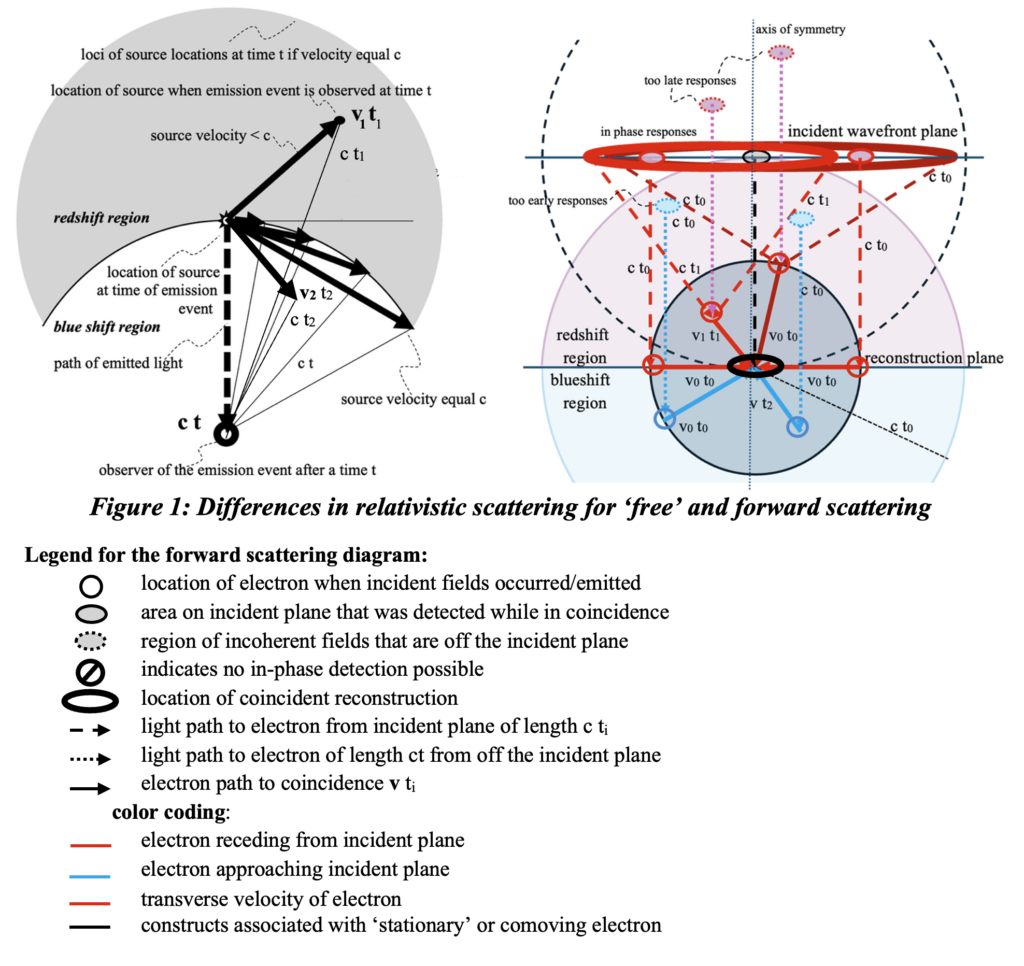
Forward scattering of light from a distant source involves incident plane wavefronts in Huygens-like procession with a phased array of electromagnetic fields. They act as simultaneous surfaces of ‘primary’ emission events to which secondary scattering electrons react differently depending on their velocities relative to the surface. In this way continuing wave planes are reconstructed.
Coincidences of the interactions with on-going wavefronts involves the displacement of the areas on incident wavefronts (in-phase wave forms) that impact the ongoing wave. The universality of the speed of light relative to the observer (detecting electrons in this case) has the effect of converging electromagnetic field responses from a broad swath of areas on an incident wavefront in reconstructing an ongoing wavefront. This was shown in the right panel of the diagram above. In that diagram, notice the following observations:
- Only fields from the incident plane will add coherently – i.e., the area from which the fields derive must be within a quarter of the wavelength of the incident radiation of the plane.
- Only electron velocities that are parallel to the incident plane (or stationary) will detect coherent fields at right angles to the plane. All other reinforcing fields will derive from rings at acute angles to the incident wavefront plane.
- The fields on the incident wavefront occur simultaneously in the ‘stationary or comoving frame so an observer (electron) moving away from the incident plane will, at coincidence, detect fields from a ring surrounding the point of closest approach to the plane.
- All the area from which fields are detected from the incident plane will be replicated by the symmetry of rotation about the axis of symmetry.
- Resonant responses of the coincident electrons will add vectorially to produce a net forward advancing wave; its frequency will have decreased by some minute amount in the process because of exclusion of blue shifted responses..
The amount of change per extinction interval and ultimately per unit of distance must now be assessed. And the extent to which this effect differs from, in spite of similarity to, the traditional impact of wave property modifications due to the index of refraction of the medium.
Leave a Reply