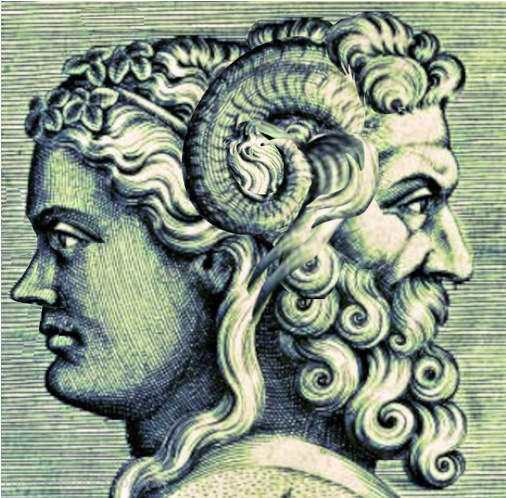
A friend indicated that he and his wife had conceived of their new relationship as the two faces of Janus. It brought several things to mind: First was that Janus was the Roman god of beginnings, gates, transitions, time, duality, doorways, passages, frames, and endings. He was conceived as having brought man from an earlier savage state into civility. In images he is depicted with two faces, one looking back into the past and the other forward into the future. Sometimes one face is male, the other female, the yin and yang of January, complementary but opposing forces that create the balance and harmony of the universe.
Those were some thoughts that came to mind as that friend read to us about his experiences related to his marriage as the Roman god. But my mind went on to how thoughts of Janus had impacted my own writings. For one thing, the image of Janus appears on the cover of one of my novels titled, ‘Irreversible Processes,’ which describes the scientific collaboration of an older man and younger woman in the discovery of the origin of entropy – time’s arrow.
As has been my usual, that novel was coupled with a non-fiction scientific volume, pretentiously entitled, ‘The Nature, Origin, and Profound Implications of Irreversibility (The driving force behind the second law of thermodynamics).’ In the preface of all my scientific books I thank my wife and children for tolerating my absence from normal household responsibilities while I am concentrating on the subject matter of the text. In one volume I called them ‘magnificently tolerant,’ to which my pretend collaborator had a chuckle.
However, in the preface to the entropy volume, I outdid myself by stating:
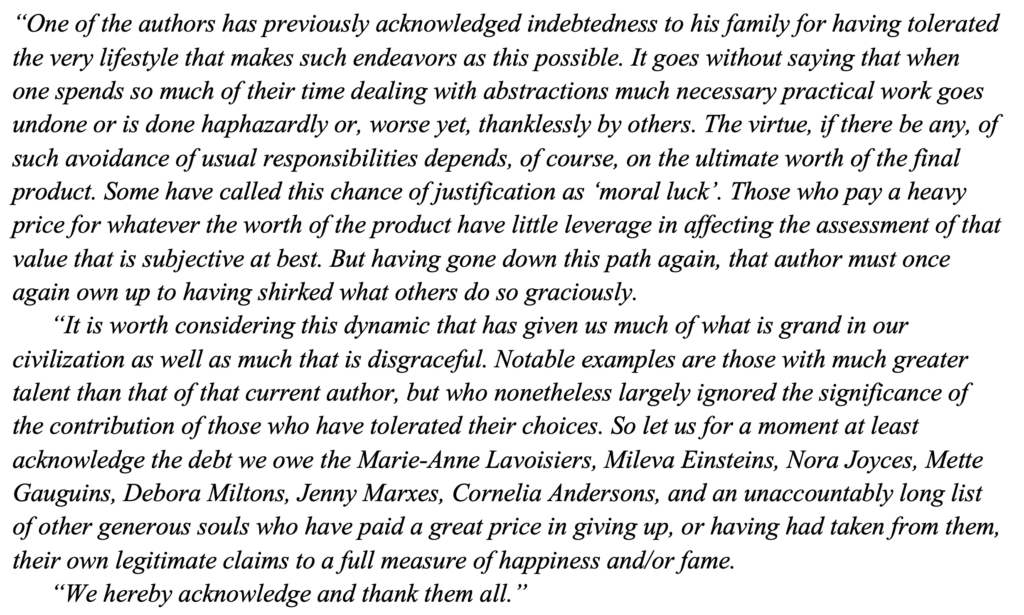
What I did not appreciate initially is that Janus is not merely a symbol of balance, but also of asymmetry. One face looks forward with agency, anticipation, and authorship – the other looks backward, burdened by memories, consequences, and cost. The two faces share a single head, but they do not share equal power.
That imbalance led my thoughts, inevitably, to cases where the moral accounting becomes more troubling still — where the debt is not merely tolerated but willfully extracted, and where the person who pays it is not sheltered by anonymity, but stands naked, their contribution diminished by proximity to a greater name.
Camille Claudel is perhaps the most painful example. A sculptor of undeniable originality, she worked alongside — and under — Auguste Rodin. Her technical brilliance was real, her influence on his work substantial, and yet history has treated her as a mere footnote to his genius rather than as an artist in her own right. When her career faltered, the moral luck reversed itself. Rodin’s success did not redeem her sacrifice; instead, it totally eclipsed her contribution. The cost she paid — professionally, emotionally, and ultimately psychologically — was not transformed into justification, but into erasure.
Frida Kahlo presents a different, though no less asymmetric, case. Her relationship with Diego Rivera was marked by admiration, dependence, rivalry, betrayal, and genuine artistic exchange. Rivera encouraged her yet also absorbed oxygen from every room he entered. Kahlo’s suffering — physical and emotional — became material, sometimes for her art, sometimes for his legend. Only later did history turn the Janus face and allow her work to stand independently, although it is still too often framed through the prism of her pain rather than her creativity.
What unites these cases with the earlier acknowledgments is not villainy so much as structure. The moral imbalance does not require malice to operate. It arises whenever recognition flows preferentially in one direction, and when the justification of cost is deferred to outcomes that history may or may not grant.
In that sense, moral luck is not merely personal; it is systemic. It governs who is remembered as a creator and who is remembered, if at all, as an enabler, a muse, a distraction, or an unfortunate casualty of the proximity to genius.
Janus, after all, does not promise fairness. He promises passage. And passage, whether through doorways of time, science, or art, often leaves one face illuminated and the other in shadow.
If there is any modest corrective action available to those who benefit from having passed through gates of success, it lies in refusing to let the backward-looking face disappear entirely — in acknowledging, by naming the debts, even when doing so is uncomfortable, incomplete, and long overdue.
Leave a Reply