Let’s face it, it wasn’t measured independently here and on Andromeda or in any other distant galaxy. And its value varies widely even here on earth, depending on whether it is transmitted through air at sea level, water, heavy glass, or calcite for example. Its universality is restricted by stating that we mean only when transmitted through a vacuum. But how do we know that?
It gets back to Maxwell’s equations from whose wave equation we can derive the theoretical value of the speed of his electromagnetic waves as:
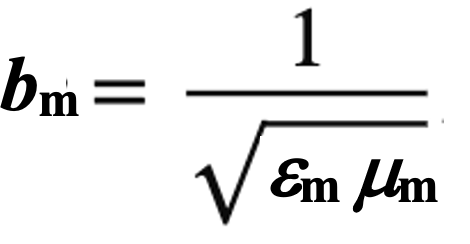
The subscript m indicates the medium through which light passes. When there is no medium, i.e. the light passes through a vacuum, the subscript m = 0 and |bm| = c. Here em is the permittivity of the medium the light is propagating through, and mum is the permeability of that medium. The former is related to the electric field with the latter related to the magnetic field characteristics in that medium. If the index of refraction of the medium is nm, then:
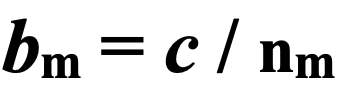
This results in a speed in vacuum for which nm = 1 of approximately c = 2.998 x 1010 cm/sec. Agreement of this value with the measured speed of light, is what ultimately lead to concluding that light is in fact a propagating electromagnetic wave.
Okay, you knew all that. But… what is the significance of the caveat ‘in a vacuum’ that makes a vacuum the ultimate limit of the approximations? Is it a caveat like ‘but your mileage may vary’ as when you buy a new car, or the caveat ‘as the crow flies’ when you want to know the distance to some address? It’s the latter since when forward scattered through a medium, the resonating electrons produce a secondary electromagnetic wave of the same frequency that is out of phase relative to the incident wave. It ultimately replaces the incident wave in a medium. The single-scattered secondary wave zigs and zags its way through the medium following ‘roads’ through electron structures of the medium rather than avoiding them ‘as the crow flies’. A birefringent crystalline structure provides multiple paths through the medium.
It is assumed that between scatterers light is passing through a vacuum even in the medium. So, this universality through a vacuum is meant to apply even within material media if we choose to investigate microscopic interactions. But what if… the medium was expanding rapidly… or were so hot that the electrons had velocities appreciable with respect to c? Then relativistic analyses would apply even though individual light paths are being treated as though through a vacuum. So, by recognition of this issue, the real restriction of the caveat is not ‘in a vacuum’, but ‘for direct transactions between a source and receiver in the same frame of reference’.
Leave a Reply