We’ve been down some roads and up some creeks I guess you have to say. And still, somehow, it’s been worth it. You begin with a universe of only 3 x 10⁻¹⁰ ergs per cubic centimeter that is indefatigably bifurcated into plus and minus portions. That could have been hell at 1013 K, but it isn’t now. It has ended up being a kaleidoscope of galaxies and stars to say nothing of emerald planets and purple and orange people. That isn’t nothing. Some ups and downs have looked catastrophic maybe and they are. Still…
So you set boundary conditions on this thing you call a universe including proudly the rejection of singularities and then you set Poisson’s differential equation loose in this space to ferret out fundamental charge/mass distributions that act for all the world like quirky indivisible particles, and you claim them as quarks. Are they? Who knows? Perhaps like ‘Finnegans Wake’, no one knows. The word itself is a portmanteau, the juxtaposition of quasi and snark, the perilous act performed first by Lewis Carroll while he was hunting for the real snarks. There aren’t any, of course. But Murray Gell-Mann apparently had the audacity to play hi-diddle-diddle on his little fiddle that came out sounding like a good surname for his invisible friends, Up and Down and the rest of the family.
I’ve put a lot of emphasis on my version of these critters on my blog, but they’re not mine. They are solutions to equations that could have been formulated by anyone. I refer to them fondly as ‘mine’, not because they are, but to distinguish them from Gell-Mann’s universally accepted quarks that I find to be a severely handicapped version that require gluons to do what a healthy quark can do for itself. The thing about ‘my’ quarks is that while acknowledging a primordial duality, they also demonstrate the homophobic propensity of locking hands so tightly that their subsequent separation is virtually impossible, namely as the electron. This feature stems from the obvious fact that any particle worth the word has mass as well as charge. We’ve found that negative electric charges have negative gravitational charge, but not to worry, complex algebra straightens it out such that negative mass is as gravitationally attractive as positive mass. But they’re both exclusive; they reject ‘the other’ which only has consequences in composite structures, where in addition to a similar quark with sufficient impetus being sucked into a immutable union, unlike quarks are forcibly precluded from losing their selfness in such a union.
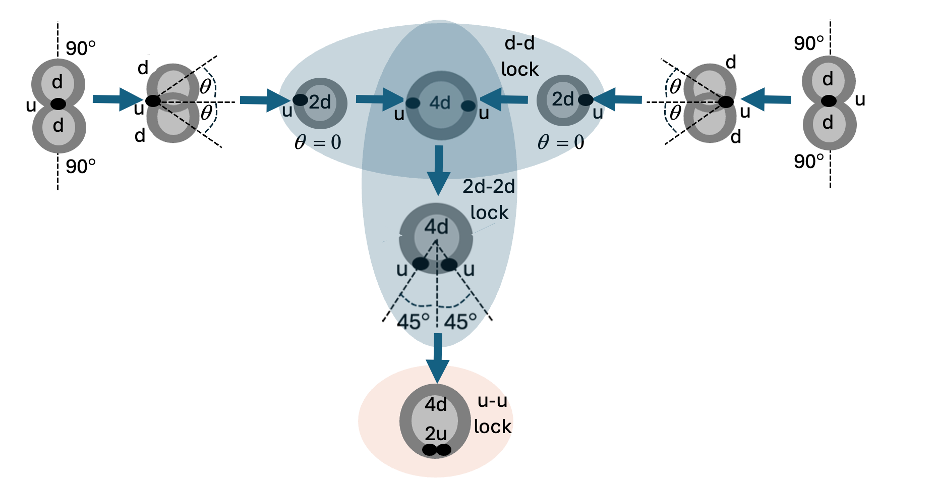
These building blocks of the baryonic universe demonstrate an ability to construct the subatomic structures by processes like those shown in the figure above which, despite a recreative aspect should not suggest an anthropomorphic similarity. The opposite charge of the up and down quarks had attracted them to form the d-u and then a d-u-d neutral structure I’ve referred to as a dud. These experience a slight but increasing attractive force when their linear alignments are cross rotated with respect to each other. The linear relationship of the three quarks in these structures begins to bend forward to shield the greater up charges of the up quarks from each other as they get closer together. Ultimately the two downs are bent so far forward that their separation becomes less that the cross over separation where their gravitational attraction exceeds their electrostatic repulsion. At this separation they ineluctably plunge into a new particle identity as a 2ds by whatever name. Machinations take place in this narrowing region between 4 x 10-13 cm and 4 x 10-14 cm that need more consideration. These transition separations are shown in the chart below.
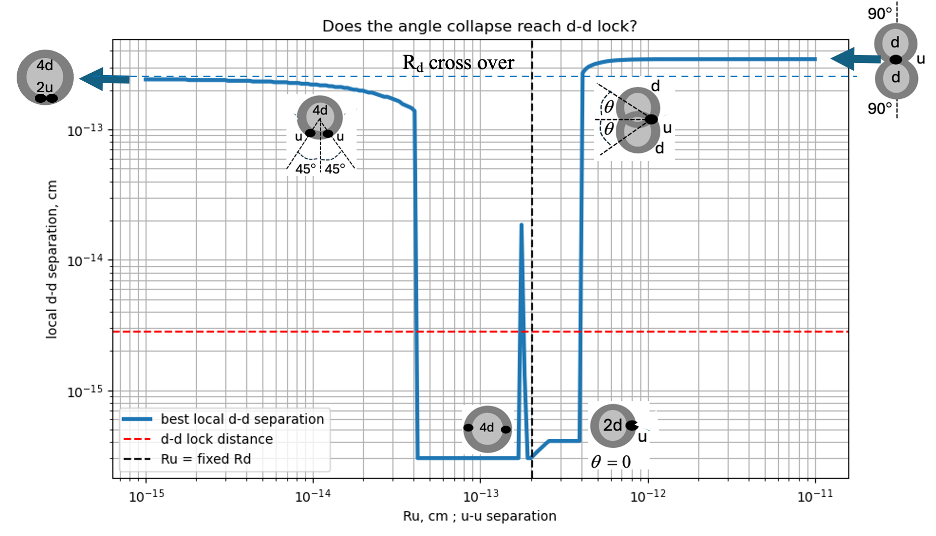
The result is not clean. We don’t see a proton emerge from this interaction. There are many variables and constraint conditions whose effects need to be explored. I hope some of you in China and Singapore who seem to have followed these discussions will work on this and figure it out. They aren’t my quarks. They’re ours!
You’ll need to start with the basics. Number one is that the universe is in a stationary state with no deus ex machina explanations allowed. No God blowing it up like a baloon, stopping now and then to take a breath. No. The universe today exhibits a baryonic mass/energy of about 3 x 10⁻¹⁰ and an additional radiation (CMB) energy of 4 x 10-13 ergs per cubic centimeters and plus and minus electrostatic charge densities of 2 x 10-17 statcoulombs per cubic centimeter. Currently the total energy is invested almost exclusively in hydrogenous plasma gas, i.e., protons and electrons in equal numbers, varying slightly only because of the little bits of Helium material mixed in. So primarily spherical regions of about one meter radius contain one proton and an electron. The boundaries of such a regions are essentially an infinity away relative to sizes of constructs within the sphere that has a zero force boundary with other spheres. So we solve the Poisson solutions as we’ve discussed before for such a region, including a constraint that potential at the origin of the solutions is zero. Voila! We get our now-familiar distributions. But there are constants to be filled in; I more or less forced them before based on presumed similarity to Gell Mann’s quarks, but you can do better than that now after all the gyrations we’ve been through. Here’s what we know:
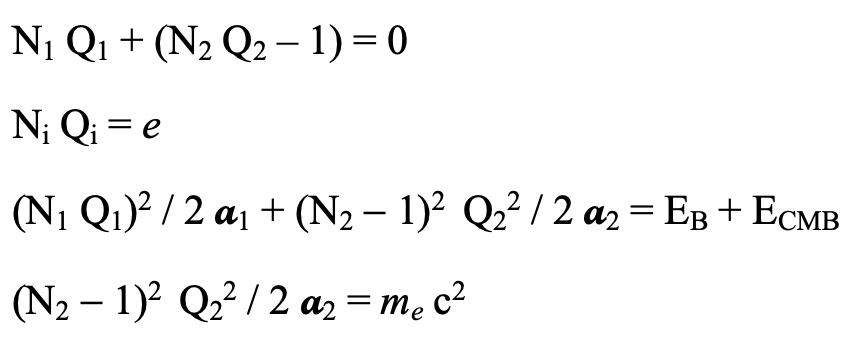
This is where you have options. Are the up quarks in the proton locked or not. Are the Qs parental or fragments locked together. This affects the protons in particular.
Go for it my friends on the other side of the earth. This is your homework assignment with Nobel prizes for the right answer. 🙂
Leave a Reply