In our previous post we cited the yin and yang aspects of physics. Any observable phenomenon involves a duality of underlying tendencies. We cited electrostatic and gravitational effects as ‘completing’ each other by ‘locking in’ a natural propensity of Poisson distributions to fragment and disperse, while ‘locking out’ a counter tendency of disparate distributions to annihilate from adherence. Both electrostatic and gravitational effects exhibit positive and negative realizations with attractive and repulsive behavior, although less recognized for gravitational behavior. But it doesn’t stop there.
The Poisson solutions pertain to fields, not ‘particles’ per se. In classical physics an appreciable charge or mass has been assumed to be an ensemble of indivisible particles, each contributing to a ‘field’ that produces the associated effect. Faraday perceived that the distribution of the effect is in essence the source itself since there is no other way to determine that to which the effect is to be attributed. The effect of the particle is what ‘exists’ of the ‘particle’; we can determine no more than that. An experimentally measured ‘force’ is a detected motive response of what we consider to be one ‘particle’ due to the ‘effect’ of the other. The combination of the two aspects of being is all that can be observed. These two aspects are the potential field of one ‘particle’ or an ensemble of particles and the material density of the other that is affected by the field. Even a single indivisible distribution exhibits these two aspects, with intrinsic energy that entails ‘self-energy’ corresponding to its rest mass.
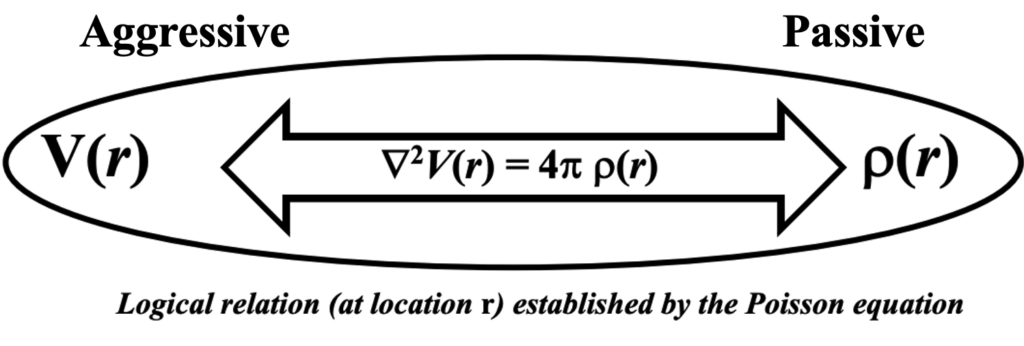
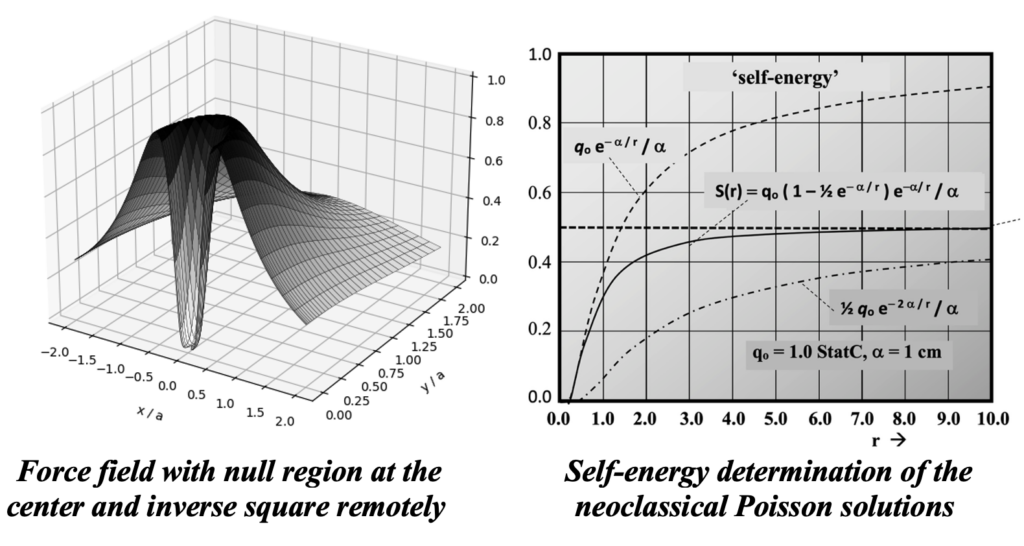
In envisioning the ‘force’ between two electric charges F = q1q2 / r2, the two charges do not have the same role. One produces the force field, ‘field strength’ q1/ r2, that affects the charge q2 of the other. Of course the force that q1 exerts on q2 is the same as the force that q2 exerts on q1. In every case it is the force field of one and the charge of the other and not the’ effect’ of potential fields on each other – they have different but symmetric roles. As such, the total force field at every position in space affects the total charge density at that same location – there is no action at a distance. The collective force of bringing the entire amount of charge one infinitesimal unit at a time into the particular Poisson distribution has an associated energy which is its self-energy.
This inextricable connection between potential and charge is what a Poisson boundary value problem describes.
The Poisson boundary value problem has been independently employed to describe gravity and electrostatics as totally separate phenomena in classical physics. The solution applicable to all space for each produced singularities at the origin. That boundary (and it is a boundary) was not specified in either classical approach; but even when that boundary condition is specified as in the neoclassical approach there is still, though its more subtle, a problem at the origin that only combining the mass and electric charge solutions can resolve. Before addressing (and solving) that problem, we will elaborate the separate solutions in this post.
The solution to a Poisson differential equation, applicable to both mass and charge, describes the mathematical relationship between the electrostatic or gravitational potential and the associated charge density (whether electric charge or gravitational mass) as shown above, where the ‘del’ symbol is the gradient (derivative, d/dr, or slope) of the variable as a function of distance from the origin as indicated by the radial distance, r.
Alternative solutions result from different boundary condition specification. A classical solution results from failing to place a boundary condition at the origin. We say ‘failing’ because denying values of r less than zero defines a boundary, which without specified boundary conditions, will not have the unique solution guaranteed when all boundary conditions have been specified. The neoclassical solution results when the non-singularity condition has been specified for the origin. These are the alternative solution expressions:
In envisioning the ‘force’ between two electric charges F = q1q2 / r2, the two charges do not have the same role. One produces the force field, ‘field strength’ q1/ r2, that affects the charge q2 of the other. Of course the force that q1 exerts on q2 is the same as the force that q2 exerts on q1. In every case it is the force field of one and the charge of the other and not the’ effect’ of potential fields on each other – they have different but symmetric roles. As such, the total force field at every position in space affects the total charge density at that same location – there is no action at a distance. The collective force of bringing the entire amount of charge one infinitesimal unit at a time into the particular Poisson distribution has an associated energy which is its self-energy.
This inextricable connection between potential and charge is what a Poisson boundary value problem describes.
The Poisson boundary value problem has been independently employed to describe gravity and electrostatics as totally separate phenomena in classical physics. The solution applicable to all space for each produced singularities at the origin. That boundary (and it is a boundary) was not specified in either classical approach; but even when that boundary condition is specified as in the neoclassical approach there is still, though its more subtle, a problem at the origin that only combining the mass and electric charge solutions can resolve. Before addressing (and solving) that problem, we will elaborate the separate solutions in this post.
The solution to a Poisson differential equation, applicable to both mass and charge, describes the mathematical relationship between the electrostatic or gravitational potential and the associated charge density (whether electric charge or gravitational mass) as shown above, where the ‘del’ symbol is the gradient (derivative, d/dr, or slope) of the variable as a function of distance from the origin as indicated by the radial distance, r.

These might seem functionally very different but in fact they are extremely similar as shown in the figure below. The ostensible difference is whether there is a singularity at the origin or not.
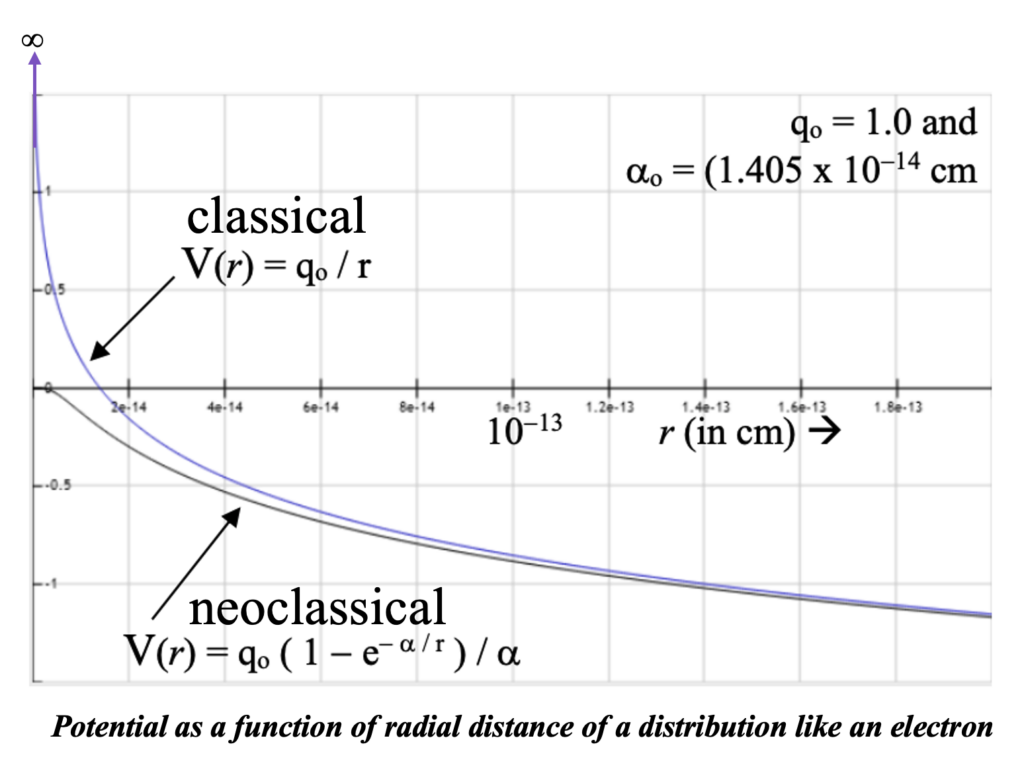
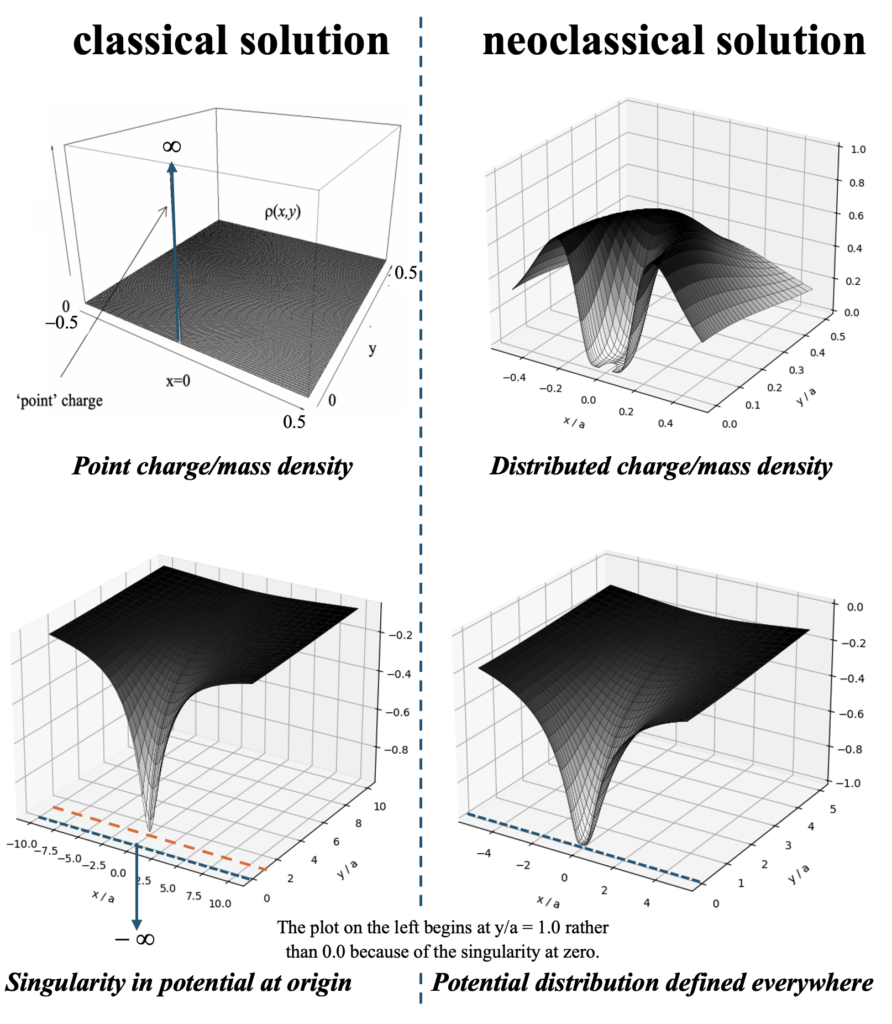
The exponential parameter an is the radial scale factor of the resulting distribution. If one is referring to subatomic particle distributions, the value of this scale factor is extremely small – particularly for gravitation. Non-zero scale factors are largely responsible for the neoclassical solution avoiding singularities – it eliminates the need for a Dirac delta function or methods to ‘normalize’ behavior. Each of the solutions (electrostatic or gravitational) encompass similar functional forms of the respective theoretical constructs as shown in the plots below. The ranges covered by the plots have been adjusted to illustrate the ranges over which the differences in classical and neoclassical solutions manifest themselves, and to avoid the region of the plots where a singularity occurs for classical solutions.
For realistic scale factors, differences in field strengths and in the total spherically encapsulated charge or mass are indistinguishable at appreciable distances from the origin for the alternative solutions. Plots below illustrate the similarities and differences for the two cases. The classical solutions correspond to the use of a zero scale factor in the corresponding neoclassical solution.
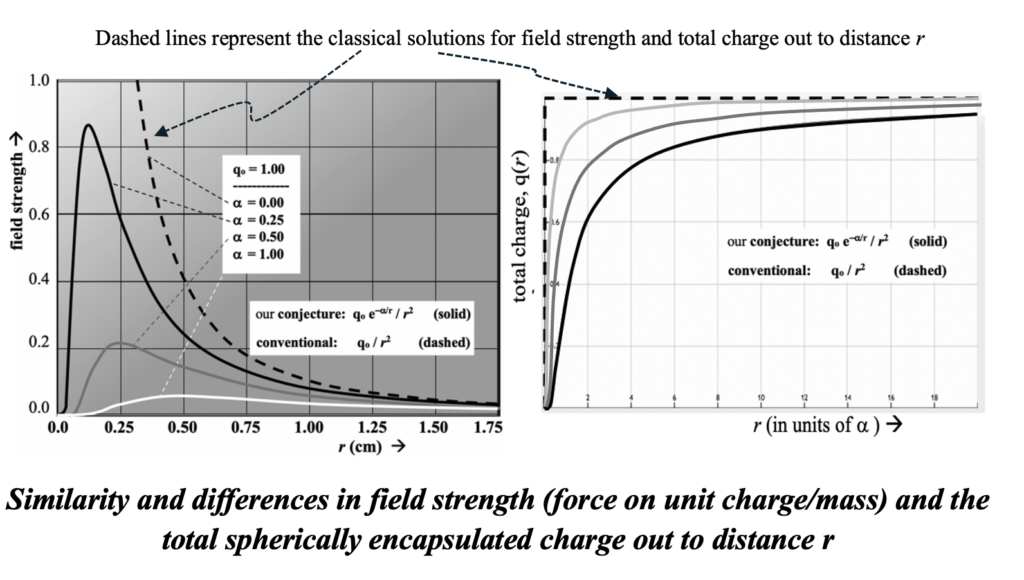
Despite similarities, the differences between the classical and neoclassical Poisson solutions are appreciable, the latter accommodating a natural merger of the baryonic charge and associated rest mass. Major advantages provided by the neoclassical approach are a zero divergent force at the center of the distributions that eliminates the singularity of the classical approach, providing the ability to compute the self-energy of the distribution. However, the separate distributions in the neoclassical approach have the apparent disadvantage of fragmentation to be discussed in the next post.
Leave a Reply