Whether ‘stars on their belly’ or a prime on ‘the other’ observers’ locations in space and time draws an unnecessary distinction that leads to categorical errors and bad thinking. Relativity should be about an equivalence that leads to covariance. That is accomplished with Einstein’s Special relativity, but only by introducing red herring in the process.

The epitome of relativity is the universality of the speed of light in a vacuum for every observer which has demanded an explanation in its own right –assigned to earlier post. Acknowledging that we do not observe ‘objects’; we observe ‘events’ that ‘happen’ (or ‘occur’) on objects was a necessary codification introduced in Einstein’s Special relativity. He further specified that there is virtually complete independence of events from the objects on which they occur. By ‘event’ one comes to understand that the theory embraces these as involving indivisible light emissions from source objects, at points along their ‘world lines’ through his newly vinted spacetime.
Detecting these ‘events’ is, of course also an electromagnetic event, but Einstein treated it very differently as merely ‘what observers do’. Of course emitting light is ‘what objects do’. There is inconsistency there. An observation is an ‘event’ along the ‘world line’ of an observing object.
The problem begins by a misunderstanding of ‘frame independence’ and the indivisibility of an associated event. An event! One. So if the world lines of two light sources become coincident at the moment each (or either) emits a photon of light, that (or those) event(s) occupy a single position in spacetime. Indivisible. How the (or those) event(s) are observed by what one calls ‘this’ or ‘the other’, ‘primed’ or ‘unprimed’ observer are subjects of Einstein’s Special relativity as illustrated here.
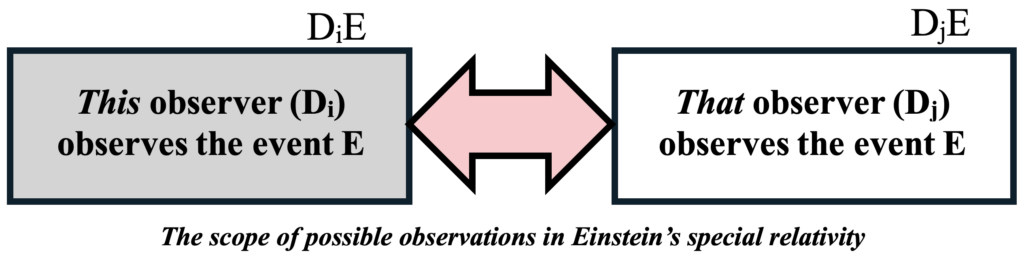
But… what if one of the coincident light emissions was from a red light and the other blue? Or what if one of the sources of the emission was receding? Won’t it be redder? And if one of the sources is moving to the right relative to the other, won’t its angular position be aberrated – separating the ( aren’t there two?) events? So what all goes into documenting a single position in spacetime?
It’s time to address the role of detection Di as well as emission Ej. The observers are just detectors of the emissions, and since emission and detection are inextricably linked as DiEj by conservation laws that do not allow a photon to be emitted into the ether, but only to a particular detector, completing the (otherwise incomplete) exchange of energy and momentum . It is the individual transactions DiEj that are indivisible. That is what Transaction Geometry is all about.
With two relatively moving observers there are four – not just two – types of observation with multiple relationships between their respective pairs. There is added an complication with regard to events in third party reference frames Dk; these relationships associate probabilistic clouds for event locations in spacetime scheme.
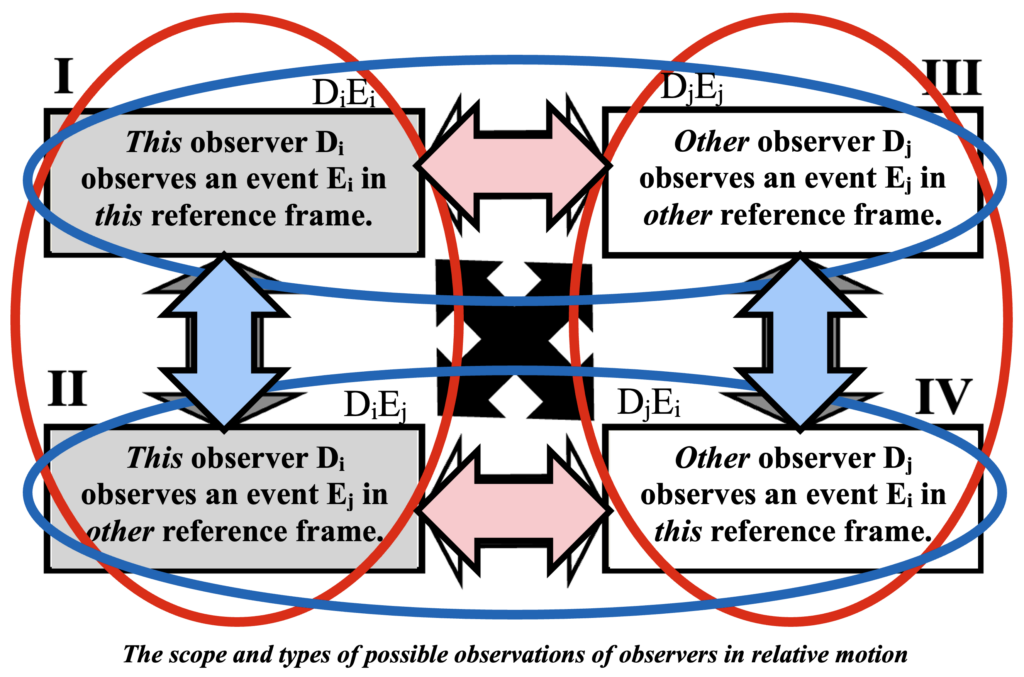
Conflating coincidence of events as identity ignores much of what relativity is all about and requires association of clock time dilation and Lorentz contraction with ‘the other’ observer even when he is going about minding his own business independent of relative motion with respect to anybody. The association precludes addressing the physical mechanism responsible for relativity leaving it a mathematical theory that is not completely isomorphic with reality. Simplifying this complex of relationships restores the autonomy of observers. Every observer – right and left in the figure above – accepts his own measurements of clocks and rods and his accounting should be accepted by others in relative motion. Only inter-frame transactions are affected by relative motion.
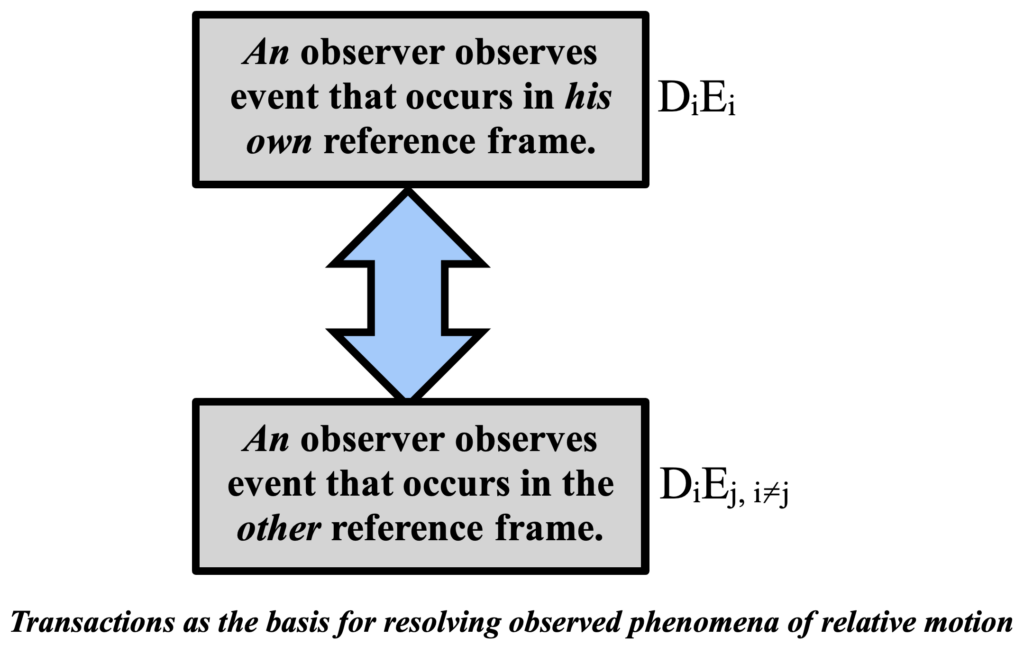
Presuming a relationship between an observer and a light emission ‘event’ involves a categorical error in the same sense as presuming a relationship between a light bulb and a detection event. It’s a mismatch. A transaction is based on a relationship between two events – emission and detection – that defines the exchange of energy and momentum between two objects. Categorical errors are anathema to any critical thinking. Observers and light sources are unaffected by the relative motion of peer objects. it is only by the interchanges between them that they are affected. The time to effect a transaction is affected by the relative dynamics of the parties to the transaction.
Leave a Reply