(a continuation of My Moment of Fame and Shame)
I headed up to Perry Sikes’ office in mahogany row the morning after the phone call that had rescued me from the beginnings of a hell that Stampalia, the head of the tech staff of the Boeing Aerospace Company, had in store for me. I was a little out of my league, to say the least, and the mahogany walls in the hallway (or whatever it was) seemed to have no purpose other than to intimidate. It had that effect on me and was reinforced by the disdainful glances of secretaries in front of each of the offices. When I reached Perry’s office, the door was open with him on his phone talking gregariously and laughing with someone. He saw me at the door and motioned for me to enter, pointing to a chair.
When he got off the phone, he laughed and told me that the other end of the conversation had been his counterpart in the KGB keeping track of him. I didn’t know what to say; it certainly seemed strange that anyone in the KGB would be interested in a jolly person in Kent, Washington for any reason. But I wasn’t about to say, “You lie!” But he proceeded to clarify that he had headed up CIA operations in the far east. Okay. So I’ve just been snatched from Stampalia’s homemade hell only to be dropped down Alice’s rabbit hole. I didn’t ask questions; I just stared. If I was supposed to be impressed, I was.
I would find Perry Sikes to be a very interesting and enjoyable character to be around. Needless to say, being in serious trouble at the bottom of a huge organization, one does not expect, or even dare to dream, that you might be rescued by a vice president inviting you to work for him on special assignment. But there you have it, and he proceeded to explain I would be working directly for him. Actually, he asked me whether that would be alright. I just nodded, not having yet recovered from the wild gyrations of things that were going on at the Lazy B.
I still worked at the desk I had occupied before the broom closet adventure and strolled on over and up to Perry’s office whenever he wanted to discuss plans for the Transition Machine. Perry, always voluble, I learned more about him every time I went to his office like the fact that he headed up Papa Bush’s campaign for the presidency in Washington. I think he had reported to Bush in the CIA, but I don’t know for sure because I didn’t ask him and I’ve noticed that CIA involvement is not provided in Google searches.
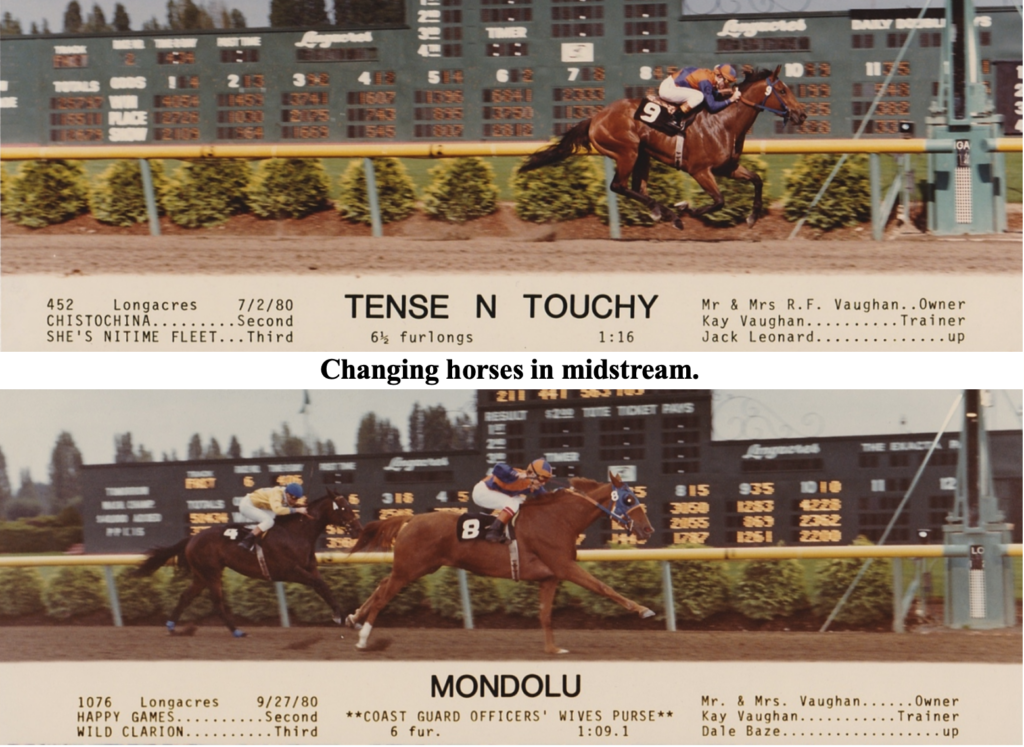
In the other organization to which I was loosely attached, things were starting to happen. Trainers saw the success that Kay was having with our home-breds and thought that they could do better, so they claimed our horses as they had Transition Machine, and now his sister Tense N’ Touchy. With the money we claimed a much better bred filly, Mondo Lu for a lower claim price, who would win her next start and become our first stakes winner.
But the last couple months of 1980, Perry must have handed me off to Boeing Associated Products, because my partner Mark and I, and one of their promoters took trips to various computer manufacturers to drum up business interest in selling rights to the Transition Machine, but without success. A memorable aspect of these trips was how profusely the guy sweated in his introductions to our dog and pony show; it streamed down his face. Another memorable aspect was the vice president of new business for Control Data, while seeming to be impressed that such research was taking place at Boeing, said, “Our new business planning is for five years out. This is further than that.” A bit ambiguous.
Meanwhile Mark and I worked on improving designs of various versions of Transition Machines, and looked at ways it could be tailored to meet particular applications. We toyed with the idea of developing a compiler for programs written in English as behavior specifications, an idea I introduced much later for the cabin management software on the Boeing 777 and for the B-2 bomber upgrade. We were also working with a patent law firm in Washington D.C. where we traveled a few times. The lawyer assigned to our effort would send us claims from other patents and ‘disclosures’ that were intended to preclude anyone else from patenting an idea even if the idea was not being patented by the discloser. It was primarily IBM who engaged in this practice. In any case there was a lot of reviewing to be done to assure our claims could not be challenged. In addition we wrote more technical papers, research reports, and documentation for the prototype and compiler we had already developed.
Perry had been absent for some time. I didn’t know why, and I wouldn’t have asked. He later laughed about his having been on ‘special assignment for then US president, Ronald Reagan. But he was back and picking up the reins of the Transition Machine once again.
I know C.Itoh manufactures high-end bikes. I looked it up. I don’t know exactly what that Japanese company did back in 1981 when Perry had us wine and dine several of their executives at expensive restaurants after our pitches. Over dinner and when in meetings I answered questions about Transition Machines and asked very few of my own. But Perry encouraged them volubly as always, never applying pressure, just jovially suggesting that maybe they should consider introducing an additional product, Transition Machines. Perry never sweated. One comment I remember from one of these gentlemen was in reference to handicapped parking that was being introduced in the US. He said, “In Japan we respect our elders and the handicapped but we don’t slow up progress by inconveniencing everyone else.”
In July Perry scheduled he and I to go to Washington D.C. to promote the high-powered capabilities of our machine to agencies including DARPA, Bureau of Standards, FBI, and the CIA. We flew into Dulles airport on Sunday. He had appointments scheduled out beginning Monday morning, July 19 at the CIA headquarters at Langley. When I came down to the restaurant in the morning, Perry was finishing his breakfast, the man across from him had his head in a newspaper. Perry introduced us, after which he put his head back in the paper. As I sat down, Perry flipped his copy over on the table in front of me, saying, “I guess we won’t be going to Langley today.” I glanced at the headline:
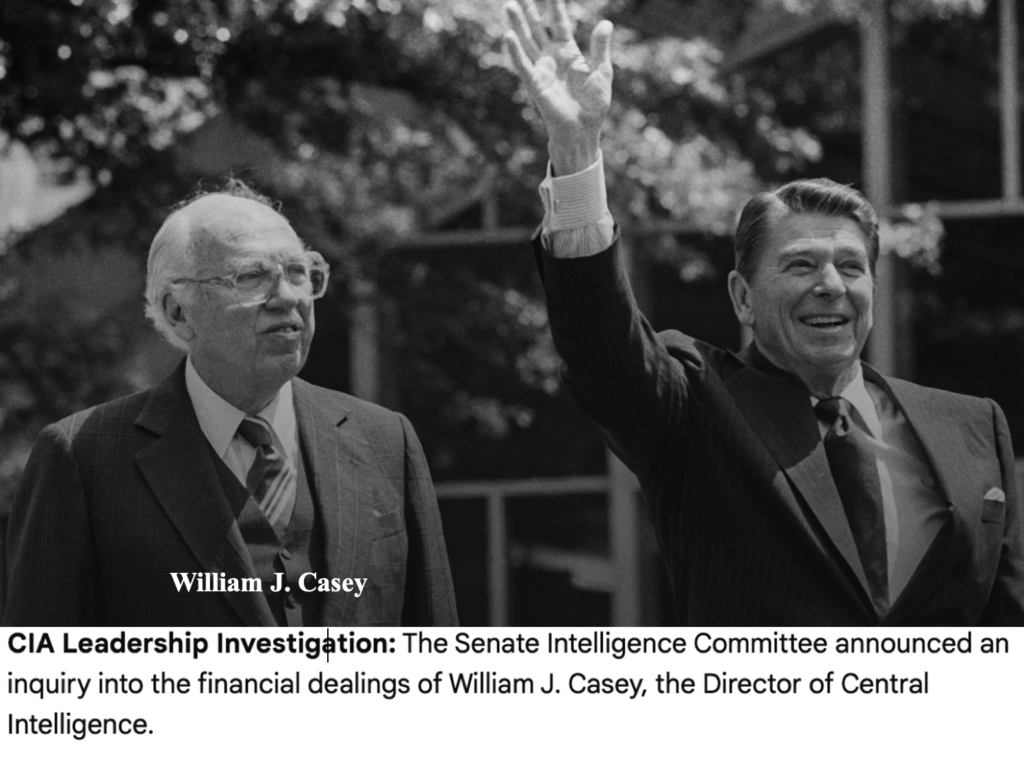
I didn’t say anything; I didn’t really know what it meant. In retrospect I could see that it was the beginning of the end for Casey. He’d been Ronald Reagan’s campaign manager, but a bad choice to head the CIA. Later with the Iran Contra scandal exposed, he escaped indictment and a prison sentence by means of a terminal illness and death.
Perry said, “Maybe we should just have some fun today instead.”
To be continued.
Leave a Reply