One can speak confidently of the universal baryonic mass density, rb. And since baryonic matter is the only kind of mass we know much about, let’s limit the discussion to that. There is also an electron number density ne, and since the hadrons are primarily protons with a positive electronic charge +e, electrons necessarily associate with each proton, it carries a corresponding negative charge –e. The electronic charge e = 4.8 x 10⁻¹⁰ StatCoul. Thus, in addition to mass density, the universe contains the positive and negative charge contributions arising from quark structure. The charges of record that provide the charge of protons and, also the neutralized components of neutrons are the up and down quarks. The electron has been perceived differently from the hadrons – as indivisible in a similar sense to that of the quarks. The up quark possesses a +2/3 e charge, the down quark a -1/3 e charge, while the electron has a full –e. So in this traditional scheme, when a neutron decays into a proton and what eventually becomes an electron, the ratio of up and down quarks has to change. The protons and neutrons are also assumed to possess a massive gluon to hold the quarks in place with its ‘strong’ force.
basis for a different model
We’ll be discussing an alternative model. It rejects several aspects of the traditional scheme. This includes as alternative to gluons that bind and separate quarks within the hadrons and also the introduction of electron structure. The model incorporates quark charge distributions that do not require a separate gluon with its strong force, and an electron comprised of three adhering down quarks. That’s the primary difference. We will demonstrate viability of this model by showing that associated observable phenomena can be exceptionally well accounted.
Model deviation begins with alternative treatment of the Poisson equation that has been used in analyzing both electrostatic and baryonic gravitational mass distributions. The issue is that the Poisson equation is only a part of an associated boundary value problem, whose solutions depend upon the boundary constraints. To obtain unique solutions, a complete set of boundary values must be specified. In the traditional treatment only the values of the required constructs, whether potential or field strength, are specified at infinity. The origin (center of a resulting distribution) has been ignored, allowing singularities. With inclusion of the constraint at the origin, a unique solution to the problem of how does charge distribute itself in space is obtained.
The Poisson equation itself as applied to electrostatics is associated with Maxwell’s vector equations, and specifically Gauss’s law which states:
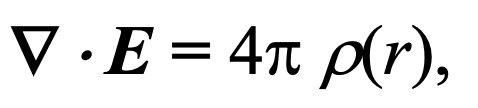
wherefor radially symmetric distributions in radial coordinates, the gradient operator is defined as follows:
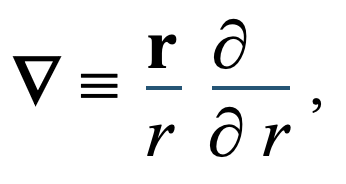
where r is the radial vector and r = |r| is the associated scalar quantity. And since,
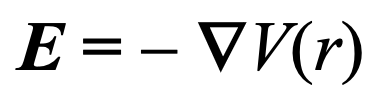
We have,

A solution for the potential V(r) appropriate to localized particles with spherical symmetry suggests a formulation in which the potential V at radius r is determined solely by the charge enclosed within that radius, q(r). This imposes a locality condition on the field that leads to a class of solutions that are finite both at the origin and at infinity, as well as being internally self-consistent. Thus we arrive at the equation:

Then by assuming V(q(r)) is a linear function of the charge enclosed in a spherical sphere of radius r, i.e., q(r), we come ultimately to obtain the solution:
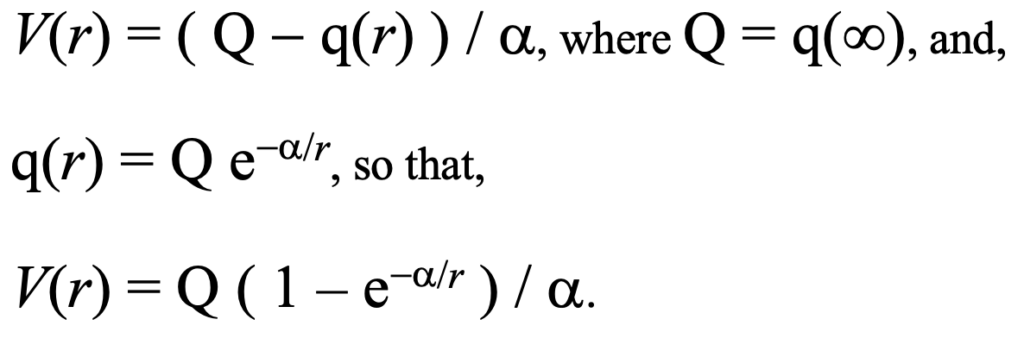
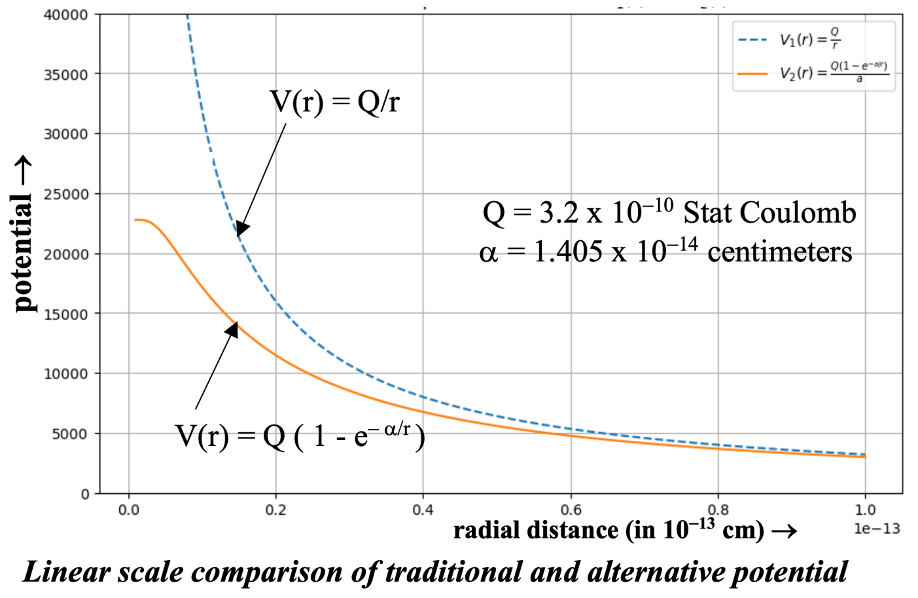
The functionality of the potential is very nearly what we have come to expect from the usual treatment as shown below. Only for r < a / 2 does it differ appreciably to avoid singularity but beyond that it is virtually identical.
The charge distribution and electric field strength expressions that result for the distribution are the following:
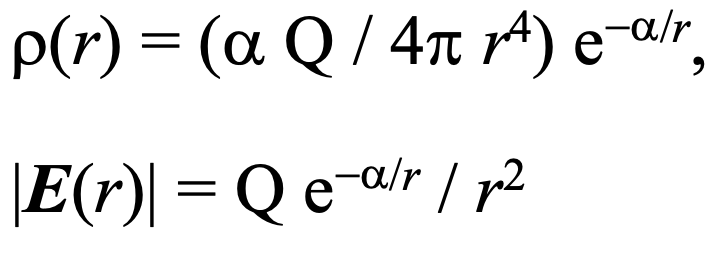
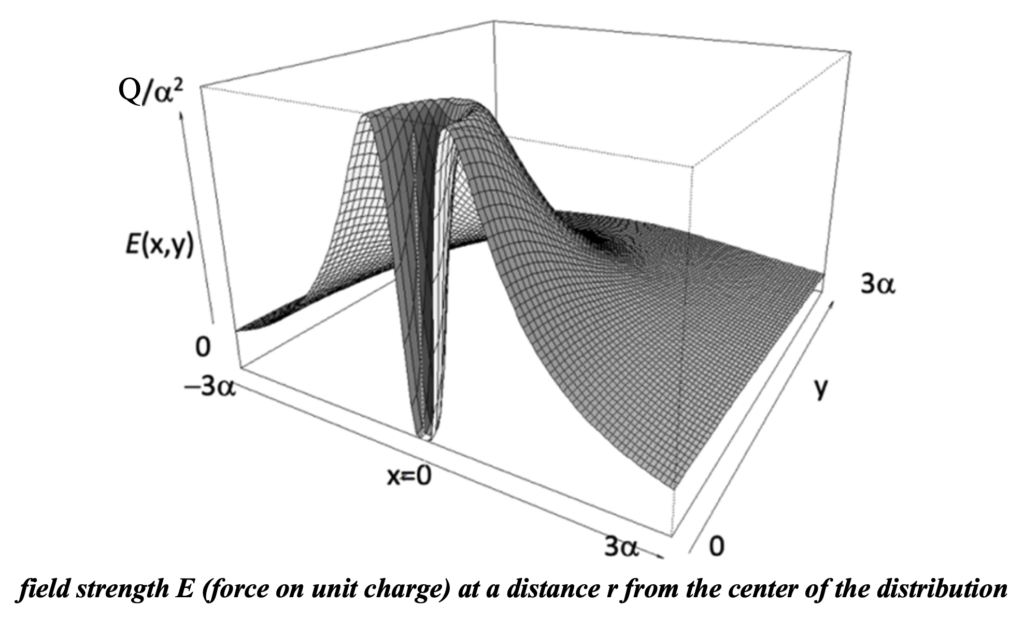
This Poisson solution provides the otherwise inaccessible capability of assigning rest mass mrest to a distribution of total charge Q and given total energy, by determining its self-energy, S(infinity). It, therefore, accommodates the association of a charge distribution with a particle of matter.

refining quark characteristics
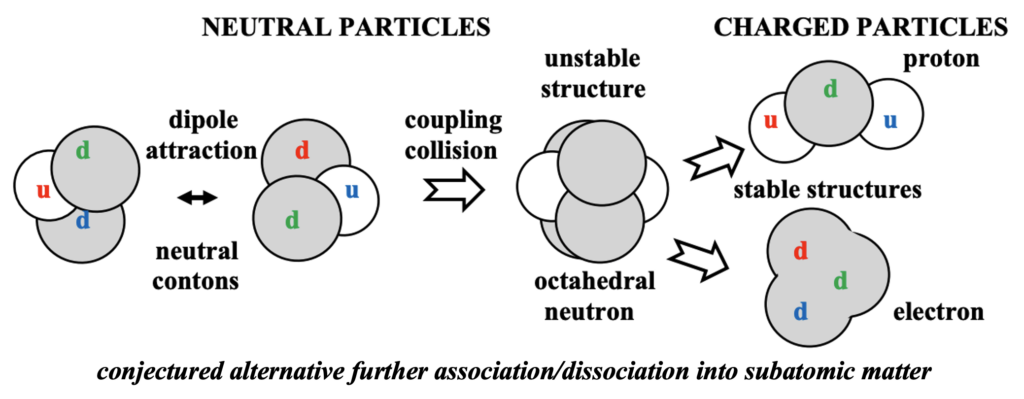
In defining the mass of up and down quarks, the model assumes there are no gluons, so the self-energy of each quark’s electronic charge distribution times the square of the speed of light defines an upper bound on the mass of the subatomic particle comprised of those quarks. These are the decompositions assumed for subatomic particles by the model:
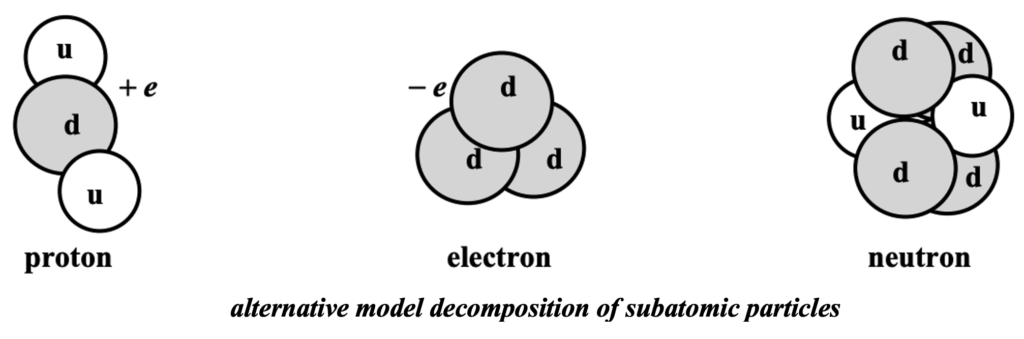
The proton decomposition in this model is similar to that of the traditional scheme. The electron may have to move into the hadron column since it is assumed to be ‘constructed’ from three down quarks, but with indivisibility. This may conflict with some current interpretations of high-energy scattering data but is in good agreement with the accepted Thomson scattering in plasma diagnostics data, where 6.7 x 10⁻²⁵ cm2 is used that implies roughly a 10-13 radius. The neutron is now comprised of two sets of what were formerly thought to comprise a neutron. It is not envisioned as a stable particle because of energetic constraints (without specific chromodynamic considerations) such that when the two stable halves are coming together, the instability results in transmutation to a proton and electron as follows:
As demonstrated for Poisson charge distributions in other papers discussing neoclassical field theory on this site, a feature of the distributions is superposition. When N identical distributions are superimposed with the same center and variance, alpha, it results in a distribution with N times the charge but N2 times the mass.
We will have occasions to see the effect of the overlap of identical distributions as it plays out in structures for which multiple quarks of the same type are present in a structure such as the electron. For the Poisson charge distribution, when multiple identical particle distribution are superimposed on each other, the associated combined self-energy (and we suppose rest mass) of the composite of N particles increases nonlinearly. If their centers coincide, the mass will be the N2 times the individual contributing particle mass. The following plot illustrates the nonlinear increase in the self-energy of the product of two distributions. The form of the distribution, in the sense of the exponential factor alpha does not change.
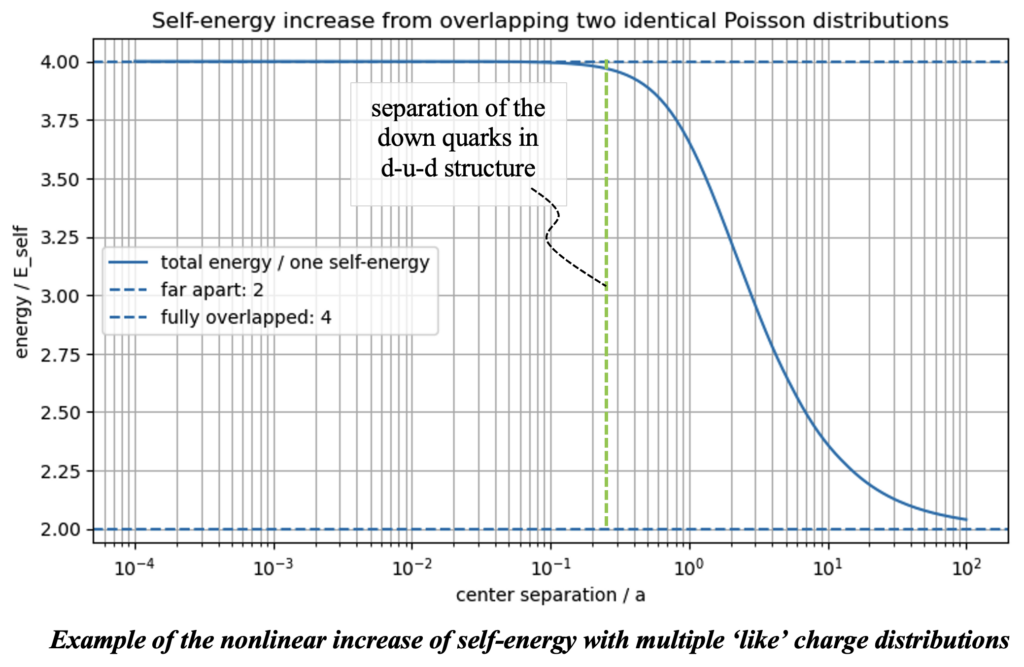
In the case of ‘partial overlap each contributing particle provides a fraction of between 0 and N units to the total self-energy of the composite. A composite does not behave like a completely separate particles nor as a fully merged unique particle. It is somewhere in between, with self-energy increasing smoothly to N2 times the original value.
Why fundamental particles exhibit indivisibility rather than fragmenting into innumerable lower-energy particles ad infinitum is a fair question requiring an answer. That answer lies in the Poisson solution of the associated gravitational mass distribution to be addressed separately. Suffice it here to say that although gravitational force is some 40 orders of magnitude less than the associated electric force at appreciable distances, within the variance of the electric charge distribution, it is many orders of magnitude greater. So that if centers of like charges converge, they will strongly adhere.
The model supports overlap in the sense that transactions become energetically much more expensive without altering the analyses dramatically.
Next time we will define the properties of the charge distributions that match the up and down quarks.
Leave a Reply