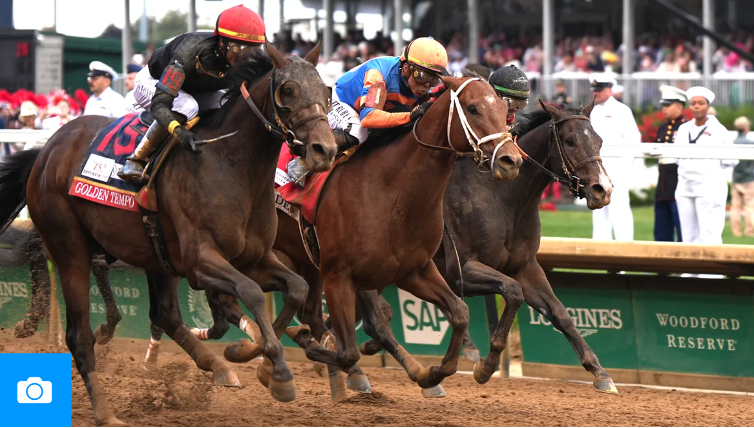
On Saturday Golden Tempo won the 152nd running of the Kentucky Derby; he went off at odds of 23-to-1. It was the first time a woman had trained the winner of the Kentucky Derby. The winning jockey defeated his brother, who was aboard the favorite, Renegade, who ran second only a neck back. But what does all that have to do with Sally Marie and Tempo per se?
Sally Marie was a thoroughbred filly foaled in 1974; she was a full sister to Paraselene, who was our first racehorse. Our 4-year-old daughter gave her the name we would have given our son if he had been a girl. Nola had wanted a sister. Sean Jeffrey and Sally Marie were both born in February of 1974. But what does that have to do with Golden Tempo, Cherie DeVaux, and the Ortiz brothers?
Admittedly, the strong connection exists only in my mind, but it is a meaningful connection that ties into what Donna read last week about perseverance. My wife Kay was a thoroughbred horse trainer who learned a lot from Sally Marie. You see, Sally won her very first start, racing as a 2-year-old because of tempo. She beat Hot Feet, who was a faster racehorse -only because Hot Feet’s jockey bet another jockey a cheeseburger that she would run a faster quarter mile than the other horse could. I don’t remember who won the cheeseburger; they were neck and neck after a quarter in 20 1/5 seconds. Horses don’t run that fast – to win horse races. Sally won the race.
Kay had not yet turned into the award-winning trainer she would become. I think Sally Marie’s maiden race triggered something in her. Kay was getting better, but trainers thought they could do a lot better and claimed our homebreds. The trainers didn’t do nearly as well. Kay took the money from the claiming prices and claimed other horses that were faster for less money. She wasn’t running for cheeseburgers; she ran her horses to win. So when she claimed a fast horse that wasn’t winning as it should have been, she would put the jockey Dale Baze on the horse because he was stronger than most jockeys and he would follow instructions – even if they came from a woman. As soon as the horse jumped out of the starting gate ready to run, he pulled it back – all the way back to last – because that is what Kay told him to do. And they won! The very first start after she claimed them, ultimately winning stake races.
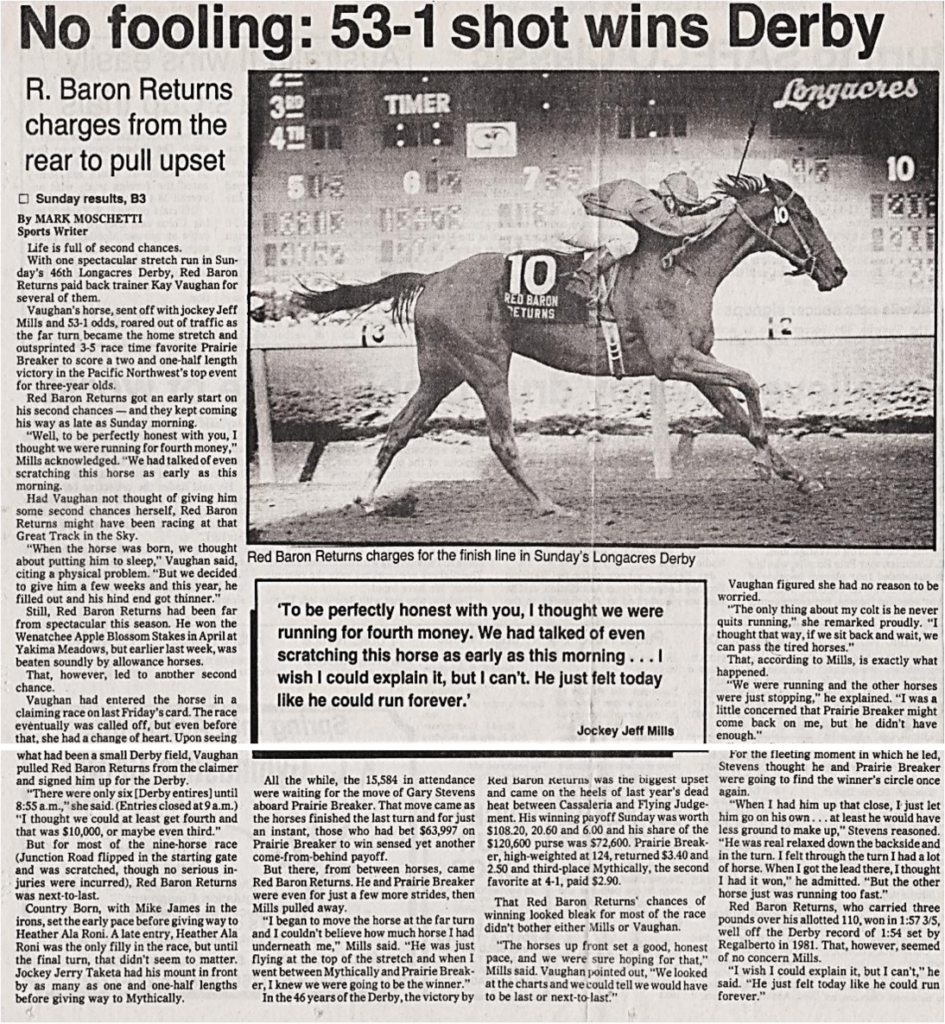
At first it looked to the other trainers like beginner’s luck. Longacres hall of fame trainer Bud Klockstad mocked that “Wonder Woman” was winning with Honey Blaze that she had claimed off of him. Then she claimed the filly TV Return who had won the Portland Derby off him to retire as a broodmare. But Kay’s horseracing success with claimers skyrocketed and the moniker ‘Wonder Woman’ was there to stay as her horses won three hundred-thousand-dollar races in a one-year period. When she won the Longacres Derby at 53-to-1 defeating the heavily favored Prairie Breaker, his owner said, “I guess that’s just Wonder Woman.” Her horse Big Flyer had gone off at 15-to-1 to beat his favored horse by a head in the Gottstein Futurity.
In an interview on TV someone in the audience asked her what kind of horses she likes to train. He had obviously thought she would prefer horses with stamina because of the way her horses ran. But she responded, “I like fast horses.” The audience and host laughed. She added, “They just have to have speed.” She refrained from saying, “You just can’t waste it on cheeseburgers.”
TV commentators made a point of noting that Cherie DeVaux was a 42-year-old mother. Would they have stated the age of a male trainer? No, of course not. The media, in addition to referring to her as Wonder Woman, noted Kay was a 40-year-old mother of two children and married to a Boeing engineer. Really? Have you ever heard about Pete Carroll’s wife, what she does in her career, how many children he had? No! Or Muhamad Ali, or any other male sports personality?
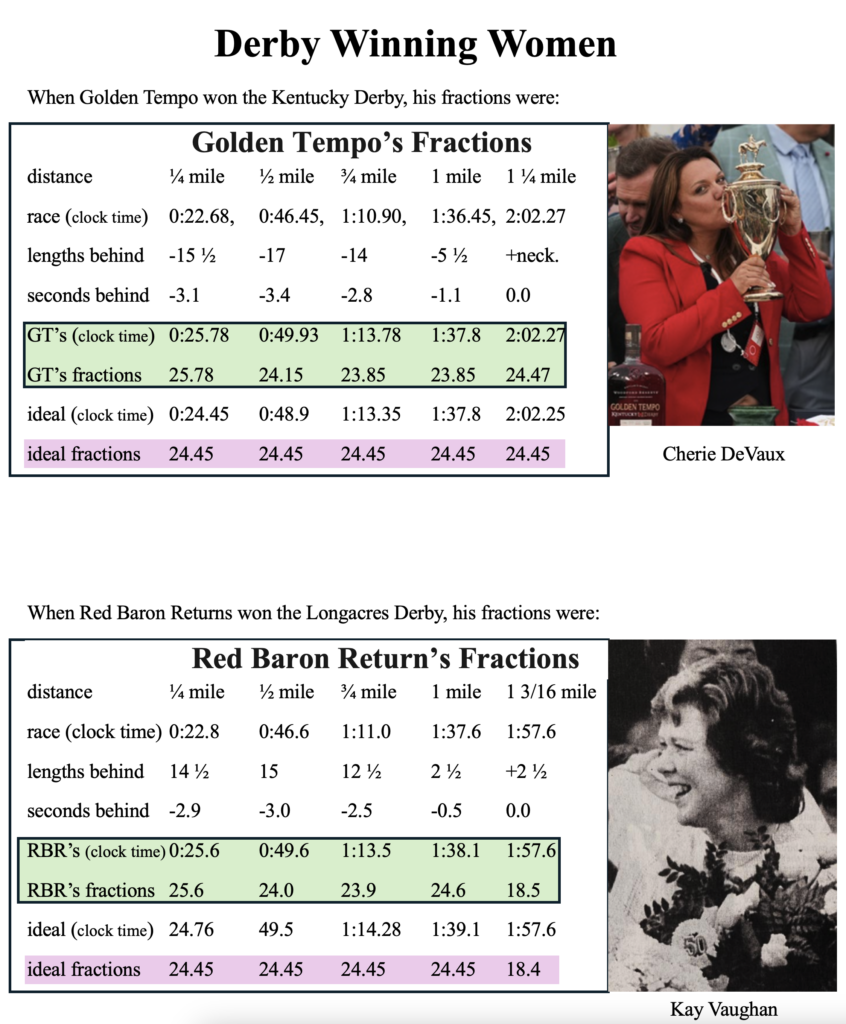
Oh, yes, Golden Tempo. It’s like Ralph’s Golden Ratio – there’s something special about it. In this case it’s fractions, which are just ratios. These are divisions of a race into how fast each quarter of a mile is run. And importantly the comparison with how fast the winning horse will have to run. Golden Temple’s trainer and jockey figured it out; they took him back to last. It wasn’t just luck; he could run faster than that – any racehorse can – much faster. When asked what Ms. DeVaux thought seeing her horse so far back, she said, “Oh, I wasn’t watching him. I was watching the horses at the front.” Why? Because the fractions were too fast; they couldn’t be maintained for a mile and a quarter. That’s why her horse was so far back. That’s where she wanted him. There must have been a Sally Marie in her life that taught her the physics of horse racing.
There’s a lot that goes into conditioning a horse to win, but strategy is up to the trainer and jockey. The amount of energy a horse uses in a race is its mass times the square of velocity. A horse weighs half a ton; if you use his top speed, you waste his energy. To win horse races you don’t show off how fast your horse can run; you figure out how fast the race will run and break that into equal fractions and that’s how fast you run to win unless there’s a class distinction in your favor and then you break their hearts right out of the gate. But usually, you let someone else set the fractions unless they’re trying to steal the race. I know this because my wife told me.
Leave a Reply