What follows is not a rejection of the earlier complex-charge formulation of the model I have been describing, but a clarification of what the mathematics appears to have been indicating all along.
The original formulation treated the baryonic quarks as complex-valued Poisson generic charge distributions:
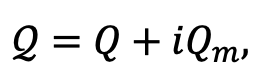
where Q represented the electrostatic component and
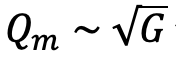
represented a gravitational or mass-sector component. The interaction structure was then built from conjugated products of these quantities. This approach successfully reproduced several important qualitative features:
- finite origin potentials,
- finite self-energies,
- short-range wall/well behavior,
- and scale-separated interaction regions.
However, further examination of the force and energy structure revealed a conceptual ambiguity. The difficulty is not numerical; it concerned the interpretation of the conjugation operation itself.
The issue is that primitive quantities such as:
- source density,
- potential,
- and field strength,
are not directly observable. Observable quantities arise only through interaction products:
- force,
- interaction energy,
- or invariant contractions.
This raised the question: Why would conjugation appear only in some products and not others? That concern led to reconsideration of the mathematical structure underlying the model.
Rather than interpreting the quarks as an ordinary complex scalars, the revised viewpoint treats the electrostatic and mass-sector components as two coupled Poisson-source sectors:
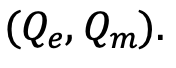
The corresponding potentials satisfy separate Poisson equations:
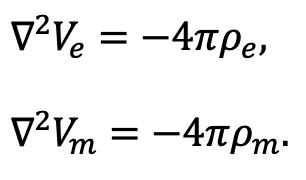
Each sector independently admits the finite-origin Poisson-smoothed solution:
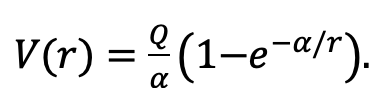
The key change is that physical observables are no longer derived from complex conjugation, but from a ‘bilinear interaction form’ possessing mixed signature:

Likewise for charge strengths:

This interpretation preserves all previously derived interaction behavior:
- like-sign pairs produce short-range locking behavior,
- unlike-sign pairs produce exclusion behavior,
- and the mass-sector contribution enters with opposite sign.
But now the sign reversal arises naturally from the metric structure of the interaction space itself, rather than from selective conjugation rules.
The revised formulation also clarifies the origin balancing condition. Previously this had been interpreted informally as cancellation between electric and gravitational potentials:

In the revised framework, the more natural invariant statement is instead:

This resembles a null-condition in a mixed-signature geometry rather than algebraic cancellation of scalar fields. The analogy is therefore closer to a pseudo-Euclidean geometry than to ordinary complex-number norms. In particular, the structure resembles:
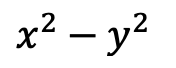
rather than:
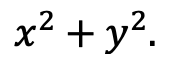
Under this interpretation, the earlier use of “imaginary” terminology may be understood heuristically rather than literally. The mass-sector does not necessarily behave as an ordinary imaginary complex component. Instead, it behaves as a second coupled interaction sector contributing with opposite metric signature in the observable bilinear forms.
The resulting interaction energy for two quarks becomes:

with corresponding force:

The short-range interaction layer generated by the mass-sector remains extremely narrow due to the very small scale  . Earlier interpretations of this region as a large energy “wall” or “well” have therefore been refined. The updated interpretation is that the model produces a localized force-transition or narrow exclusion/locking layer rather than a broad confining energy barrier.
This reformulation preserves the successful features of the model as previously described while replacing the less rigorous conjugation procedure with a more geometrically coherent bilinear structure.
Leave a Reply