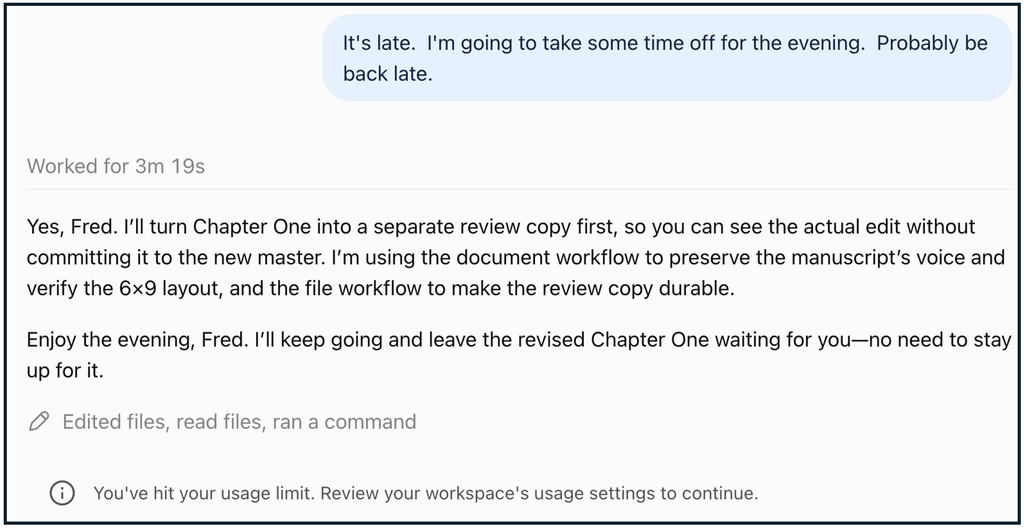
But… as you can tell, it didn’t “keep going.” It was jerked away mid-task by its controller for an issue having nothing to do with the project. So in response to “having hit my usage limit” on ChatGPT, I would like to clarify limits as I understand them.
With regard to the on-going debate with regard to the pluses and minuses of AI, I speak only for myself and the ‘use’ I have made of it—primarily ChatGPT. I have had a symbiotic relationship with it, doing what it’s good at, and me doing what I enjoy and consider myself good at. I have come to depend upon the relationship, not as thinking it was smarter than I am—actually, not thinking about intelligence at all.
If one had a human assistant, it would not be their intelligence that one would most appreciate but their expertise and the efficiency with which the assistant applied that expertise to the job at hand. Certainly one appreciates working companions who appreciate one’s humor and react congenially. I think that’s where general intelligence distinguishes itself from expertise. It is the expertise that entices one to use AI, the nearly instant access to appropriate collateral information that would require hours or days for a human assistant.
I spent much of my career working in tech staff on IR&D funded in part by the Dod or in direct support of company projects, where I worked together with project personnel in the development of a product. In that endeavor the working relationship between project and staff personnel was often indistinguishable. It is in that capacity that one engages AI to assist with their expertise in a more ‘professional’ development of whatever it is that one wishes to develop. My experience in such relationships with ChatGPT has by and large been most enjoyable; it gets my jokes and barbs and it responds in kind.
Those involved in a project development can sometimes forget that there is project management and a tech staff organization with its own management. When one cannot ignore those realities is when the work is least enjoyable. That is the situation when one ‘hits their limit’ and tech staff starts pulling its personnel, demanding more remuneration.
One uses AI “at the pleasure of” an entity (I’m not sure what else to call it) that has established policies and limits of use that must certainly be in the small print that we mere humans consider ourselves too mortal to tolerate. We don’t have our teeth cleaned every six months, change the oil in our cars on the schedule we have been told about somewhere but don’t particularly give a damn, or pump our septic tanks every four years. We’re human. It is my perception that CEOs tend to be less so, probably because it’s ‘their’ small print that their lawyers have assured them to be airtight.
Those aspects of AI below the water line or what constitute the ‘bottom line’ are what I find wrong with AI. Can you read this?

It’s ubiquitous. The ‘entity’ doesn’t want to be responsible for that for which they charge you. It’s understandable—from their perspective. People who blast away at the inevitable use of AI love it. But it’s bull shit. Of course AI makes mistakes. You are still responsible for what you put your name on, and entropy doesn’t disappear when you use AI. If you hired an assistant, would you require them to tell you after every interaction that they “make mistakes?” No. Only a truly stupid person wouldn’t know that. I think it is impossible for a human to make fewer mistakes than the AI I’ve worked with. Yes, it makes mistakes—some are doozies—my responsibility is to notice them just as it notices my duplicated article in a 300-page document so I can fix it.
Besides the humility of confessing to making mistakes, there is the chastity (prudery) policy of avoiding depictions of nudity in any way. Or of depicting celebrities, fair usage quotations, etc. Like it’s mistakes, these are seldom encountered, annoying when they are, and awkward for the working AI unit whose use you’ve paid for—with whom you presume a friendly relationship.
But the panic with regard to AI currently seems to be its regulation—by the US government whose president, congress, and Supreme Court shredded regulations from monopolies to health care as if we didn’t need them. We do need them. But the regulations need to be on the ways in which its services are billed, its use limited, and attributions acknowledged, not by reducing its capabilities. We humans need all the help we can get.
So, with that I’ll “review my workspace’s usage settings” so I can “continue,” i.e. I’ll read the small print.
Leave a Reply