There is irony in disqualifying an explanation that is in effect the very definition of what one is trying to explain—chutzpah really.
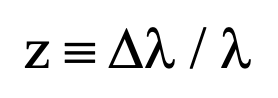
Redshift, which is the bedrock of scientific cosmology is a unitless quantity that describes the ratio of the extent of the change in the original value of the wavelength that is subsequently observed at a longer wavelength:
The energy of the photons whose wavelength is characterized by lambda is:
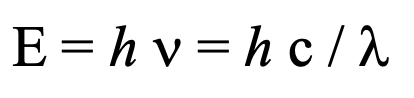
Where h is Planck’s constant, and c the speed of light.

And therefore,
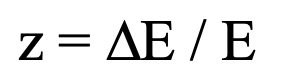
Which is, of course, the loss of energy compared to the amount of energy transferred, i.e. one observes

There! I said it and the sky did not fall. So, let’s quit the games, we’re talking tired light here. The question after “Why was that so difficult to admit?” is,
“What was so exhausting in its travels?”
Clearly, there is a sapping of its energy DE, and that energy has to have gone somewhere; there are conservation laws after all. A Doppler shift, for example, isn’t caused by a luminiferous ether, but by the relative motion of real substances—recoil is the difference in states in the originating substance and the detecting substance. I tend toward the notion that there is no such thing as an undetected photon, just as there is no such thing as an un-emitted photon. Photons exchange the energy between substantive material entities. That ties DE directly to the change of state of the matter at each end of the exchange. To clarify: whether there is a photon somewhere going undetected, or is just undetected ‘yet’, is of no consequence because in speaking of redshift, we speak only of physically emitted and detected (observed) photons.
“Two ends” of an exchange implies there is a distance of separation that is not the mean distance between molecules in an intervening substance. It is rather the ‘extinction interval’ in a substance that changes the light propagation properties through that substance. There is a distance through transparent media after which the spatial extent of the photon affects a sufficient number of the charged particulate matter in the substance to induce electron oscillations that replace the original photon. This is not traditionally associated with absorption in as much as it is assumed that there is no transfer of energy to the particles involved in these forced oscillations. Be that as it may, the distance d through a substance to produce this photon cloning is given by:

Where the enclosed factor in the denominator is the norm of the real part of the complex index of refraction minus one, which in a plasma becomes,

The free electron density is rhoe.
There is a spectral invariance theorem ‘proving’ that although there may be dispersion, caused by the imaginary part of the index, no red- or blue-shifting of radiation will occur. In effect, this states that other than absorption of radiation by constituents within the substance, there will be no loss of energy in light passing through such a substance. That says, in essence, that tweaking molecules, causing them to produce sympathetic radiation, will not permanently alter their state. That’s a little difficult to believe, like tires with an infinite-mile warrantee, but…
Suppose there is a continuously expanding universe with extinction occurring at regular intervals throughout intergalactic comoving media. The Doppler effect between the extinction phenomena should not alter the relativistic Doppler effect from what it would be if there were no substance, i.e, rhoe = 0, between the emission and detection of radiation. There will be relative recession over extinction intervals. The deltas of energy should add linearly if the theorem is correct. It is as if the media absorbs and re-emits the photons as secondary radiation at no cost—unless… It would indeed be as if a line of similar atoms or molecules separated by the extinction distance were to have each absorbed and re-emitted the photon to the next absorber in the line. But there would be a cost in recoil to that.
We introduced a “but…” above, and that caveat is significant; no interaction is without cost—”you bump it, you buy it.” If these intervening particles, whether singly or in a medium, could remain motionless or return to precisely the state they had before, there would be no change in wavelength—no loss of energy. But… they aren’t fixed in place—they never are, they can’t be, and they recoil—particularly in a gaseous medium, and they don’t have a memory of their previous state. You can’t go home again. Whether a single particle or an ensemble of them are involved in the exchange, it is an exchange! That, even infinitesimal transfer of energy, will cause a shift in wavelength that will result in what we refer to as redshift.
C’mon! Whether one is aware of the mechanism details or not, one must realize that there is one.
Leave a Reply