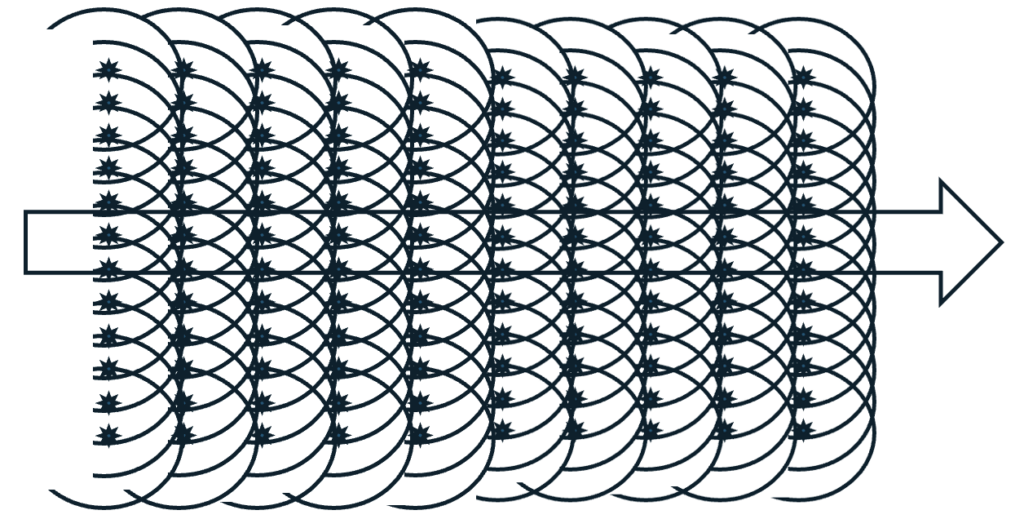
In getting beyond Huygens, we assume that in every vicinity of a point in space there must be a probabilistic presence of secondary radiators (plasma electrons, if you will). Radiation passing through a plasma encounters a population of free electrons. In Huygens’ concept as elaborated more fully by others, secondary sources produce an out-of-phase, phased array of radiators destructively interfering with an earlier wavefront and finally overwhelming and replacing it; this continuous process repeatedly completes and continues propagating through ‘extinction intervals’ to the ultimate observer But these electrons (particularly in a hot plasma) cannot be treated as stationary; they possess a distribution of velocities determined by the plasma temperature.
The object here is to describe the properties of the plasma medium precisely to support the derivation of effects on the radiation passing through it. We will address that derivation subsequently.
Electron Number Density
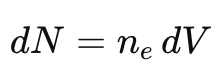
In a plasma, the relevant quantity is the electron number density, . It is very location dependent — near the center of galaxy clusters it’s on the order of 10-1 cm-3 with an overall universal density of on the order of 2 x 10⁻⁷ cm-3.
The mean number of electrons in a small volume is expressed as:
Thus, a medium through which radiation propagates can be characterized by its spatial density and a velocity distribution determined by temperature.
Thermal Speed Distribution
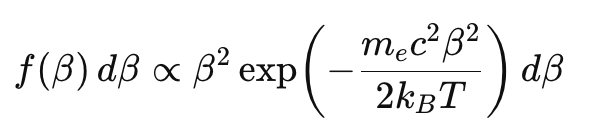
For a plasma in thermal equilibrium, electron speeds follow a Maxwell–Boltzmann distribution (MB). Speed is the magnitude of a velocity and for convenience we use the unit-less construct of beta for velocity, i.e, v/c. In the case of non-relativistic velocities, the MB is expressed as follows:
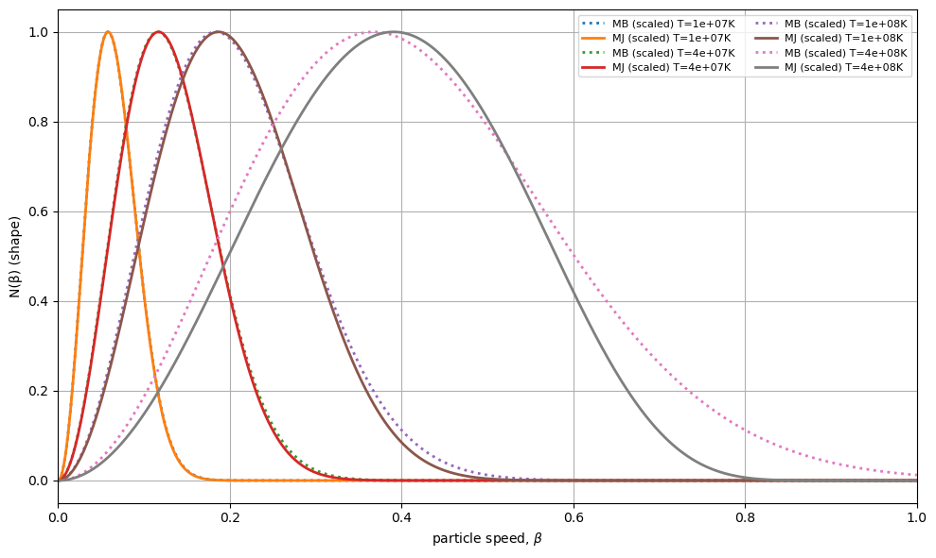
For temperatures as high as 108 K the difference is slight as shown below and only in rare cases does the temperature at the center of galaxy clusters exceed this value.
The temperatures vary, but average between 103 and 104 K.
Geometric Decomposition of Velocity
For radiation observed along a given line of sight, each electron velocity may be decomposed into a radial and a transverse component as illustrated in the following diagram:
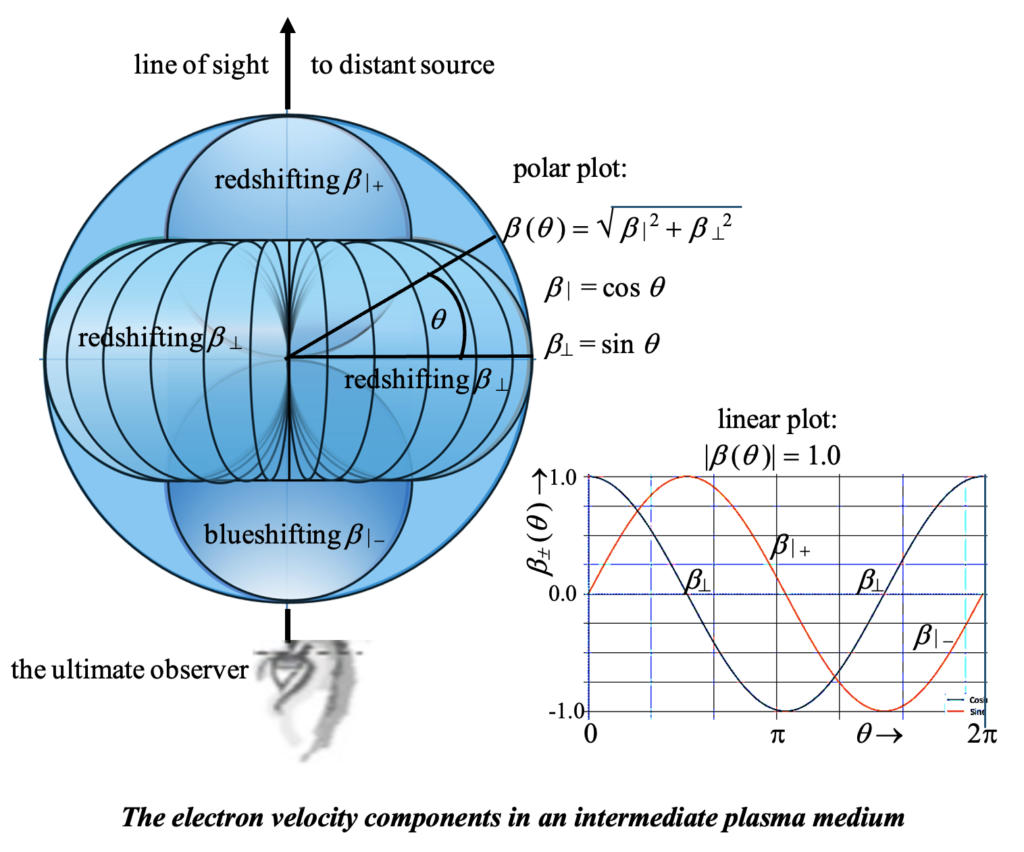
For a fixed absolute speed , all possible decompositions lie on the surface of the larger sphere in velocity space. Points near the poles correspond to predominantly radial motion. Points near the equator correspond to predominantly transverse motion.
This geometric decomposition does not imply probability weighting; it simply describes the kinematic possibilities for a given speed.
Doppler Channels Associated with Motion
Motion introduces two distinct Doppler effects:
- First-order (radial) Doppler effect, proportional to , which changes sign depending on whether the electron moves toward or away from the observer.
- Second-order (transverse) Doppler effect, proportional to , which depends only on speed and is independent of direction.
Thus, first-order contributions to spectrum shift depend on the sign of the radial motion, i.e., either red or blue shifting as shown in the illustration above. The second-order contributions derive from the transverse Doppler from transverse velocity components restricted to the equatorial toroid in the diagram.
The plasma therefore provides a medium in which radiation encounters a population of moving scatterers whose number density is set by ne, whose velocity magnitude distribution is set by temperature, and whose velocity components determine what Doppler effects occur.
Scope of the Present Discussion
In this post we have defined only the physical properties of the medium as a basis for analyses of implied effects on observations of distant objects seen through the intergalactic plasma. This includes spatial electron density, thermal energy (and associated pressure) distribution, geometric decomposition of the speed associated with thermal energy into component velocities, and the available Doppler channels associated with those components of electron velocities.
The next question — still to be addressed — is what is the cumulative observational effect of viewing radiation through an extended region possessing the properties specified here?
Leave a Reply