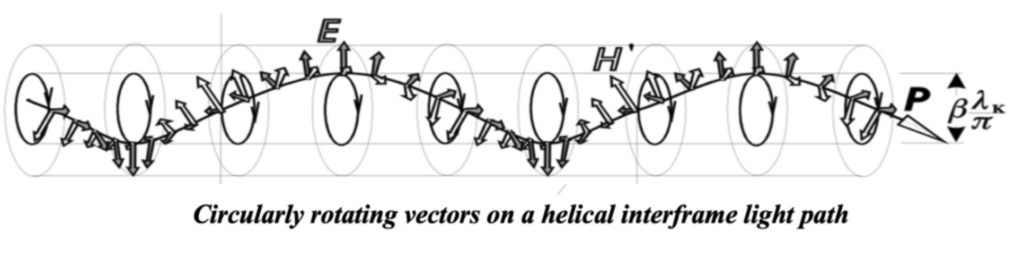
Lorentz contraction of rigid bodies and time dilation of observers’ clocks is what most laymen consider the essentials of Einstein’s Special relativity. And admittedly they were featured as essential by Einstein himself. But they are not essential; They are not factual; they represent a misinterpretation of the more relevant transaction interval that is the distance and duration of an electrodynamic energy transfer. The transaction interval is a length and duration consequence of electrodynamics, not just a mathematical artifact to solve a problem resulting from an erroneous interpretation of the Lorentz equations. The transaction interval is the length and duration of a helical path traversed at the speed of light but of greater length and longer duration. The physics of these helical light paths was described in the post on Transaction Geometry.
Of course there are reasons why the concepts of contraction and dilation were embedded in the extended dogma of the special theory. They result from forcing frame independence on the coincident detection of what are constrained to be frame independent coincident emissions. Einstein considered there to be a direct connection between two frame-independent indivisible events as a resolution to what he saw as the kinematics problem since events are located on the relatively moving objects where they occur. However, his interpretation of frame independence did not support that agreement without altering the shapes of rigid bodies and times of occurrence in one of the two uniformly moving frames of reference.
The primary difference between the observations of two observers in uniform relative motion is the extent of the difference in the transaction intervals c Dt’ and c Dt of two co-located observers. Holding the velocity of light constant, this difference of a factor of gamma must either reflect a difference in when separated events occurred or in how long it takes light to propagate between the assumed-indivisible coincident events. This perspective ambiguity of frame independence between events occurring on sources and observers illustrated in a previous post we duplicate here .
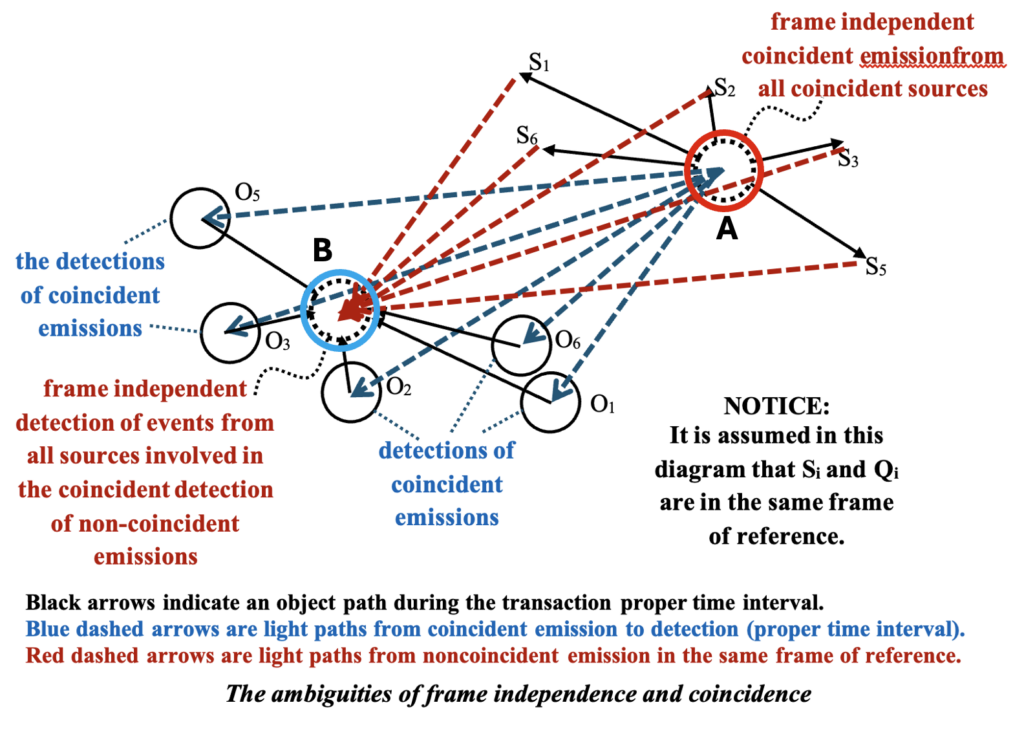
Any (and every) one of the six observers could detect the coincident emission event in which all six of the light source objects were coincident when their respective emission events occurred. But these six detections of the coincident emission from the six sources are not observed from the same perspective (angle) of their coincidence location as indicated by the blue circle. The perspective of each observer is from that of the respective black circles. The essential difference between frame independent emission and detection is that the source paths begin at emission when a connection is established for an observer. It will be detected by the observer as if he were at that position when that emission took place even though it will not actually be consumated until he is at the location at the end of his indicated path of the same duration as the light path. So sure, there is frame independence of coincident detection, but the detected coincident emission event will not be indivisible in that sense. It will be in different directions with differing amounts of red and blue shift for each observer located in the blue circle when he detects the coincident emission.
Einstein did not address this difference in perspective and light travel distance as counter to his interpretation of frame independence of both emission and detection events that he saw as implying indivisibility of the two related coincident events at both the emission and detection ends of each transaction. That interpretation of the transaction interval demanded that the observers (as defining a reference frame) account differently for the same time and distance of the differing transactions over the same path rather than acknowledging the different path lengths between the events for two relatively moving observers.
Events, whether emission or detection, occur on objects – sources and observers. When and where individual events on an object occur must be when and where that part of the object happened to be located at that instant. That is factual. It is what Einstein considered to be the kinematics problem. But as a problem, it exists exclusively with his interpretation of how coincident events are to be handled. His interpretation requires Lorentz contraction of otherwise rigid bodies and clock time dilation throughout the other observer’s reference frame rather than acknowledging that the difference applies exclusively to the individual transactions.
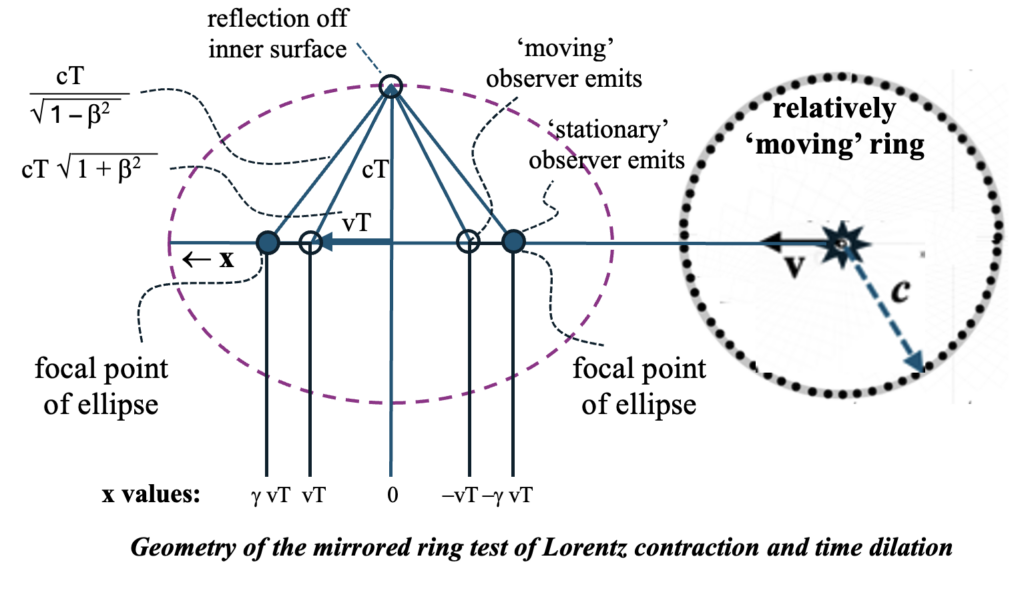
Let’s analyze the implications of his interpretation using a rigid ring in the x-y plane – a cross section of a sphere of radius R = c T. The inner side of the ring has a mirrored surface. The ring is in motion at half the speed of light and moving to the left. At the center of the ring at time zero an instantaneous burst of light is emitted by either observer (Einstein assumed it would make no difference). One emitter is situate at that location of initial emission and the other fixed at the center of the ‘moving ‘ ring. White arrows in the following diagrams indicate how far the center of the ring has traveled at each of the nine stages of progress of the thought experiment. The wavefront of the emitted light is shown with the progress of Einstein’s ‘rays of light’ in the various directions.
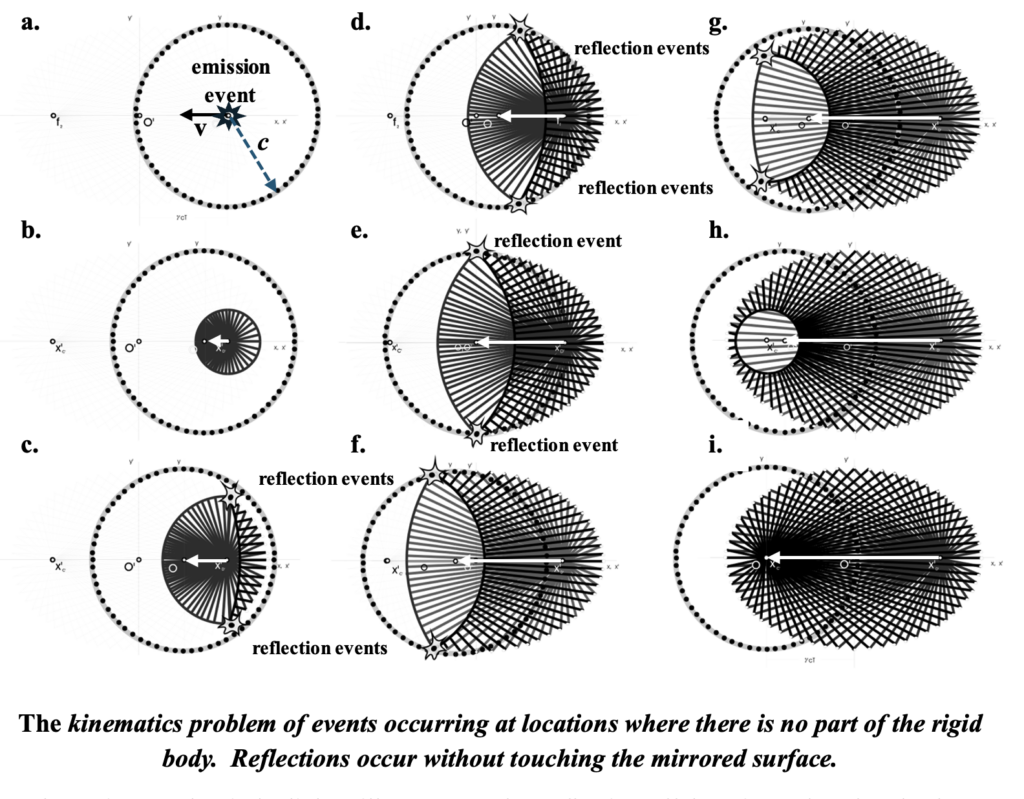
As shown in snapshot i, the light will converge after reflection off the mirrored surface back to the center of the ring and (Einstein evidently believed) to a relatively stationary detector at a coincident distance 2 v T from the original source location all at time 2 T. The convergence is to a location that Einstein believed a stationary and the moving observer would see the total convergence.
The problem – Einstein’s ‘kinematic problem’ – is that using the Lorentz equations, reflection would not occur at the inner surface of the ring at any location on the ring except directly overhead and below the center. This is shown in the diagrams – most clearly in frame c and g. That is a real problem to be solved. Right? Every light path is extended by a factor of gamma = 1 / root( 1 – (v/c)2 ). To solve this problem he assumed a moving sphere (ring in our case) would be contracted along the direction of relative motion by an inverse gamma factor of root( 1 – (v/c)2 ) and the clock time of an observer associated with the ring would be dilated by the gamma factor. And yes, that does solve his ‘kinematics problem’ as you can see in the similar thought experiment below (and as justified by Penrose in demonstrating that Lorentz contraction can never be observed.) All reflections occur at the inner surface of the contracted ring. But so what? At what cost? That is how you fudge experiments to make things fit the data. It’s not how God would have done it, to mimic Einstein’s sense of when he knew an explanation was valid – usually by it’s simplicity.
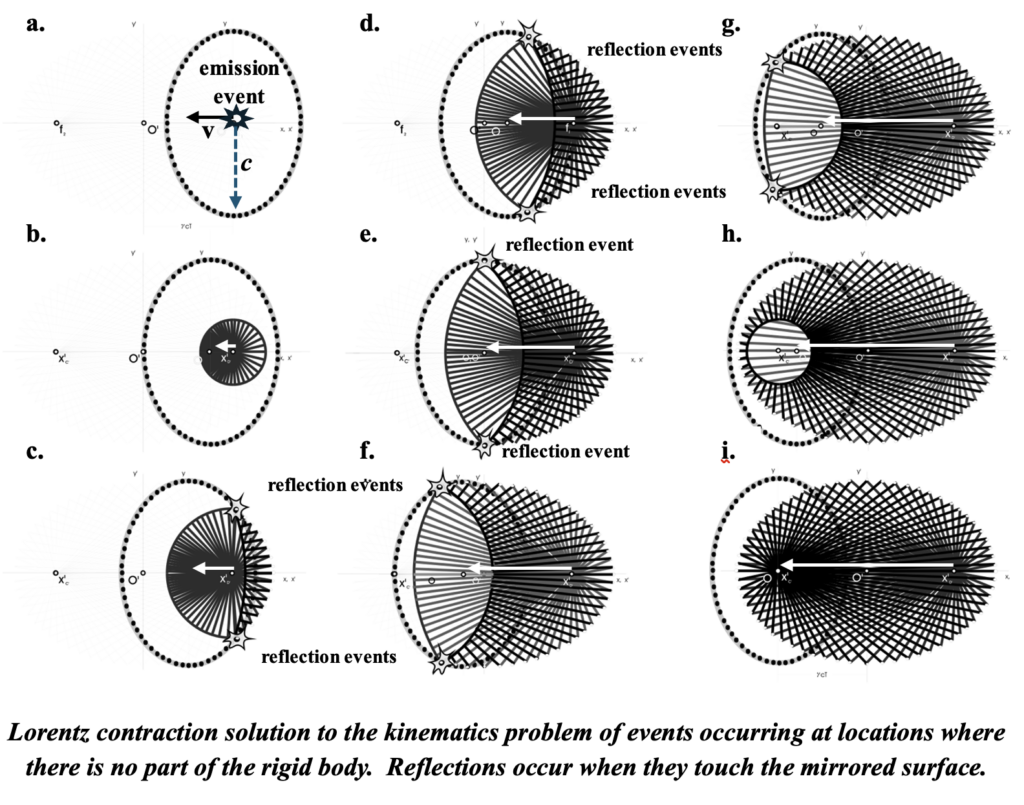
The ‘problem’ isn’t with rigid bodies or observers’ clocks it’s with lack of recognition of the nature of electrodynamic transactions. Transactions are not rays of light shot out into the ether. They are the conjoined relationships between to objects with an emission event at one end and a detection event at the other. Conservation laws require the duality. For a transaction between relatively moving objects the duration of the transaction is longer by a factor of gamma. The distance traveled by the transaction is less than the helical light path by a factor of the inverse of gamma. Those are the realities. Refer to the helical light path diagram above.
In the ring thought experiment, there is a real difference in which observer emits the light. If it is emitted from a frame of reference including a rigid association of the center of the ring, there is no relative movement between the emission and the detector (reflector) on the inner surface of the ring or on the reverse transaction back to the center of the ring. So the combined transaction time duration is 2 T, and the center of the ring will have traveled 2 vT. However, the coincidence of the center of the ring with a ‘stationary’ emitter when it emits a burst of light poses a different situation. Emission and reflection in this case will occur on a relatively moving object as well as in the reversed transaction direction. So the gamma factor applies to the transaction between the ‘stationary’ observer and the ‘moving’ mirrored surface and also on the return trip. In both cases reflections occur at the inner surface of the ‘circular’ ring and there is no kinematic problem and there is no clock problem – just different distances and durations.
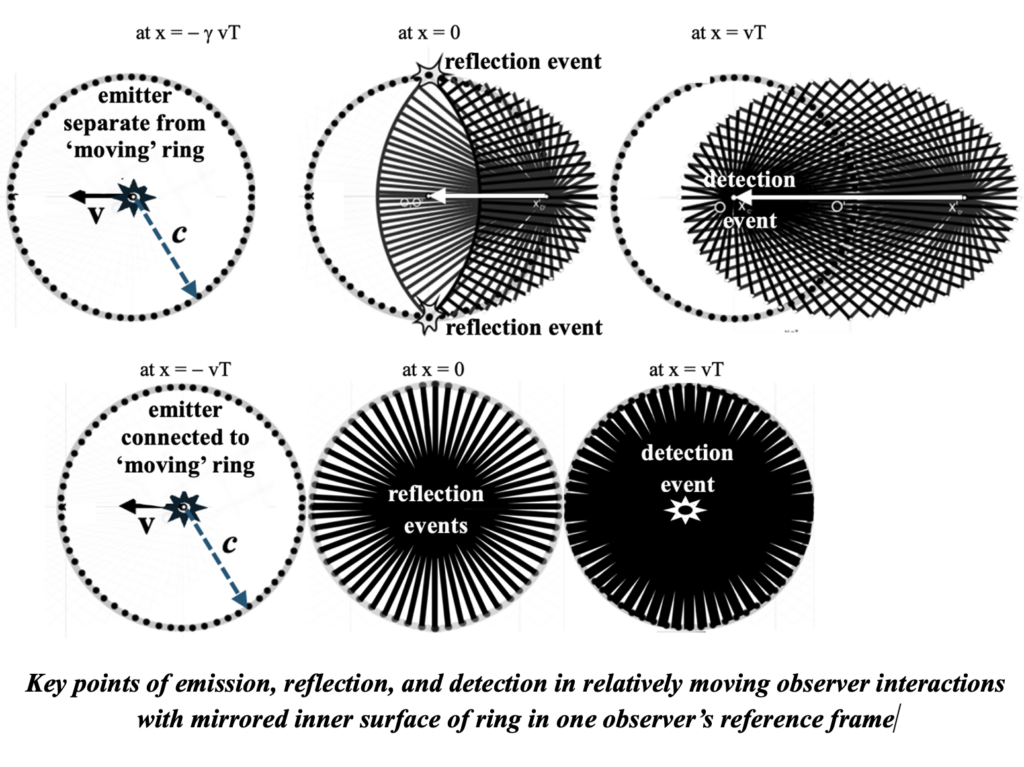
The implications should be obvious: a difference of interpretation that doesn’t require an unrelated fudge factor.
Leave a Reply