‘What’ and’ how’ are scientific questions. We ask why because what and how are never enough to satisfy our curiosity. Why is thus presumed to be the useless subjective aspect of knowledge.
Christians who accept a literal interpretation of their scriptures believe that Jesus died on a cross to atone for their sins. Their scripture states quite simply ‘what’ supposedly happened and ‘how’ it frees them from the guilt of their sins. Skeptics would ask, “Why?” The answer is provided in the same scriptures: “God so loved the world that he gave his only begotten son that whosoever believeth on him should have everlasting life,” or words to that effect. It’s all neatly tied up with a bow on top. Of course, beneath the bow of Pandora’s box is the nagging question, “Why do I deserve eternal damnation beyond the river Styx.
Science doesn’t work that way. In fact it is fashionable to state that not only are we incapable of understanding why things are the way they are, but they are inherently incomprehensible, that it is beyond the human brain to understand them. And for some reason religiously inclined people seem to take comfort in such statements. I don’t. The tree of the knowledge of good and evil, whether scriptural or scientific, is heavy with ripe fruit for the taking. Those juicy pods are the ‘whys’ for which we are cautioned not to seek answers.
There are different conceptions of scientific explanation that have evolved over time as scientific theories took on different forms:
- Classical realism: Reality is ‘out there’ and science will eventually uncover it.
- Positivism: We can’t know what is ‘real’, only its effects on what we observe.
- Logical positivism: Reality is known only through what can be measured.
- Instrumentalism: Measurement procedures and calculations ‘are’ observable reality.
- Scientific realism: Scientific theories approximate reality.
- Paradigm philosophy: Sociology of science assigns what we consider to be reality.
- Structural realism: Science discovers only relationships and logical structures of reality.
- Information interpretation: Reality is secondary to correlations of measurement.
Each of those was fashionable for a time but I would say only in the same sense that mini and maxi skirts have been in vogue from time to time. And just as a woman may look more beautiful in one outfit than another, just so, these views tend to match certain scientific personalities. But none of them address why whatever it is they presume to describe is the way it is. They assert only that that is, in fact, the way it is. I find it very unsatisfying.
Voltaire addressed this issue in ‘Candide’ by having his Professor Pangloss propound, ‘We live in the best of all possible worlds.” He uses ‘world’ in the sense that we would refer to ‘universe’ or ‘reality’. It’s Voltaire’s sarcasm at its finest, right up there with, “If god did not exist, we would have to invent him.” However ridiculous it may sound, I stand, scientifically, with the professor. But I would change “best” to “only”. “We live in the only logically possible universe.”
That is the “why?” that I see behind every scientific explanation. It gets back to Occam’s razor, Einstein’s “God would have done it that way,” and Penrose’s picture in his book ‘The Emperor’s New Mind’ that describes the limitations of God’s possible creations to a mere one in
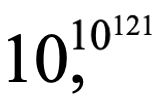
a number so tiny that it would have more zeros trailing the decimal point before a digit than can be described in words.
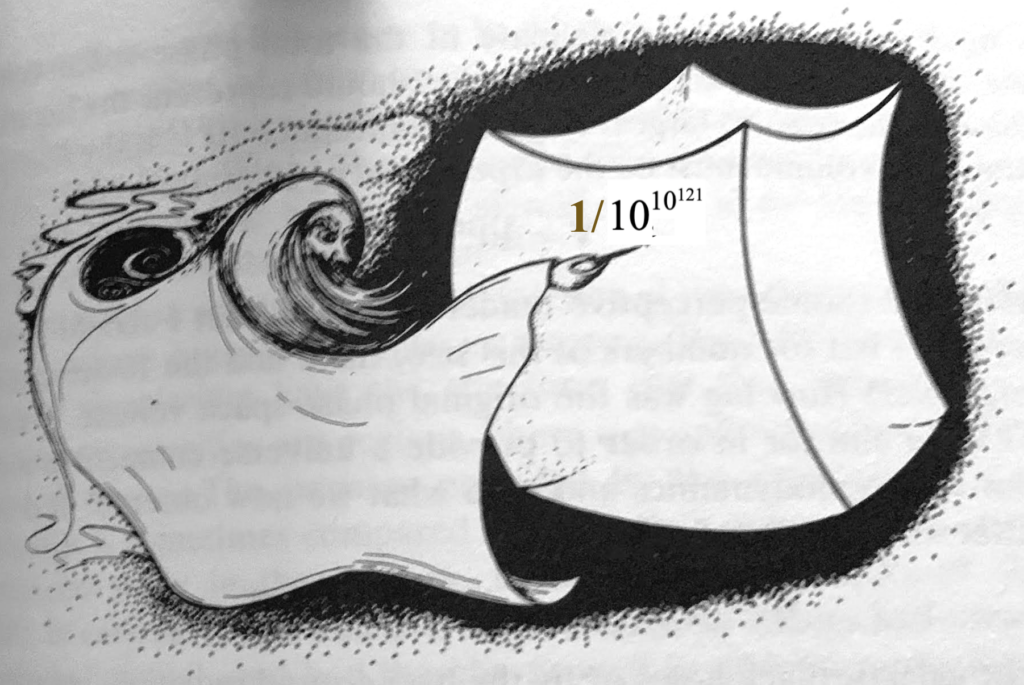
The limitation is inconceivably small; it encapsulates restrictions on all the atomic and subatomic particle interaction possibilities, thermodynamic and thermonuclear. And if God had done it a mere 6,000 years ago there would have been all the photons to set in motion six thousand light years away to simulate their having come from billions of light years further away, which is the observable aspect of our reality. But the ‘what’ and ‘how’ we observe of our universe wouldn’t work without the nitpicking precision. The scale of this task dwarfs the effort of the atonement miracle intended to play out on that stage.
But it has to be simpler than that. There has to be a logical framework that enforces and restricts the range and magnitude of influence of one aspect of reality upon other. Given some minimum set of realities, then everything that can happen must certainly happen given enough time. It is a scientific endeavor to determine the logical framework of those unique aspects of reality without which there would be nothing at all. But why are there unique aspects to reality? Can it be that it is a logical consequence of there being anything at all – that given an energy density, it will partition itself into those compatible aspects?
Leave a Reply