(a continuation from Fun and Games in Washington DC)
Well, after the minor interruption of touring the Smithsonian museums, we were back on our schedule. We ‘did’ the Bureau of Standards at nearby Gaithersburg, Maryland on this trip, but they were dismissive – like what in the hell would we do with a transition machine? It’s been nearly fifty years, so I don’t recall exactly, but I think whenever it was, the undersecretary of whatever cabinet position that met us with regard to DARPA’s possible interest in transition machines, listened to our pitch politely but was so enthused about a star wars related fantasy they were entertaining and what they considered ‘massively parallel’ was out of our league. I wasn’t comfortable, partly because I didn’t know exactly who we were talking to, whether it was ‘just’ the head of DARPA or if Perry had hooked us up with the Under Secretary of Defense to whom DARPA reports. Was he to be addressed as The Honorable whatever or just by his name? Of course for Perry, everyone was just a chum. Anyway, he showed us stuff like the big dinosaur-ish looking mechanical beasts in the movie and how it related to massive parallel processing from his perspective. I thought he was a bit naïve, but…
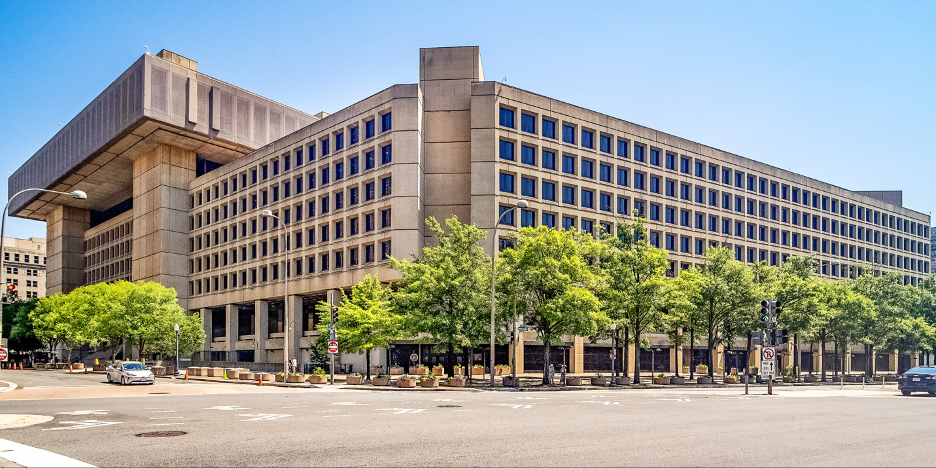
Then it was to the FBI Headquarters quartered in the J. Edgar Hoover building situated on Pennsylvania Avenue. I don’t remember who we talked to, partly because I didn’t do much of the talking. Perry explained why he and I were in Washington peddling our product and I don’t even recall whether I gave my pitch and if I did, it wasn’t very long before Perry and whoever it was (I think it must have been Director William Webster, who was manning up the under positions at the time) excused themselves and disappeared into another room. I sat there for what seemed to be a long time so that I started to get the idea that maybe I was just along on this trip as a diversion – an excuse for Perry to talk to people in the administration with whom Perry was interviewing for a position.
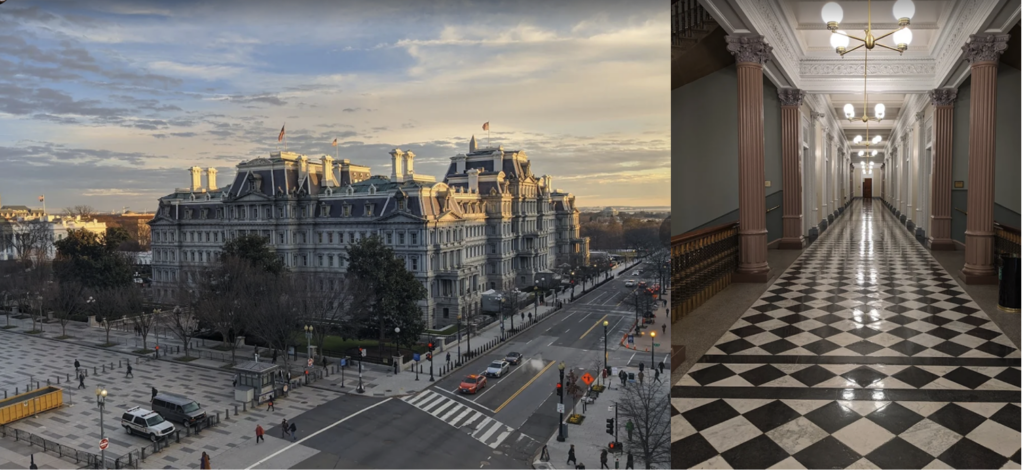
My suspicions seemed to be confirmed when he said, “What do you think? I think we’ll stop by the White House.” What he meant (of course?) was the Eisenhower Executive Office Building adjacent to the White House also on Pennsylvania Avenue. Well, Perry got us in there and met someone he seemed to know who would take him to whoever was more important that Perry was to talk to. Again, I was shown a seat off of a long hallway with an opportunity to rest for a while, no pitch required. Back to the realization of my minor role in life.
Perry seemed to be happy with the ‘success’ of our trip despite not having drummed up any new business.
Perry continued to be supportive of transition machine futures, but it was definitely on his back burner from then on, I think. I reported back to tech staff with Mark and I continuing to do quite a bit of traveling in the pursuit of follow-on research funding but now escorted by Tom Nicolino. We had some good times, but we were aware that we were not going to be the next IBM.
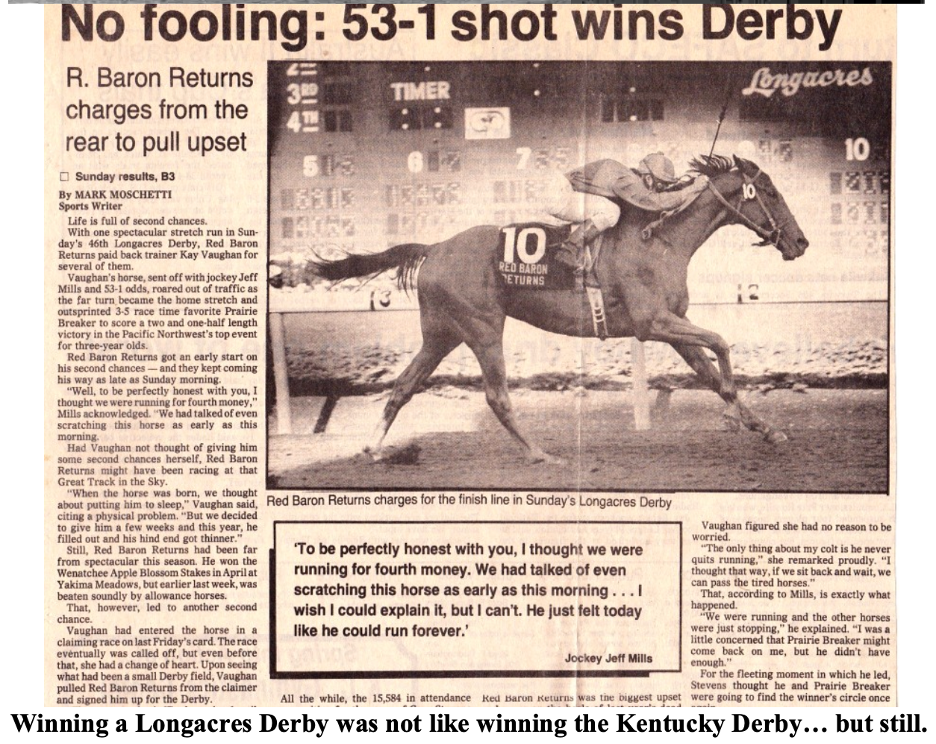
When the Red Baron Returns won the Grade II Longacres Derby, I was out of there. Tentative, as always, I applied for a six-month leave of absence. That after six months lapsed to permanent.
I presented one more paper on the fault tolerant aspects of the transition machine at a conference held in Seattle during my absence from the Boeing company. And Perry had me present the T machine to outside financial interests later. But it was over. Several years later I went out to lunch with Perry, and he helped me hire back into the company, again in tech staff. They had a funded project they called Overlord which they claimed was based on transition machines, but it wasn’t. It was based on all processes on a single bus that severely limited any parallel aspects. But it didn’t matter. I had purposed that I would never get involved with transition machines again. It had been at too extreme of human relations trauma. I was not interested in another war.
But I guess I had become a sort of cult hero, the Che Guevara or Cool Hand Luke of the tech staff. Art Perkins greeted me like a hero. He was actually excited to meet me and told me he had inherited my file cabinet with all the reports, pitches, documents, patents, and disclosures we had reviewed. He offered it back to me, but no. I did not want to even look through it. He was inventing a little different concept of parallel processor based somewhat along the lines of emission-absorption of signals of readiness for processing assignment. I was happy for him and liked hearing about what he was doing, but I was just finishing out my career so I could get the hell out of there with a retirement.
Boeing Commercial subcontracted to Boeing Aerospace to do the cabin electronics on the Boeing 777 jetliner to which project I was assigned. We used transition machine software structures to implement the up to 1500 computers in the various sized cabins to control lights, temperature, requests, etc. We called them ‘behavior specs’ written in English and converted by a compiler into tables used by a small emulator in each machine. I was then assigned to the B-2 bomber upgrade to redo all the software, which was again done with behavior specs, ala the transition machine.
I retired then and I don’t think I made too many enemies on my last tour of duty.
I was an engineer for 32 years. I have been retired for 29 years now; a very happy 29 without conflict. I still go to work every day like the old horse standing out in the pasture in front of the old rusty plow. I do physics like I would have enjoyed doing all 61 years. I’ve enjoyed my retirement and investigating the nature of thngs.
And that, as they say, is that.
Leave a Reply