The vertical transaction perspective between emission and detection rather than the horizontal perspective between observers clarifies the effects of relativity. Detection is an event, no less than, emission, and it is the interplay between these two types of events that is the epitome of relativity. Specific times kept by observers’ clocks and specific positions in space of emission events is irrelevant. It is the relative time and distance intervals between them that are affected by the relative motion of observers.
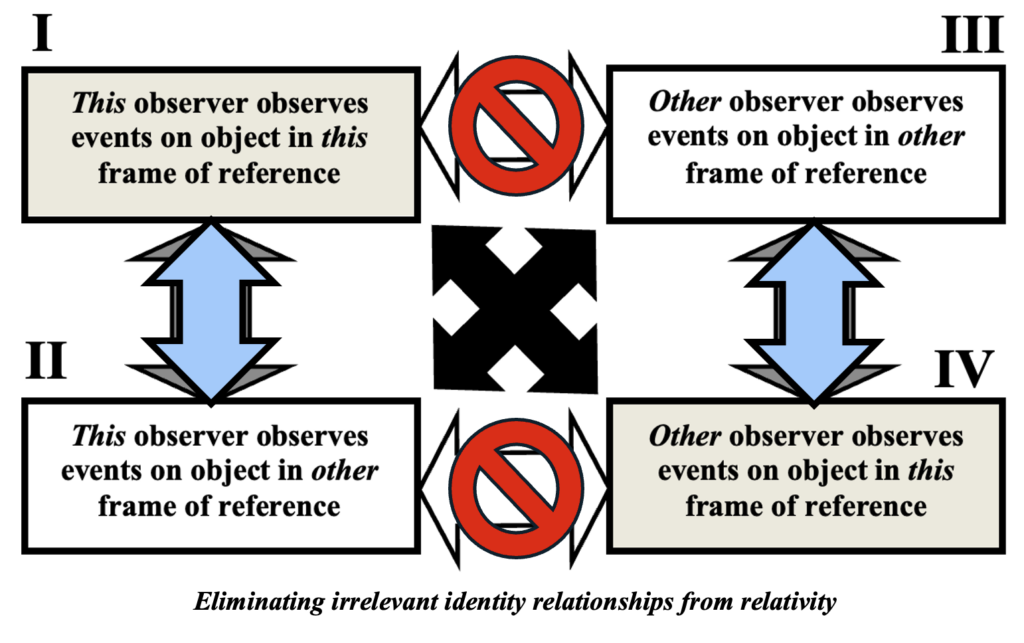
We must insist on getting rid of the nomenclature of an ‘observer’ who detects just as originally, we got away from speaking of the ‘source’ that ‘emits’. We are aware that observers and sources are objects that exist and can be said to move along world lines in a spacetime we can construct that is unique to each. The uniqueness is addressed as their respective ‘reference frames’. That is the transaction geometry of relativity. The top and bottom boxes in the diagram above should read:
I and III: “Light emitted in one frame of reference is detected the same frame of reference.”
II and IV: “Light emitted in the other frame of reference is detected in this frame of reference.”
Those are the only meaningful distinctions in the context of relative motion. To assume a list of differences between observers based on another non-interacting observer in motion relative to him is illogical and inconsistent. The observed differences are in the transactions between them. Next we will explain the sense in which Lorentz contraction of rigid bodies and time dilation of observer clocks rather than transaction interval extension have embedded themselves into the extended dogma of relativity.
Frame independence is a touchstone of relativity that distinguishes the localizability of emission or detection events from the variability of the associated dynamics of the objects on (actually the reference frames in) which the events occur. It has been primarily applied to the light emission events rather than associated detection. We will consider it in both contexts; the latter involved a sort of unwritten ‘mutual observability’ contention. To understand its full ramifications we need to understand how concepts of simultaneity and coincidence are defined and handled in relativity.
Simultaneity of multiple emission events that occur in one frame of reference is not a property that will apply in a relatively moving frame of reference. Simultaneous or not, whether emission events can be detected simultaneously depends on the distance between the respective emission events and the detector in the detector’s frame of reference.
Coincidence of multiple emission events implies simultaneity and co-location in any, and all, detector frames of reference. That does not imply that detection of the coincidence will occur when the detectors in different frames of reference are in coincidence. In fact, coincidence of multiple detection events does not imply that coincident emission events will be detected as coincident it only means that they are ‘detecting’ when in coincidence, not what they are detecting at that instant. Coincidence does not apply at both ends of an interaction when the source and observer are in relative motion.
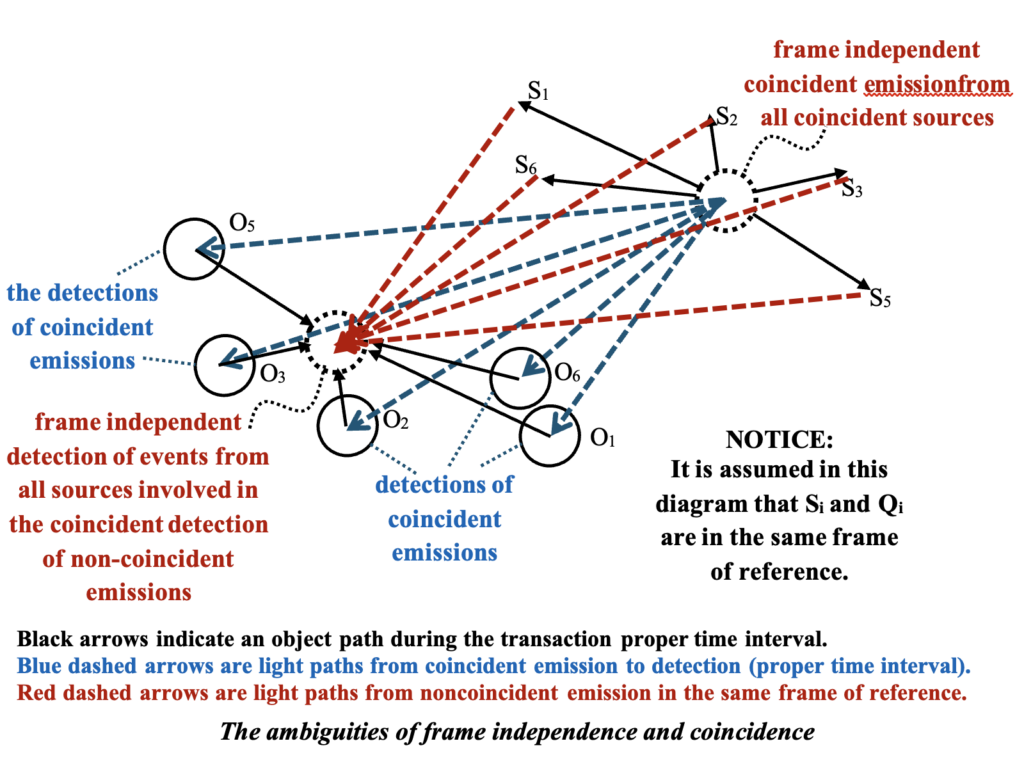
To colloquialize with regard to frame independence of emission events, if an event occurs at a given location and time in my frame of reference, I will see it right there. It doesn’t matter how fast or in what direction the source of that light emission event was headed. If the emission event occurred when the source passed that location, that’s where I will see it
To colloquialize with regard to frame independence of detection events, if events are detected at a given location and time in multiple frames of reference, coincident emission would only be detected by the one in whose frame of reference to location is specified. Events from each of the sources that were coincident can be detected by any coincident detector, but not the specific events that occurred at coincidence.
Considerations of frame independence will play a major role in forward scattering in a plasma.
Leave a Reply