If one were to consider all evidence for the supposed time dilation, it would fall into a general category of alterations in rates associated with spontaneous state transitions between energy levels in matter. It has been dramatically demonstrated by radioactive decay phenomena where half-lives of basic particles are substantially altered when their relative motions are increased with respect to the laboratory in precise agreement with Einstein’s formula.1 If the half-life of the particle type were assumed to be a standard unit of clock time, a legitimate conclusion would seem to be that time is indeed dilated in such cases. The same basic numerical agreement is obtained with atomic clocks, like the cesium clocks cited by Will,2 which involve an atomic resonance between energy levels as a standard unit of time.
It has been argued elsewhere, however, that clocks (and measuring rods) of relatively moving observers need not (and could in fact only inconsistently) be culpable in the case of there being unique values of time and space measurements obtained by uniformly moving observers within their own frames that are related by the Lorentz transformation. So, if that skeptical position were to hold true as the author believes, why do timed state transitions with well-defined half-lives and resonances exhibit increases in the value of this ‘standard unit of time’ parameter exactly as would be predicted if time dilation as a function of relative velocity were the correct interpretation of the temporal Lorentz Transformation equations? In other words, in the face of such convincing data that seem to confirm Einstein’s time dilation formula, how could one rationally still maintain that there is no such thing?
1 Schwinger, pp. 55-58.
2 Will, pp. 54-57.
To begin this discussion, let us consider how handy it is that the most basic building blocks of nature should carry clocks by which we can verify the interpretations of our theories – or do they? Whatever the nature of these “clocks,” they were most certainly not designed specifically to check our theories, so we must investigate the degree to which the temporal quantities produced agree with the specified characteristics of clocks defined in special relativity. In other words, to what extent do measured decay rate data represent standard time units generated by an ideal clock? This will obviously involve the issue of what constitutes such an ideal clock. Let us consider this.
Invariance of the measured time interval duration of a periodic mechanism is key. Precise periodicity is exhibited on earth by gravitational pendulums, astronomically by Keplerian motions and statistically at microscopic levels of reality by ensembles of radioactively decaying particles and resonating atoms. Of systems that have been used as clocks, the measured time intervals associated with resonance frequencies of atoms exhibit the highest degree of invariance. On the other hand, radioactive particles are the easiest to accelerate to extreme velocities and so they have typically been the clocks selected for relativistic experimentation.
When such radioactive particles are moving at a constant velocity (as in a collimated beam) relative to laboratory apparatus, the distribution of the distances traveled prior to decay provides an accurate assessment of their half-lives. Half-life may be determined as, T(v) = < d > / v, where T(v) is the half-life of a particle traveling at the velocity v, < d > is the average distance traveled a by the particle before decay. Notice that this is merely an empirical formula for measuring half-life, not a theoretical parametrical derivation for determining it a priori. T is not a function of distance.
In the case of the pendulum and Keplerian motion we have some understanding of the mechanisms or ‘workings’ of the clocks so that a theoretical a priori prediction can be obtained for sizes of time intervals between successive cycles as functions of parameters pertinent to the construction of the clock. For example, to a high order approximation, the differences in the cycle time of a pendulum on the moon and an identical version on earth would not be attributable to differences in the scale of time on the moon based on its velocity around the earth or of the earth’s velocity around the sun. This is because the difference can be traced directly to a parametrical difference between the descriptions of the two clocks, namely the ratio of the mass of the moon relative to that of the earth that determines the force pulling the pendulum back to its null position.
In the case of atomic and subatomic clocks, therefore, before we can attribute measurable differences to one cause or another, we must know something concerning the mechanism of radioactive decay. One could not otherwise discriminate between the half-life of radioactive particles being altered by a time scale difference affected by the relative motion as predicted by Einstein or by the decay process proceeding differently after a particle has been accelerated. It has of course been demonstrated to depend on relative velocity in accordance with the peculiar functionality of the time dilation formula. However, that might either be an indication of direct functionality through parameters of operation such as energy content that is reflected as velocity or, as typically accepted, the presumed change in the scale of time itself. For example, if it were to be conjectured that time proceeds more slowly on the moon in accordance with the ratio of the masses of the earth and moon, the results of the pendulum experiment would make the absurd hypothesis somewhat difficult to disprove just because data would seem to confirm it. One would be forced to demonstrate that the peculiar functionality of a pendulum, and not the nature of time itself, has determined that behavior. So we are forced to attempt an understanding of the possible mechanism of particle decay, acknowledging nonetheless that such a mechanism has not currently been fully specified so we are at somewhat of a disadvantage.
However quantum mechanics is based on experimental evidence of phenomena that fall into the category of energy dependent state transitions. We discussed that in a previous post. There is a large body of data and an accepted theory that confirm that the likelihood of a system transitioning to a “lower” energy state is directly dependent on the difference in energy between the states. This is true also of the types of particles whose decay is assumed pertinent to time dilation measurements – mu mesons in particular. For example, Jackson3 states that:
“Since the rate of decay depends sensitively on the energy release, [difference between energy levels]…tightly bound negative mu mesons exhibit a considerably slower rate of decay than unbound ones…”
3 Jackson, p. 358.
So muons decay more slowly in situations that do not involve high energy, i.e., those in the upper atmosphere are have not experienceing the grater gravitational potential once they reach sea level.
Now, it can be shown as a direct consequence of the Lorentz transformation (without having to assume scale differences in the units of measure) that the mass of a particle moving at the velocity, v, relative to the observer increases with respect to its rest mass, m(0). This increase is given by the formula, m(v) = gamma m(0). By the well-known related formula, the total energy of a particle is shown to be, E(v) = m(v) c^2, where E(v) and m(v) indicate, respectively, the energy and mass of the particle when it is moving at the velocity v relative to the observer. So that in general we have the relation between the energy of a relatively stationary and moving particle as follows:
E(v) = gamma E(0) , where the Greek gamma is:
gamma = 1 / SQRT( 1 – v2 / c2).
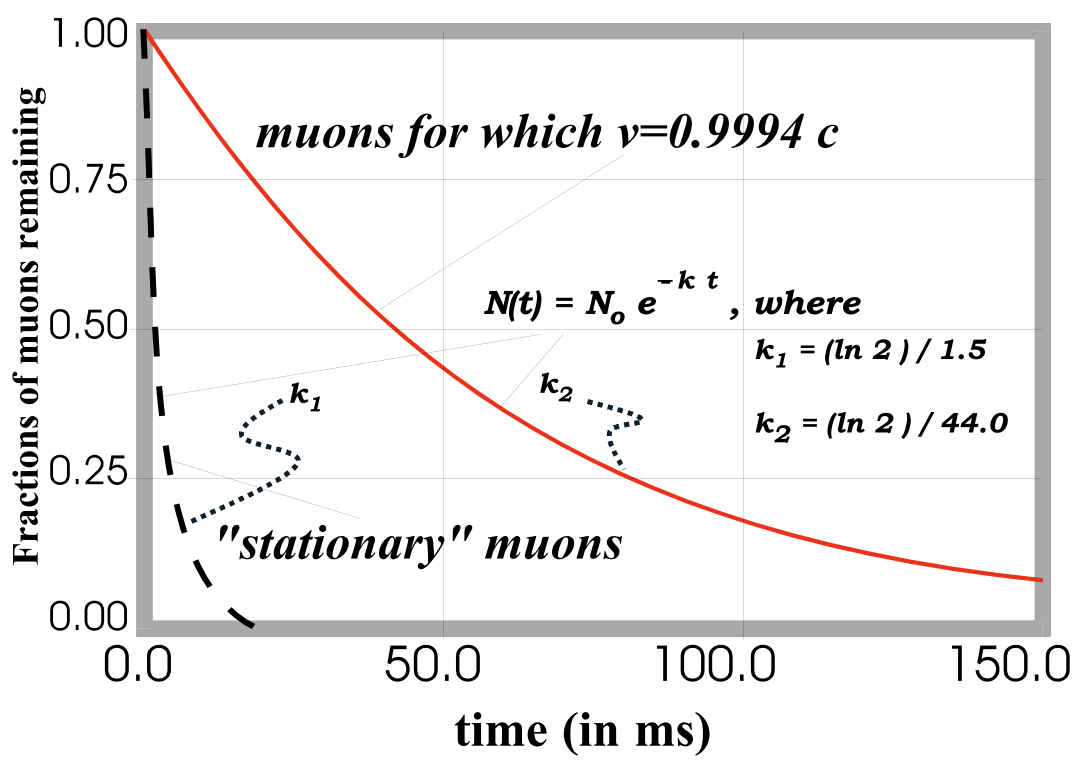
Radioactive decay formulas are characterized by exponentially decreasing quantities as explicit functions of time: They have the form:
N(t) = N(0) exp(-k t)
where N(t) is the number of particles which have not decayed after a time, t, if there were N(0) particles originally. If k is large, decay is rapid. Since the half-life, T_h, of the particles can be determined by measuring the amount of time required to reduce N(t) to one half its original value:
N(T_h) / N(0) = 1/2
So that:
k = ln 2 / T_h
This is merely an empirical formula, of course, for fitting the exponential decay formula to the actual decay distribution data. But, the parameter k is potentially derivable from quantum mechanical considerations like those used by Gamow, Condon and Gurney for deriving alpha particle emission rates in radioactive elements in 1928 that were in excellent agreement with the empirical data.4 Decay rate data is highly dependent on the binding energy as indicated in Jackson’s comment above where the higher the energy the less likely is decay. Let us posit in particular, therefore, a relation k ~ 1/E. Then we obtain:
T_h ~ E(0) ln 2
Thus, we should expect T(v) ~ E(v) ln 2, for a moving particle, from which it follows that:
T_h = T(v) / gamma = T(v) SQRT( 1 – v2 / c2).
This might appear to be in complete agreement with Einstein’s prediction since the half-life for a stationary particle is predicted to be less than that for a moving particle in precisely the right proportion, but it most certainly is not in agreement with that hypothesis! In this case, we have predicted that from all perspectives the particles will decay more slowly. We have not attempted to take into account that the rate of ticking of some abstract clock, supposedly residing in the particle might, in some obscure sense, have ticked off T_h seconds while laboratory clocks were ticking off T(v). In fact, it has been demonstrated to be precisely like the analogy of placing a pendulum on the moon. The difference in the generated interval of the mechanism has already been determined as a consequence of the functionality of the decay of matter from one energy state to another. Like in the analogy, an observer whether on the moon or on earth, on the accelerated particle or in the laboratory, would measure decay to have occurred after the same time interval according to its clock because *it* is at a higher energy with the result that it will decay faster. If we were to additionally take into account the supposition that the scale of time is affected as suggested by Einstein’s interpretation of the Lorentz equations, and virtually every physicist with any credentials on this subject, we would obtain:
T_h = T(v) / gamma2 = T(v) ( 1 – v2/ c2 ), with no square root.
The additional factor of gamma completely contradicts the hypothesis of the time dilation formula as dependent on velocity per se and is refuted, rather than confirmed, by the experimental data.
4 Eisberg, pp. 238-239.
So the meaning of the temporal Lorentz transformation equation cannot be that the scales of clocks must be transformed so as to compensate any observed differences. The time intervals taken by light between corresponding events related by the Lorentz transformation must actually differ according to that equation without the asymmetric caveat, “It’s actually the same amount of time, but his clock is dilated.” The nature of that correspondence between a transformed event and the observer now becomes the key issue of any viable theory of relativity since events that are being correlated by the Lorentz equation cannot be identical without introducing inconsistency. This is what the earlier posts on Transaction Geometry were all about. The meaningful interpretations of length contractions and time dilations pertain to the helical paths that light is forced to take between relatively moving frames of reference. And these helical paths are a physical consequence of relativistic aberration of the transverse electromagnetic fields of radiation and not some mathematical twist without a physical basis.
A full explanation of why the two sets of events correlate as they do was illusive prior to recognizing the helical route light is forced to take due to aberration of electromagnetic fields. But one should not have needed an alternative in order to reject inconsistent logic. That is the role of intelligence. It would have been, perhaps, a legitimate role of faith to allow even scientists to have survive periods without answers.
Bibliography:
1. Robert Eisberg, Fundamentals of Modern Physics, John Wiley & Sons, 1961.
2. John Jackson, Classical Electrodynamics, John Wiley & Sons, 1962.
3. Julian Schwinger, Einstein’s Legacy – The Unity of Space and Time, Scientific American Books, Inc., 1986. 58.
4. Clifford Will, Was Einstein Right? Putting General Relativity to the Test, Basic Books, Inc., 1986.
Leave a Reply