As we have found out, a little glitch in our analyses has revealed the need to address gravity as the resolution of the charge overlap issue. Fundamental particles possess not only electric charge, but also mass. The fact that the associated gravitational force is some forty orders of magnitude smaller than the corresponding electric force has made it easy to ignore in the context of interacting quarks. But without gravity there would be no fundamental particle distributions of charge because they would fragment into smaller and smaller distributions of the same form and net charge but lower net energy – mass. And given enough energy, multiple distribution could be driven to overlay until at complete overlap, a new single particle would be formed with N times the electric charge and N2 times as much mass. Addressing only the electrostatic issue results in the alternatives shown in the figure below.
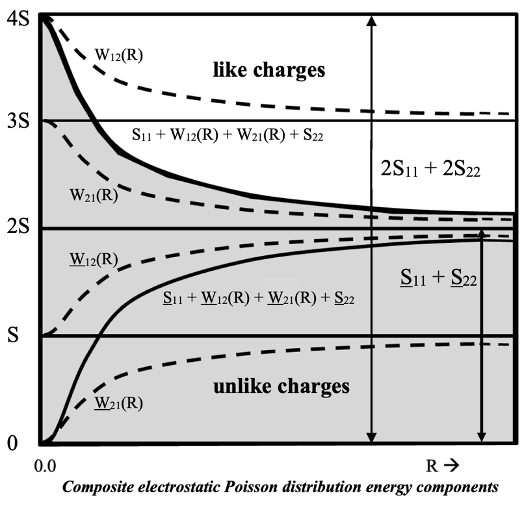
The resolution of this fragmentation problem is gravity with its similarities and differences from electric force. ‘Charge’ as the instigator of force must include a gravitational charge that has the same sign as the electric charge albeit imaginary.
Q(r) = q(r) ± i root(G) m(r),
where the sign of the imaginary part must be the same as the sign of the electric charge. And,
m(r) = q(r)2 / 2 a
The normal force as a gradient of the potential and other associated formulas apply, with complex conjugation now required for expressions involving products of complex quantities.
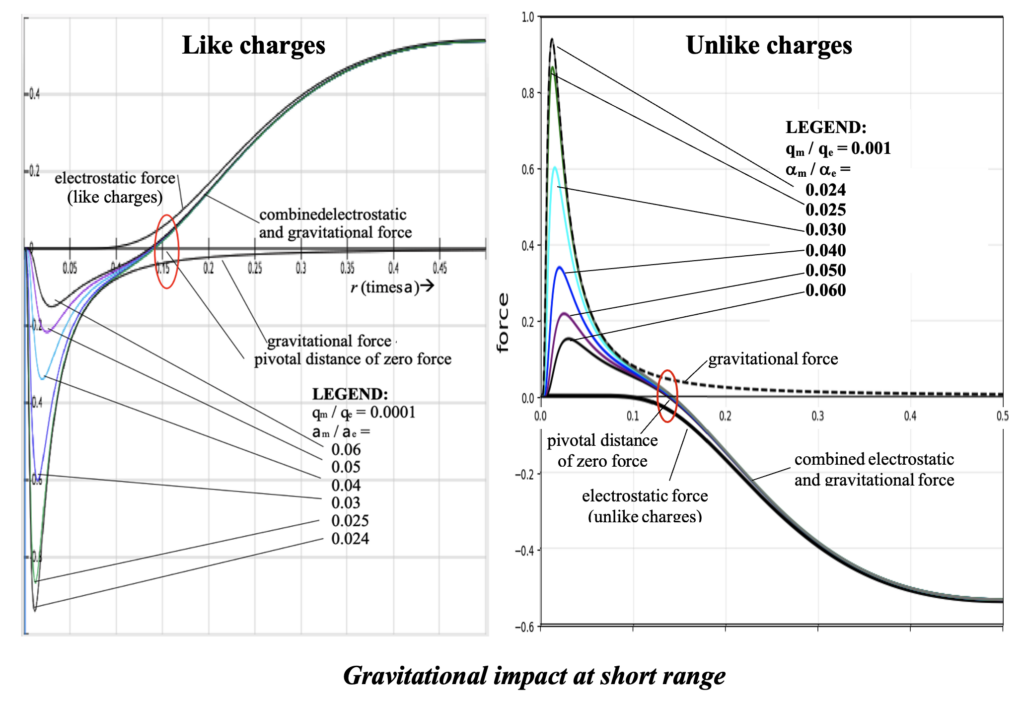
This provides gravitational attraction for like signed charge as well as net neutral objects as we will see below. But interestingly there is gravitational repulsion for unlike signs, although in such cases the objects are attracted much more forcibly by their opposite electric charges at all appreciable distances of separation. A positive (however small) gravitational push is something new. Its nature and profound effects need to be understood. It does not alter mundane physics but at the quark level it has the profound effect of avoiding complete collapse of unlike charges. It is an aspect that one suspects has never been addressed. For like charges it provides the Lego-like snapping into place that prohibits a fragmentation of fundamental particles and enables the creation of N2 more massive new indivisible particles. It is this effect on unlike charges that, however long it has been ignored, is now obvious.
The first attached chart (below) that I drew long ago addresses only the close range gravitational effect that accompanies the electrostatic aspect of converging particle distributions that locks then into place. This chart includes the gravitational force similar to the traditionally defined inverse square law but solved with the additional Poisson boundary condition. But my previous effort did not address the inclusion of alternative sign on the imaginary part. So that chart only applies to electric charges of like sign. The chart at right is virtually the same, but inverted – instead of the Mariana Trench near zero, we have a Mount Everest wall as opposite signed charges approach zero separation.
Thus there is either an abyss or a huge barrier as two fundamental particles approach each other.
Differences in Interactions of Like and Unlike Charge Distributions
An indivisible particle such as an up or down quarks possesses both an electric charge and a rest mass. The latter acts as gravitational ‘charge’ as follows:

The product of these complex ‘charges’ as in force fields requires complex conjugation, so that like charge interactions respond differently than unlike charge interactions when the separation of their centers vanishes. Like charges adhere very strongly, whereas unlike charges even though they attract strongly at a distance will reject complete overlapping.
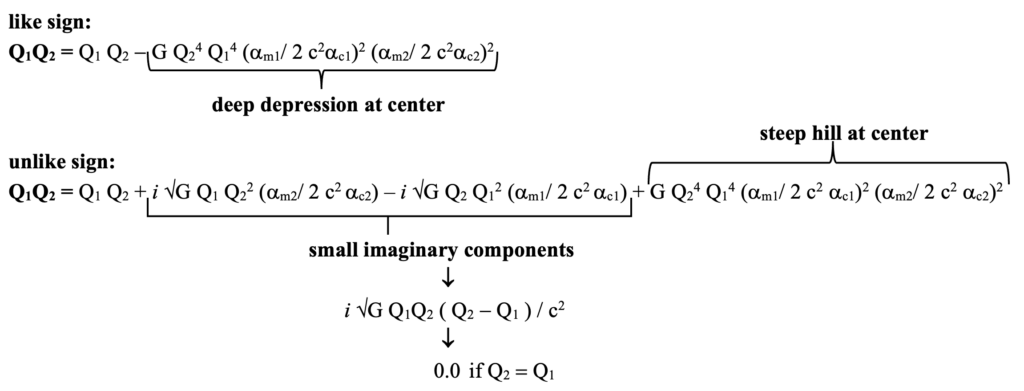
Because:

For less than complete overlap, one must replace Qk with Qk e-alpha_k / R.
A neutral hydrogen atom will experience gravitation as each proton and electron gravitate toward the other atom as follows:
[ ( e + i mp ) + ( – e – i me ) ] * [ ( e + i mp ) + ( – e – i me ) ] = ( mp + me )2
This development will contribute to the effort of filling out the table we presented earlier.
Leave a Reply