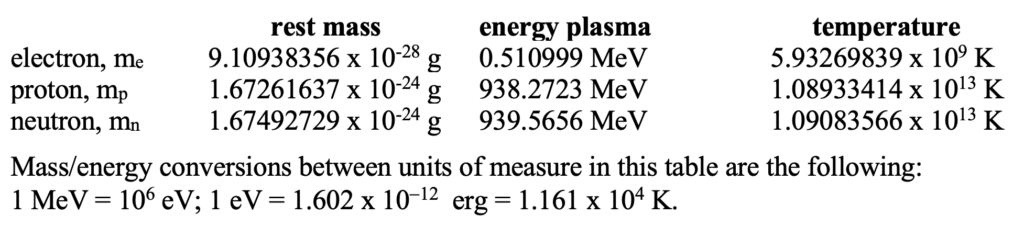
Here are subatomic particle masses that are known accurately. These are the values we will use in our analyses for assigning up and down quark properties:
In our last post a demonstration of the complete super-positioning of Poisson distributions of identical charge. If N such distributions are forced into complete overlap, the result is a unique distribution with the same radial scale but with N2 as much mass. It requires extreme force to bring like charge distributions to converge, but in quark interactions we encounter, there are such binding forces. In the transition from neutral structures there are rearrangement forces that result in creation of a proton from two up and a down quark, but also in conjoining three down quarks.
When three down quarks are concentrically superimposed as we have conjectured as the electron decomposition, the result is a single unified distribution that is locked in with nine times the self-energy of a single down quark. In the case of the electron with N=3, instead of what we would otherwise posit as md = ⅓ me, we assign the following mass to a down quark:
me = 9.10938356 x 10⁻²⁸ g = 32 md = 9 md , so that
md = 1.012154 x 10⁻²⁸ g.
With the mass of the down quark in place, we compute a mass estimate mpu of the up quark based on the proton mass data using the formula:
mu = ½ ( mp – md – Ep )
By assuming the (negative) binding energy Ep between the up and down quarks is small relative to their rest masses, we obtain a lower bound estimate of the mass of the up quark:
mu » 8.362575773 x 10⁻²⁵ g
When we plug this estimate into traditionally assumed quark structure of the neutron, we obtain:
mnT = mu + 2 md – En » 8.365 x 10⁻²⁵ g
This is very nearly half of the accepted mass of the neutron, which suggested the possibility of a tandem of the traditionally conceived quark structure of d-u-d has traditionally been assumed for the neutron. We have proceeded with the tandem to octahedral neutron in our analyses.
These lower bound estimates of quark masses will need to be adjusted based on the extent of the overlap of the down quarks in the electron and in the octahedral neutron pre-transmutation state and up quarks in the proton. We initially go with:
md = 1.012 x 10⁻²⁸ g.
mu = 8.363 x 10⁻²⁵ g
The determination of a mass of the down quark was a direct calculation firmly based on the field theoretic bound energy calculation assuming complete ‘overlap’ of the three down quarks. Slight differences in the mass estimate up quark can be attributed to the yet to be determined binding energy. Poisson exponential factors for the two quarks are tied directly to these rest masses through the mass energy relation using associated charge distribution self-energies:
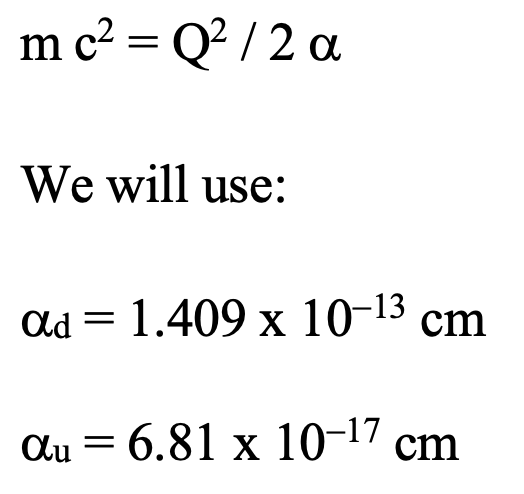
The implied separation of scales of 4.84 x 10⁻⁴ is central to the model.
We now have a complete initial characterization of the up and down quarks. To summarize the essential features:

These will need to be refined once the interaction energies have been established.
quark interaction stages
Traditionally, a ‘quark soup’ has been conjectured as the high temperature state of the early universe. In this model it is more of a logically primordial state in which temperature dictates the association/disassociation dynamical state of the matter involved. The combined standard models of particle physics and cosmology begin by accounting for association/disassociation of reified subatomic components at about 109 K rather than with the association/disassociation of quarks of which they are comprised. How, for example, would two highly charged positive up quarks and a single less charged down quark meet and agree to coalesce in becoming a proton? The repulsion of the greater positive charge would seem to veto any such proceeding and there is no temperature at which an associated thermonuclear reaction could be in equilibrium with such a reaction. Thus, unanswered questions concerning the origin of protons, neutrons, and electrons are natural ones to ask. Merely stating the words “quark soup” does not suffice.
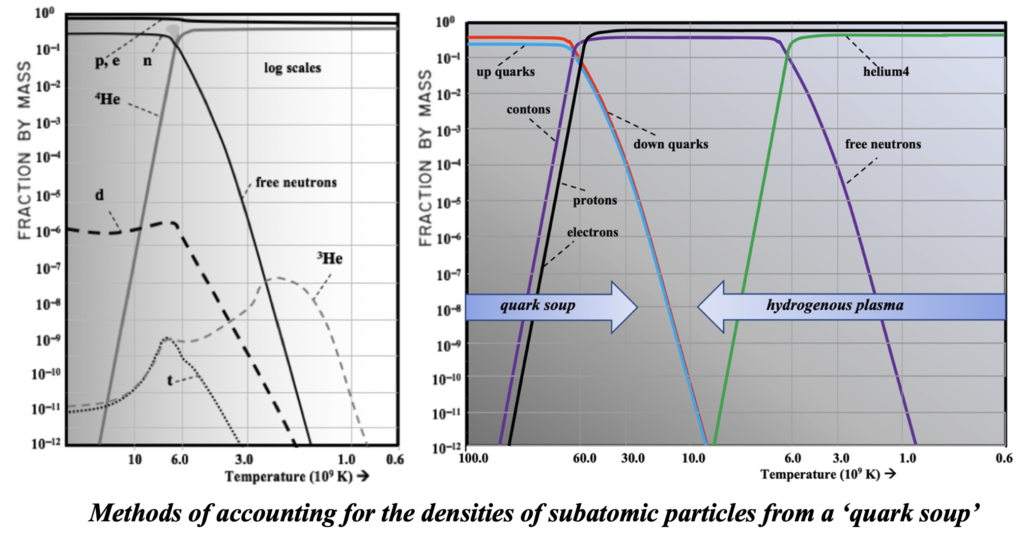
Let us attempt such an explanation by supposing that at some temperature (or point in time, as the standard model envisions) a plasma ‘soup’ of unbound quarks at high temperature (let us say 1011 K) in a logically defined precursor state to the left in the log plots of subatomic particle densities that are usually shown and for which we do not take much exception. Of course there are more questions concerning how far to the left could analyses go – what monsters exist in the infernal regions to the far left. We leave that to later – if at all. In a stationary state universe we embrace charge and energy as being conserved. So we’ve started with the inferred up and down quarks and the charge distributions of which they are comprised.
What could have happened as cooling took place? That is the issue. How would we get to anything like the observed hydrogenous plasma at the right of the traditional log density plots within a purely electrostatic picture? We must look at all that might have, and did, happen.
Six-Quark Structural Family Table Construction
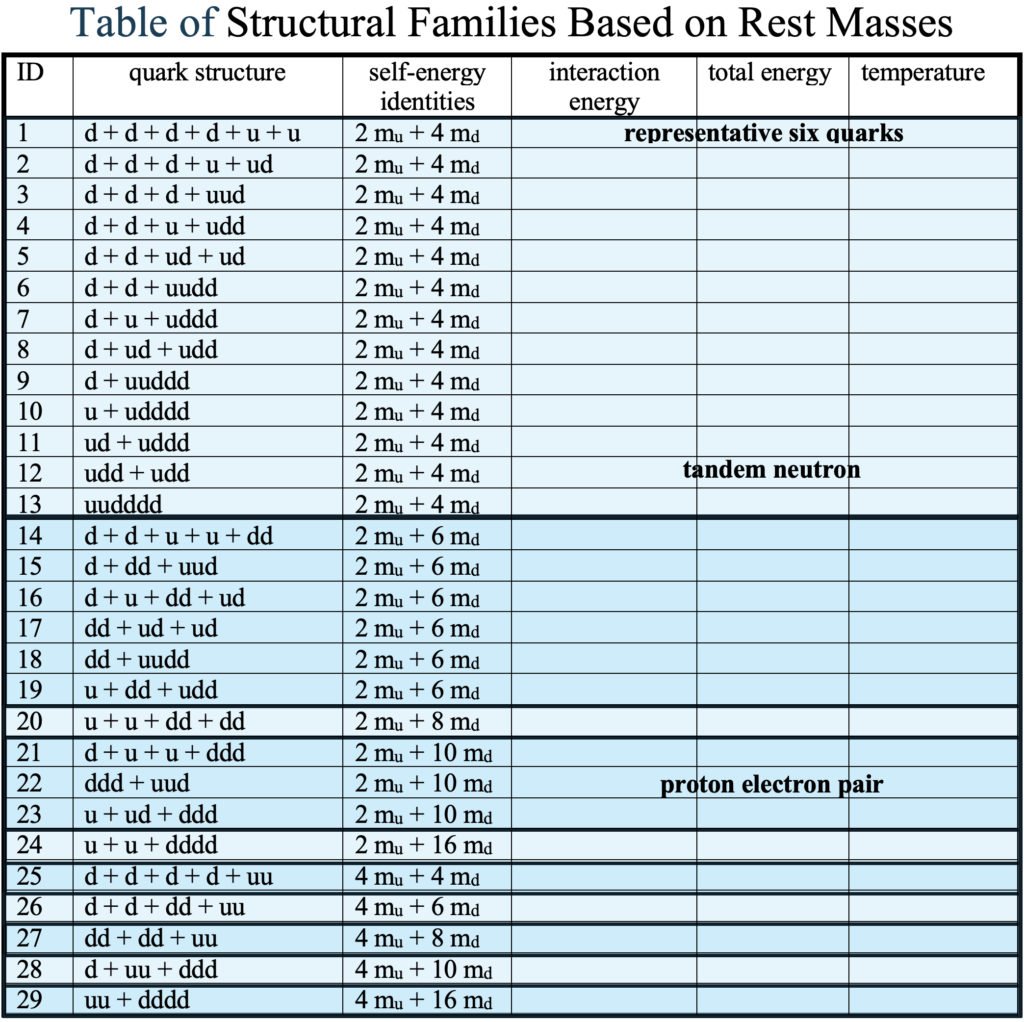
For six quarks (or anything else) there are 6! = 720 ways to rearrange them. But the two ups are identical and the four downs as well. So there are only 6! / (2! 4!) = 15 unique arrangements. But those are still just different sequences of the quarks independent of their attachments. Once temperatures drop, their opposite charge will begin a grouping process. We must determine how many unique combinations of quarks there are and what self-energies are associated with each. Enumerating partitions between clustering of the six quarks {u, u, d, d, d, d} is the first task. Each cluster includes ua db quarks with 0 ≤ a ≤ 2, 0 ≤ b ≤ 4, a + b > 0. There are 29 possibilities that are grouped into ‘families’ based on self-energy rest masses of their separable ‘particles’. These are illustrated in the following table that is organized in the order of the anticipated total energy based on the self-energy rest masses of the composite particles included in the structure. To clarify, we identify conjoined structures comprised of multiple identical distributions as indivisible particles in their own right including a d-d-d electron structure. This does not pertain to multiple ‘mixed’ ‘particles’ within a composite heterogeneous structure, the profound rationale for which will be addressed in the next post. The following diagram illustrates all the alternative possibilities whose viability we will investigate based on stability and creation path.
The following diagram illustrates the general outline of what we envision the model to demonstrate as an initial phase in the development of subatomic structure.
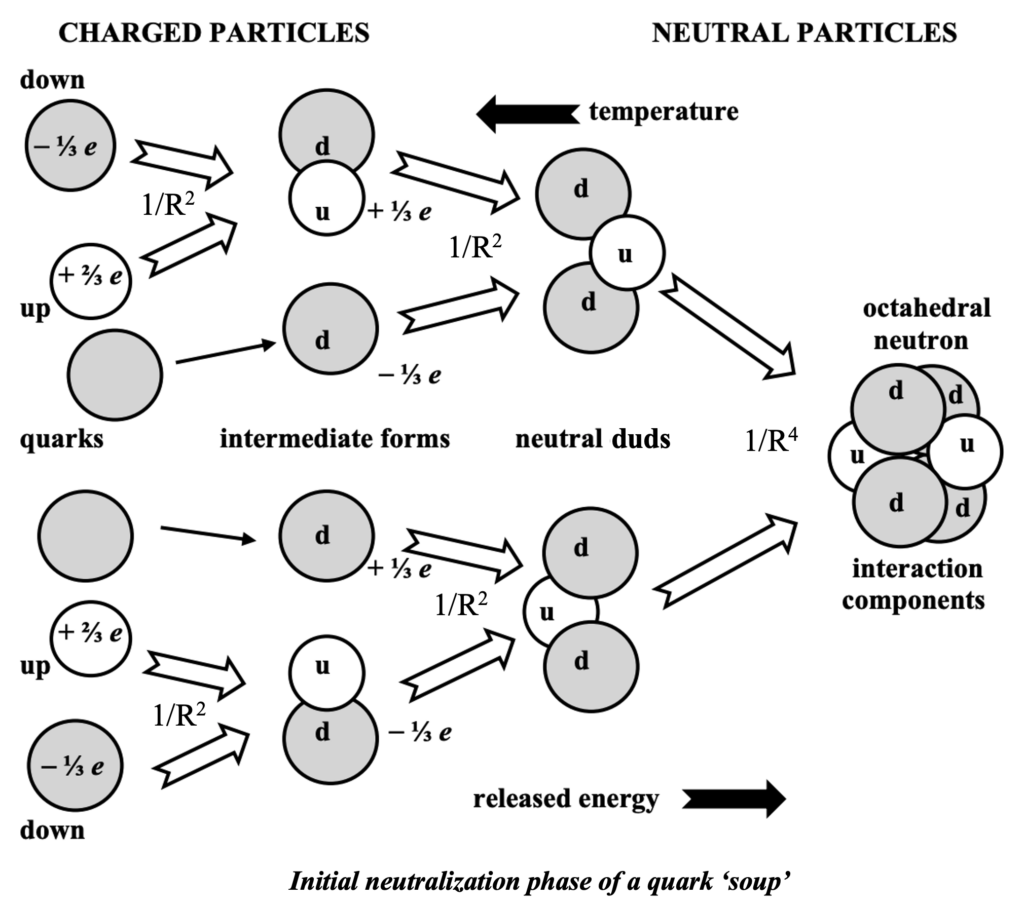
Of course there are vagaries in the transitions including possible viable alternative particles at particular temperatures. And in every case where we define a ‘particle’ we are obscuring the fact of the distribution that comprises it. At some scale, “the saltshaker is here and the plate is over there” is the right ontology because it is impossible to describe ‘supper’ in terms of the quantum field amplitudes because that would destroy useful structures that actually persist and matter at a useful level of conversation. Precision, like perfection, has its downside. We prefer to vacillate. But at some junctures it becomes difficult to decide whether to refer to a particle or an associated distribution. The ambiguity becomes severe when the overlap of the distributions is incomplete. It is the binding that unites unlike charges, but when binding is so tight that it forces the identical ‘particles’ to coalesce, they become a uniquely identifiable separate particle in their own rite. In ordinary parlance we speak of a stable up with two down quarks as a “dud”, of two down quark distributions overlapping as a separate negatively charged “particle”, of three overlapped down quarks “becoming an electron”, or of a “super dud” form. But mathematically what is happening is that charge densities reorganize, new self-energies emerge, a new force balance is realized.
In getting from an up-down quark soup to subatomic particles, there are viable and inviable transition paths that allow some possible alternative structures but not others. In this model with immutable up and down quarks, the creation of the subatomic particles from quarks requires six quarks to represent the up-down quark soup. The table shows all the possible combinations of constituents, defining whether there is a viable path to creation and, if there is, the temperatures at which they would be created and persist.
We are filling in the table by defining interaction energies and transition temperatures of viable paths to what is observed.
Leave a Reply