In this model baryonic matter is all comprised exclusively of charged up and down quarks. Their charges are not merely electronic; they also include the gravitational component. These charges not ‘real’ scalar quantities – they are ‘complex scalars’ with a gravitational component that is ‘imaginary’. The product of quark charges requires complex conjugation.
Up and down quarks are particulate as descriptive of indivisible fundamental charge distributions that result as the formal solutions to the Poisson boundary value problem complex charge density over all space with boundaries specified at both infinity and the center of the resulting potential. If one posits a complex density, r then the Poisson equation for potential V becomes:
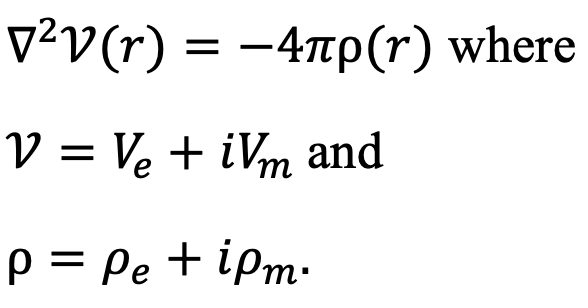
Then the real part gives the electrostatic Poisson solution, and the imaginary part gives the mass-sector Poisson solution:
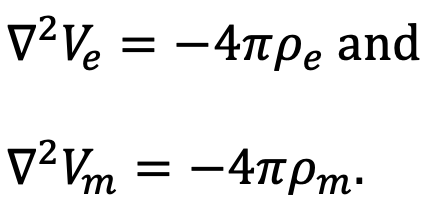
So mathematically, the complex potential is just one Poisson equation over a complex-valued charge density region, where ‘charge’ is now given the physical interpretation:

Multiplying complex quantities requires complex conjugation:

The inclusion of the collective signs, s1 s2 modifies the effective sign of the imaginary-sector interaction term after complex conjugation. This creates a sign-dependent ‘well/wall, very narrow lock-in-or-out barrier at small separations of separate quarks in composite structures.
Although mathematically, the complex potential is just the solution of a single Poisson equation over a complex-valued charge density region, it is more than that. It is determined in large part by the differential equation, but much more completely by the imposed constraints:
- finite Poisson potential at the origin,
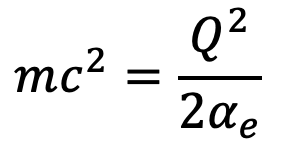
- self-energy relation of mass to electrostatic charge, mc2 = Qe2 / (2ae),
- gravitational charge definition, Qg = root(G) m,
- mutual sign association with both electrical and gravitational charge, and
- combined zero electrostatic/gravitational potential, Ve + Vm = 0 at the origin,
Starting with a classical approach to a Poisson-smoothed finite electrostatic charge distribution solution with the added constraint of finite potential at zero radius,
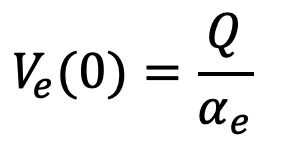
and whose self-energy determination gives:
Then we associated the mass parameter with a gravitational ‘charge’ as an imaginary-valued companion to the electrical charge:
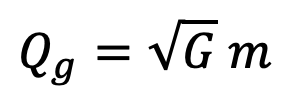
with its own shorter imposed scale, alpha_m that enfored the combined zero-at-center potential:
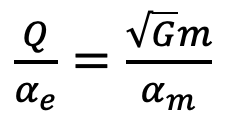
From which we obtained:
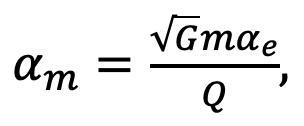
which by substitution gave us:
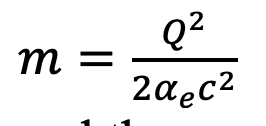
and then:
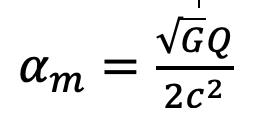
So the mass-sector parameters become algebraically constrained by the electrostatic sector under the imposed boundary and self-energy conditions.
Leave a Reply