In the summer of 1979, Kay was training our homebred thoroughbreds at Longacres racetrack in Renton, Washington—still against my better judgment—that would be the year she turned the corner and began operating a money-winning stable. We had lived in Enumclaw, Washington, for over ten years by then. Our daughter, Nola, was nine, and Sean was five. I was employed in electronics engineering at the Boeing Aerospace Company in Kent, engaged in the invention and development of the Transition Machine parallel computer. We had suffered considerable bad luck with cars over the years, and my grandfather’s legacy 1950 Plymouth was on its last legs. I needed something inexpensive and dependable for the lengthy commute to Kent. What we were looking for, therefore, was the cheapest new car in America.
I have never liked car dealerships. I have always been a fixed-price kind of guy: tell me your price and I’ll tell you whether I’m a buyer. We raised thoroughbred horses, selling many of our homebred horses and buying many others, but that never involved bickering. Although horses are sometimes sold privately “for one dollar and other considerations,” that was not our usual process. Most changed hands through claiming races, where the price is fixed like the ante in a poker game. If you think a horse is worth more than the trainer is running it for, you put up the stated price before the race. Once the race begins, whatever happens, the horse is yours. If the horse breaks down, you own a carcass; if it goes on to win stakes races, it is yours to flaunt. I think cars should be sold that way. That is probably why, years later, I bought a Saturn with its fixed-price policy.
I no longer recall the inevitable bickering over the little Honda at Hinshaw’s, but it must have gone fairly smoothly. Perhaps the salesman was the one who told me it was the cheapest car in America. At any rate, I believed him, and that made me love the little car even more. It was a purchase to flaunt.
I loved that car. It gave us lots of opportunities to get into trouble together.
If our horse-breeding and racing operation was an iceberg, Kay was the eye-blinding white above the water, and I was the blue beneath it. The racing stock was stabled twenty-five miles away at Longacres in Renton; Kay left early each morning to make certain she got the horses onto the track before it closed at ten. I took care of the horses at home, feeding them in the morning and turning them out into their various fenced fields. During foaling season, I made late-night rounds to check the mares due to foal and often remained there for most of the night assisting with the foaling. All of which is my excuse for frequently being late to work.
All of which may also have contributed to my driving fast. If I’m going from A to B, I want to get there already. It wasn’t that I got my kicks from automobile racing—although, as things turned out, perhaps I did. I got a lot of tickets during those years, as I have described elsewhere. After writing this, however, I reread that account and discovered that the habit long predated the Blue Flash. I cannot blame the car; at most it was an accomplice. But speed did not produce a perfect record of punctuality. I was late to work regularly, I think one could say, and the parking situation at many Boeing Aerospace locations contributed mightily.
At the Duwamish Slough facility, a narrow roadway ran all the way around the plant. On the far side it was elevated on piers, with very narrow parallel-parking spaces along its outer edge. My parking pass got the Honda inside the fence, which was considerably better than parking across East Marginal Way and walking to where I worked. But whenever I was late, every legitimate parking space was taken.
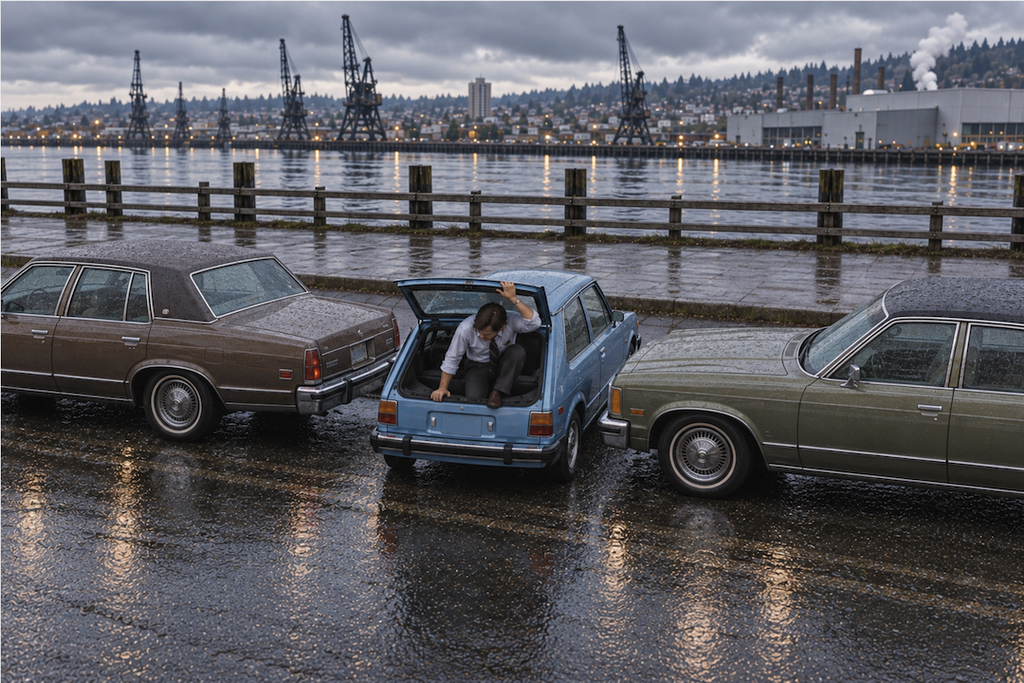
This was where my little blue Honda excelled. Sometimes the cars parked along the roadway left just enough space between them for me to back the Flash into the gap. If the opening was too tight for that, I could drive into it nose first and crawl out through the hatchback.
Much of the time, however, I was assigned to the Kent plant off Orillia Road. A large, blacktopped parking lot was on the west side of the complex. On the east side, near Building 18-08 where I frequently worked, Boeing had merely graded and graveled an area to save everyone from having to park much farther away in the blacktopped lot. There were no lines marking individual spaces. Once again, the convenient parking was insufficient to accommodate my late arrivals.
In an unlined parking lot, people tend to leave too much room between cars—either as a flaw of human nature or to protect their car doors. The Flash and I did not truck with such behavior. Sometimes I would line the Flash up with one of those gaps, get out, and shove it in. If I left work before the owners of the adjoining cars, I would crawl in through the hatchback, and the Flash and I would be on our way.
I received a number of nasty notes under my windshield wipers or stuck to the rear window. Some were threatening, vile statements unbecoming university-educated engineers. Eventually Human Resources became involved and warned me that line managers sometimes took such behavior into account in performance reviews. I don’t think mine did.
Image by ChatGPT
Leave a Reply