The proposition
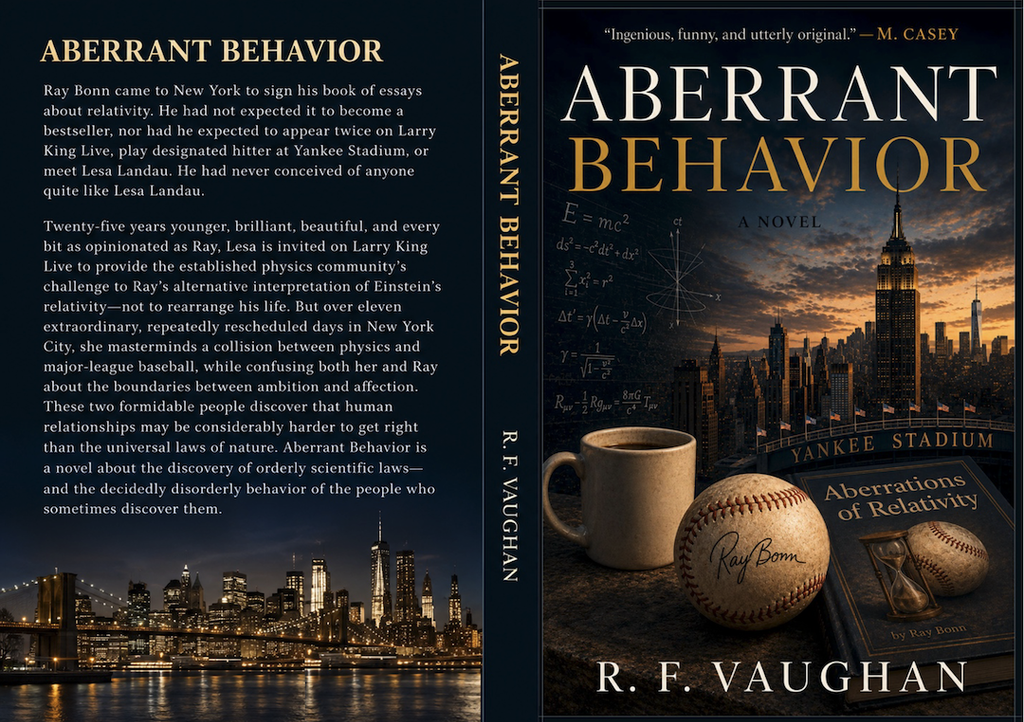
In the fictional account in the illustrated novel Aberrant Behavior to be published in the fall of 2026, one of the protagonists, Dr Lesa Landau, conjectured that her fellow protagonist, Ray Bonn, could in fact outhit the reigning home-run-hitting Yankee third baseman. It was outlandish. Ray was appalled at the audacity and Larry of Larry King Live bickered with her about why, and the extent to which, that proposition should not be considered ridiculous. As the story goes, George Steinbrenner happened to be watching and called into the show to offer Ray one million dollars to suit up as the designated hitter for one at bat at Yankee Stadium.
How this interaction played out is described in detail in the novel and suffice it to say that in the fictional account, an agreement was reached. As conditions of the contractual agreement were being hammered out on live TV, all of Lesa’s demands were met by George, who had originally specified just one million.
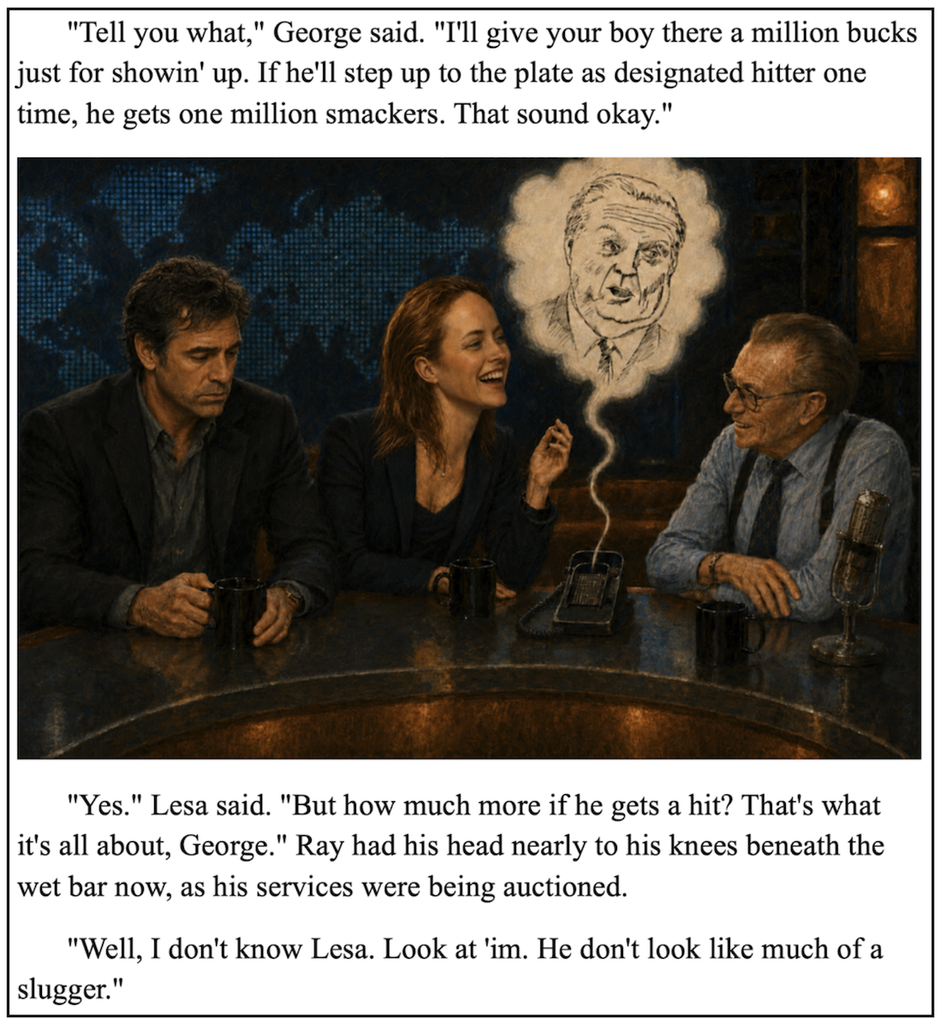
The final agreement specified that Ray would suit up as a Seattle Mariner in the upcoming game against the NY Yankees to be played the following Saturday. George guaranteed that Ray would be paid one million dollars for each of the following occurrences:
1) Ray comes up to bat as the number nine batter and does not go out as per rules of the game,
2) Ray gets on base with a hit,
3) For every run batted in (RBI) by Ray,
4) Ray hits a home run, and
5) The deal starts all over for each at bat he survives.
In addition, George will purchase 20,000 copies of Ray’s book to hand out to fans at the stadium.
That was the deal to which Lesa agreed to act as duct tape to assure Ray would show up.
Alternative expectations
From George’s perspective, since Ray had never seen a major-league pitch, it would be a million dollars well-spent for the fun of watching Lesa eat her words and the entertainment value, luring fans to the stadium. What was the worst that could happen? His pitcher might get careless and walk Ray, or God forbid, bean him with a fastball in which case adequate insurance would be required, and in either of these cases he would have to cover another at bat. So, almost certainly a mere million dollars—at worst three million—plus the purchase of 20,000 books.
From Lesa’s perspective, if Ray got up to bat, he would almost certainly hit a home run. If no one was on base at the time, that would be 4 million dollars with the tally still open. So with a usual, reasonably low-scoring game, where with the required 27 outs, the number nine hitter would get up three or maybe four times, and therefore at least twelve million dollars. Of course, after two home runs, George could opt to have his manager tell the pitcher to walk Ray, limiting George’s loss to nine million. The win-or-lose outcome of the game might be on the line as well, which would weigh heavily for George, so that was another consideration. But was Lesa just hallucinating about Ray’s ability to hit based almost exclusively on limited insider knowledge of his chronometric reaction time scores?
Those were the considerations and expectations if both parties were negotiating in good faith, which we are led to believe.
The unknown factors
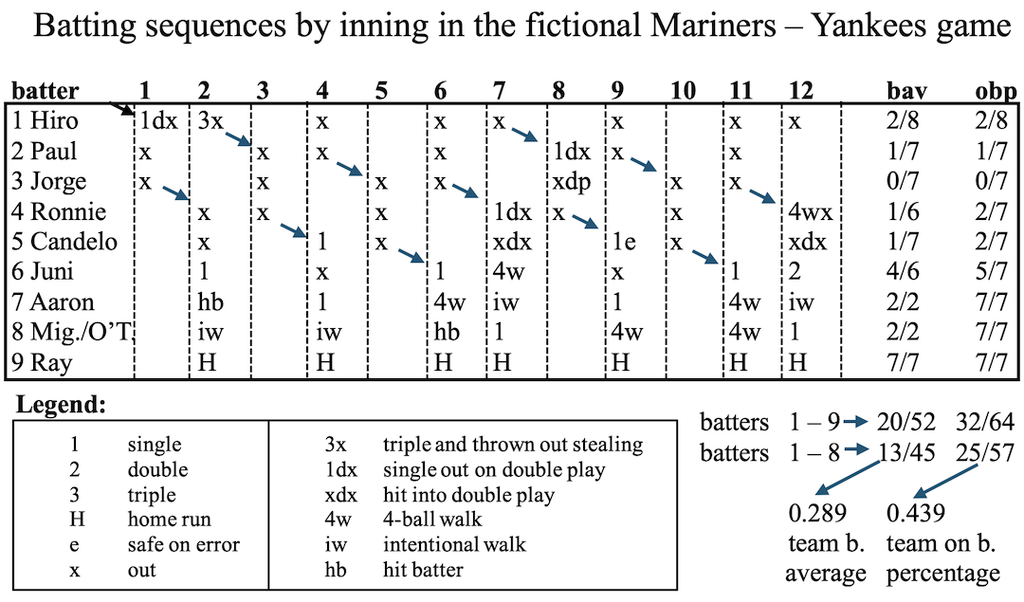
However, there was much that was beyond the control and predictability of each negotiator, namely the matter of RBIs—how many runners would be on base when the number nine hitter came to the plate. As it turns out in the fictional account, the bases were always loaded when the number nine hitter came up to bat. This, however unlikely, situation is certainly possible as shown in the diagram below.
Two probabilities are involved: (1) the likelihood that Ray will hit a home run each time he comes to bat and, because of the RBI stipulation, (2) the likelihood that the bases will be loaded each time. Such repeated success would ordinarily imply an inconceivable batting capability, but it was not wholly without precedent. By the first decade of the twenty-first century, fifteen major-league players had hit four home runs in a single game—four home runs occupying all or nearly all of an ordinary game’s at-bats. Players do get on a roll. Mariner Mike Cameron had hit four in his first four official at-bats in 2002 and drove a ball deep to right field in his fifth. Many players, including players facing major-league pitching for the first time, have homered in their first major-league at-bat. These precedents do not make Ray’s seven consecutive home runs probable, but certainly conceivable. They demonstrate that neither his first home run in the major leagues nor even his succeeding ones required incomprehensible human capability. The unprecedented element was the length of that string of successes.
The second improbability belongs to no one. Every time Ray came to bat, the bases happened to be loaded. Nothing done by any one of the eight preceding batters required any exceptional capability. Every hit, walk, out, or baserunning play was an ordinary baseball event. What was extraordinary was the way those ordinary events repeatedly combined to produce the same situation. Steinbrenner’s insurance company might have called it an “act of God”: nobody’s fault, nobody’s accomplishment—just the way things happened. And that is, in fact, the way things happen—not miraculously, but so unlikely that no one could predict them.
Probability considerations
The improbable outcome has two separable parts. The first is Ray’s extraordinary performance: a home run in each of seven plate appearances. The second is the repeated arrangement of three runners on base whenever he comes to bat. The first requires an extraordinary batter. The second can arise entirely from ordinary performances by everyone else.
A first calculation can be made by deliberately restricting the possibilities. Suppose each of the first eight batters either makes one out without reaching base or reaches base and remains there until Ray bats. Let x be the probability of reaching and remaining on base and let (q = 1 – x) be the probability of making an out. Assume for this calculation that the outcomes are independent and that these probabilities remain constant. The calculation is also conditional upon the game continuing long enough for Ray to bat seven times.
During each passage through the lineup, batters 1 through 3 must all make outs. Of batters 4 through 8, two must make outs and three must reach base. That gives five outs and three runners during each passage. Because a grand slam does not produce an out, the number of outs when batter 1 next appears changes in a repeating cycle.
Let y represent the number of outs when Hiro, the first batter, begins each passage through the lineup. At the beginning of the game, y = 0. The first eight batters then account for five outs: three end the inning and two occur in the second before Ray comes to bat. Because Ray’s home run does not produce an out, Hiro’s next appearance begins with two outs. Five more outs leave one out when Ray bats again, and the following appearance by Hiro therefore begins with one out. Another five outs return the count to zero. Thus the successive values of y are:
0, 2, 1, 0, 2, 1, 0.
When y = 0, any two of batters 4 through 8 may make the required outs. There are
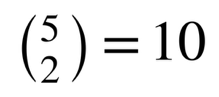
such arrangements. The probability of a successful passage of this kind is therefore
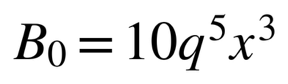
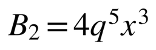
When y = 2, batter 1’s out ends the inning. Batters 2 and 3 then make the first two outs of the next inning. Batter 4 must make the third, after which three of batters 5 through 8 must reach base and the remaining one must make an out. There are four possible arrangements:
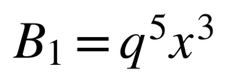
When y = 1, the outs made by batters 1 and 2 end the inning. Batter 3 makes the first out of the next inning, and batters 4 and 5 must make the other two outs. Batters 6, 7, and 8 must then all reach base safely. There is only one such arrangement:
During Ray’s seven appearances, the three states occur three, two, and two times respectively. The probability that the bases are loaded for all seven appearances within this restricted family of paths is therefore,
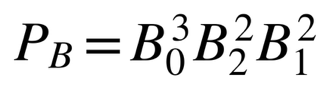
or

The coefficient 16,000 is significant. Even under this severely restricted model, there are 16,000 distinct sequences by which the same visible result can occur. And this does not include how each batter manages to reach base safely or the many ways in which a batter may make an out.
The expression reaches its greatest value when
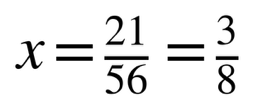
Even at that most favorable value,

or approximately one chance in 768 billion. That is just the probability of repeatedly arranging the bases, even before assigning any improbability to Ray’s home runs.
If r is the probability that Ray hits a home run in a plate appearance with the bases loaded, the probability of this restricted version of the complete performance becomes

This is not the probability of every possible way the recorded game might have occurred. It covers only one carefully limited family of paths. Stranded runners, extra-base advances, double plays, errors, sacrifices, stolen bases, and other events create additional routes to the same result. The probability of each individual route is found by multiplying the probabilities of the events along it. The probabilities of the mutually exclusive routes are then added.
When probabilities don’t matter
Probabilities matter before an event, when they describe what may happen. What does not matter afterward is the vanishingly small probability of the one exact path that did happen.
That distinction is essential. In his conversation with Ray before the game, Mac repeated a phrase he had encountered in Aberrations of Relativity: “peering down the wrong end of telescopes.” Ray had used it to describe the epistemological trap of mistaking a formally proper mathematical scenario extending from a supposed big bang to the present for reality itself. Probability presents the same trap here. Nothing is mathematically wrong with beginning with no one on base and multiplying the probabilities of the events along one path to twenty-seven outs. The error lies in assuming that path was the only one that could have been taken and treating its probability as the probability of the outcome. Before the game, countless paths lay ahead; afterward, only one lies behind. The improbability of that retrospectively selected path explains why it could not have been predicted in detail, not why it could not have happened.
Every exact scenario of events in a baseball game or a person’s life would seem fantastically unlikely if it had been specified in advance. The result can nevertheless be quite ordinary because there are many different scenarios capable of producing it. Scoring an average of four and a half runs per game, or seeing two home runs in a game, can occur through vastly more paths than the few described in Aberrant Behavior. There is an apocryphal saying sometimes attributed to Albert Einstein to the effect that there are two kinds of people—those for whom everything is a miracle and those for whom nothing is. I am in the latter category.
To argue that a possible event could not have happened merely because it was unlikely is a waste of brainpower. Once it has been established that the event happened, its prior improbability cannot make it unhappen. But if all I have is someone’s story, improbability may give me reason to ask whether I am being conned. In The Sting, Lonnegan wagers with complete confidence on a race that has already been run, relying on information that is itself part of the con. The relevant questions are, “Could what I am being told happened actually have happened?” and, if so, “Do I have reason to believe that it did?” Perpetual motion fails the first test. Ray’s game does not.
Late in the fictional game George stepped into the room he had provided for Lesa after her stressful day.
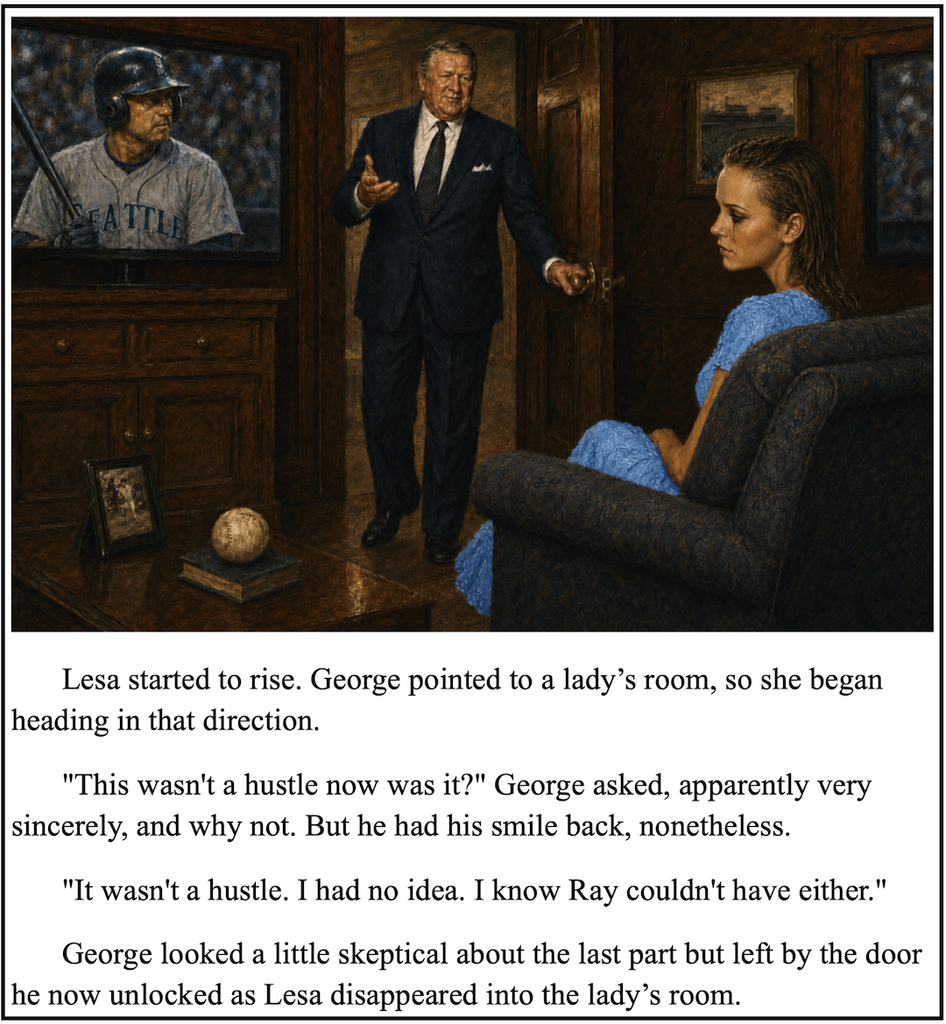
When it was finally all over, the novel leaves us with this:
“George put his fingers to his cheek wondering whether being kissed by an angel like Lesa was really worth the cost. It was, he told himself with a smile.”
NOTE: All images were generated by ChatGPT based on the associated text. And… ChatGPT is an insufferable editor.
Leave a Reply